










As protests rage in Nepal and Prime Minister K.P. Sharma Oli is forced to resign, a new face has suddenly emerged as the “voice of Gen Z.” Balendra Shah, the rapper-turned-mayor of Kathmandu, is being projected as the next possible Prime Minister. But is this really a spontaneous uprising or yet another classic regime change operation? Shah’s 2024 meeting with US Ambassador Dean R. Thompson and his strong anti-India stance raise troubling questions. Is Nepal about to witness its own Zelensky moment, with an American-backed leader being groomed to replace a China-leaning communist government?
The Gen Z Uprising and Oli’s Fall
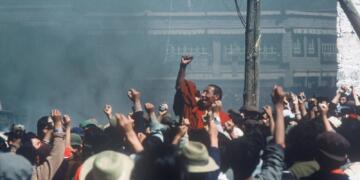
Nepal was thrown into chaos after the Oli government’s controversial decision to ban social media triggered widespread Gen Z protests. What started as online outrage quickly spilled onto the streets, with violent clashes between protestors and security forces leaving at least 19 people dead. Shockingly, mobs even attacked senior politicians five-time Prime Minister Sher Bahadur Deuba and his wife were assaulted, while former PM Jhala Nath Khanal’s wife died in the violence. Facing mounting pressure, Oli resigned, leaving a dangerous political vacuum in Kathmandu. Into this vacuum, the name of Balendra Shah better known as Balen began to dominate social media and protest slogans.
Who is Balendra Shah? From Rapper to Mayor to PM-in-Waiting
Born in 1990, Balendra Shah is an engineer with a master’s degree in structural engineering from India’s Visvesvaraya Technological University, Karnataka. But before politics, Shah was a rapper and lyricist in Nepal’s underground hip-hop scene, where he used music to target alleged corruption and inequality. In 2022, running as an independent candidate, he shocked the establishment by winning the mayoral race in Kathmandu with over 61,000 votes. Since then, Shah has built an image of being anti-corruption and youth-friendly.
But Shah is far from being a neutral figure. He has repeatedly positioned himself against India banning Hindi films in Kathmandu, objecting to a dialogue in the movie Adipurush that described Sita Mata as the daughter of India, and even installing a controversial “Greater Nepal” map in his office, which absurdly claimed parts of Uttarakhand, Himachal Pradesh, and Sikkim. His nationalism is wrapped in anti-India rhetoric, a dangerous card that resonates with some sections of Nepali youth.
The American Connection: A New Mohammed Yunus or Zelensky?
What makes Shah’s sudden rise particularly suspicious is his alleged closeness to American diplomats. In 2024, Shah met US Ambassador to Nepal, Dean R. Thompson who, incidentally, was earlier posted as US Consul General in Kolkata, a region crucial to Washington’s South Asia strategy. Reports suggest that Shah has been on Washington’s radar since at least 2022.
This timing is critical. Oli, who initially tried to balance India and China, had in recent years moved significantly closer to Beijing and the Chinese Communist Party (CCP). For Washington, allowing Nepal to drift firmly into China’s orbit would have been a strategic setback. With Shah’s anti-corruption image and appeal among Gen Z, the Americans seem to have found a useful vehicle to reset Nepal’s political course.
The comparison with Nobel Laureate and Present Chief Adviser of Bangladesh government Mohammed Yunus who is often accused of being a Western favorite against Dhaka’s political establishment or even Ukraine’s Volodymyr Zelensky is striking. Like them, Shah embodies a “clean image,” anti-corruption rhetoric, and youth appeal, but with suspiciously well-timed Western backing. The danger for Nepal is whether he would end up becoming another pawn in Washington’s larger game of countering China in South Asia.
Nepal’s Strategic Importance and the Spy Games Around It
Nepal is no ordinary neighbor. Sandwiched between India and China, it occupies one of the most strategic locations in the world. For Washington, New Delhi, and Beijing, Kathmandu’s orientation matters greatly. If Nepal drifts too close to China, India’s northern security becomes vulnerable. If it tilts too far towards the US, China sees it as an American foothold on its Himalayan frontier.
It is no secret that Nepal has become a playground for global intelligence agencies. The CIA has a long history in the Himalayan nation two decades ago, it tacitly encouraged Maoist insurgents who eventually dismantled Nepal’s Hindu monarchy. Today, as Oli’s communist government grows too cozy with Beijing, the rise of a Western-backed leader like Shah fits the familiar pattern of regime change operations. Shah’s sudden portrayal as a “symbol of change” by social media warriors echoes the same playbook used in other parts of the Global South.
Will Nepal Witness a Scripted Regime Change?
Balendra Shah’s rise amid Nepal’s Gen Z protests is being celebrated by some as a generational shift, but the timing and foreign links cannot be ignored. His meeting with the US Ambassador in 2024, his carefully cultivated anti-corruption image, and his sudden elevation as the “face of change” all bear the hallmarks of Western orchestration. With Oli gone and Nepal at a political crossroads, the question is whether Shah will become the next Mohammed Yunus of Nepal backed abroad, disruptive at home or even a Zelensky-like figure who looks to Washington for every move.
Nepal’s Crossroads: Sovereignty or Subservience?
For India, the developments in Nepal demand close watch. A leader who openly positions himself against India while aligning with Western diplomats could destabilize regional balance. If Shah becomes Prime Minister, Kathmandu may once again become a stage for great power rivalry this time not between monarchy and Maoists, but between Beijing, Washington, and New Delhi. What looks like a youth-led protest might, in fact, be another chapter in the CIA’s long playbook of regime change in South Asia.