
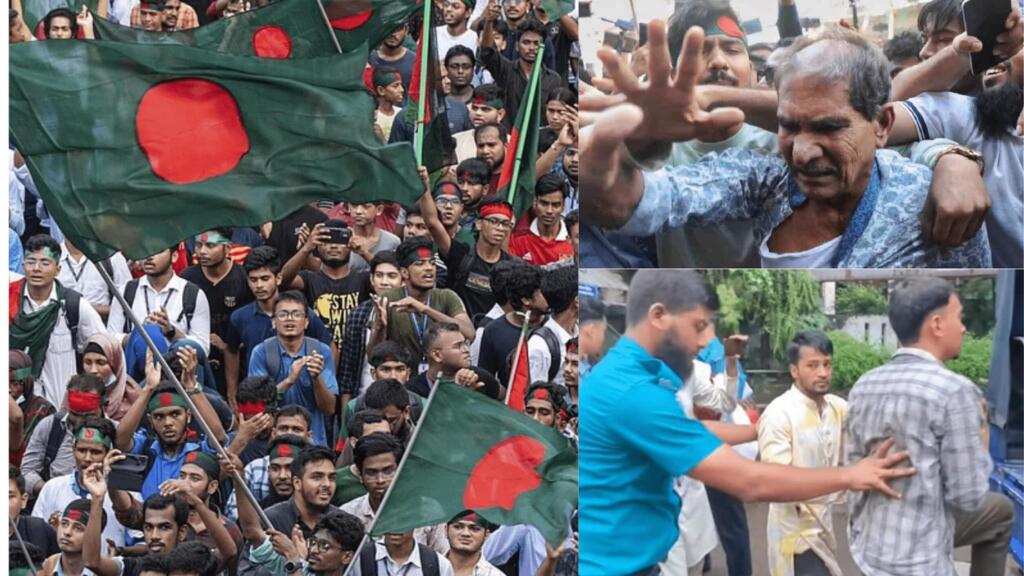
Bangladesh’s interim government is using arbitrary arrests as a tool of political control. For the past year, from the time it has been in power, the regime has targeted people for their political identity, affiliation, and participation, which has put basic democratic rights under tremendous strain.
This has been evident from the arrests and targeting of journalists, activists, and even politicians who formerly held coveted positions in the Hasina-led government. Ordinary citizens, too, have become a target for the ruling Yunus-led interim government. This has instilled an atmosphere of fear among the people, who were associated with or remain in support of the Awami League. Even journalists who are critical of the current regime face intimidation.
Reportedly, only a few days back, as part of a crackdown against the Awami League, the authorities arrested the country’s former Deputy Press Secretary to Prime Minister Sheikh Hasina, Abu Alam Mohammad Shahid Khan, under the Anti-Terrorism Act, along with five other former leaders of the Awami League. Reportedly, it was alleged that the accused attempted to destabilise the country through armed struggle, as per the case.
This is just one example of a recent crackdown on Awami League leaders and others associated with the country. Only a few days ahead of this case, 16 people, including former minister and freedom fighter Abdul Latif Sidiqqui and Dhaka University Professor Sheikh Hafizur Rahman, were sent to prison under the Anti-Terrorism Act.
Earlier in April this year, when dozens of Awami League supporters gathered in Khulna in April 2025 to take part in flash processions, short, spontaneous marches known locally as ‘jhotika michil’, the police swiftly arrested 25 leaders and activists.
Meanwhile, other political groups held permitted rallies without any such disruption. This has highlighted the disparity in the treatment of supporters of different political parties or those with contrarian views. At a discussion, when a Dhaka University professor, Prof Rahman, warned of attempts to undermine the constitution, a group stormed the venue, tore banners, and handed participants over to the police. Later, even their bail came to be dismissed.
The Bangladesh Awami League, the party most affected, wrote on its official page on September 12, “The surge in arbitrary arrests across Bangladesh is neither random nor isolated; it is systematic, targeted, and designed to dismantle the very foundations of political organisation. Each case reveals a disturbing pattern: pervasive surveillance, preemptive detention, and the deliberate criminalisation of peaceful or symbolic acts of dissent.” The party mentioned that there was no safe space left and that students, women leaders, and intellectuals alike had come to be targeted under the Yunus regime.
Reportedly, in a nationwide operation on 5 August 2025, about 1,593 Awami League leaders and activists were detained by police. Many arrests were connected to protests held in July the previous year, a report in The Morung Express stated. According to another report by The Morung Express, 56 people from the Awami League and its affiliated wings were arrested over flash processions between 19 and 25 April 2025. Charges included “attempting to destabilise law and order” and “creating panic” by sudden processions.
Vague Charges, Permits, and Selective Enforcement
Many of the charges used are imprecise, “creating panic,” “destabilising law and order,” “attempting unrest,” or distributing leaflets with content said to be “disruptive.” These charges do not amount to arrests.
In fact, Awami League supporters do not receive permits for processions or rallies with the same ease as rival groups. In November last year, the Yunus government called the Awami League fascist and blocked its rally from taking place. Reportedly, Muhammad Yunus’s press secretary Shafiqul Alam said that anyone who tried to hold rallies, gatherings and processions by taking orders from the “mass murderer and dictator Sheikh Hasina will face full force of the law enforcing agencies”.
Awami League’s activities are also frequently broken up. Contrary to this, event permits or formal responses for rival party gatherings do not get blocked.
Court and Oversight Remarks
Human Rights Watch has urged the interim government to uphold impartiality in law enforcement. It said that arrests should not be politically motivated or blanket detentions, and due process must be respected.
When one political group is repeatedly targeted for arrests, threats, or prevented from assembly, while others are allowed freer mobilisation, the government’s impartiality claim weakens. That also ends up eroding public trust, fuelling grievances, and sparking escalation.
Credible neutrality by any ruling requires equal rules for rallies, transparent arrest and bail data, courts that check for political bias, and independent oversight.