
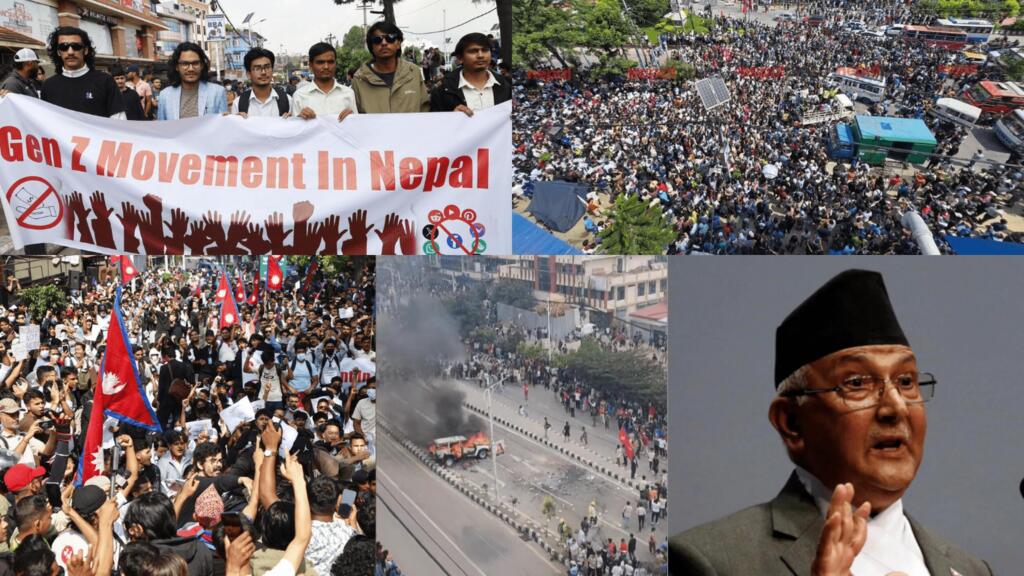
In Kathmandu, the streets are burning, water cannons roar, and the army has been deployed. Fourteen people have already lost their lives, and over a hundred lie injured in what is now being described as the biggest protest wave Nepal has seen in years. Officially, the demonstrations erupted over the government’s sudden ban on popular social media platforms like Facebook, Instagram, and TikTok. But here is the question no one is asking: can the shutting down of apps alone lead to such massive bloodshed? Or is the ban just a convenient smokescreen to hide a larger, more dangerous game of regime change?
What began as a youth-led protest against the government’s restrictions on online platforms quickly spiraled into violent clashes. Gen-Z demonstrators, armed with sticks and slogans, stormed restricted zones near the Federal Parliament, even breaking curfew to enter the compound. The police retaliated with tear gas, rubber bullets, and water cannons.
Yet, many observers argue that the sheer intensity of the protests seems “inorganic.” Social media bans have happened in Nepal before TikTok was blocked for nine months last year but such bans never triggered violence of this scale. Why, then, is this time different? Are young protestors being fuelled by frustration alone, or are outside forces deliberately pushing Nepal toward instability?
The Shadow of the Deep State
This is not the first time South Asia has witnessed sudden uprisings leading to political turmoil. Just last year, Bangladesh fell into chaos after what many analysts described as a “regime change operation,” allegedly backed by international networks, including the US Deep State in collaboration with Pakistan’s ISI. That country soon found itself at the mercy of Islamist radicals and jihadi groups.
Now, with Nepal’s streets ablaze, one cannot help but draw parallels. Could a similar conspiracy be unfolding? After Afghanistan, Sri Lanka, and Bangladesh, is Nepal the next domino in a dangerous game of destabilization? And if so, who benefits from pushing the Himalayan republic into chaos global powers, regional rivals, or vested groups eyeing a collapse of Oli’s government?
Oli’s Dilemma: National Dignity or Political Survival?
Prime Minister K. P. Sharma Oli has defended the social media ban, arguing it is not about restricting expression but about upholding “national dignity.” He insists foreign companies have long ignored Nepal’s demand to register under its laws, pay taxes, and appoint local grievance officers. On paper, his reasoning seems straightforward.
But critics argue otherwise. Nepal has around 13.5 million Facebook users and nearly 4 million Instagram users. Many livelihoods depend on these platforms. Was the timing of this crackdown just as anti-corruption anger was brewing too coincidental? Or is the government deliberately stifling online spaces to prevent dissent while it fights a larger internal battle against hidden enemies?
Protests or Proxy War?
Amid the chaos, a young protest leader was heard urging his fellow demonstrators to step back, warning that “vested groups” had infiltrated the movement to provoke violence. His words raise troubling questions: who exactly are these groups, and what is their agenda?
The protests began with slogans against social media bans, but they quickly expanded into chants against corruption, authoritarianism, and the Oli regime itself. Is this simply a youth rebellion against unemployment and corruption, or are these demands being amplified by external actors hoping to turn Nepal into another playground for geopolitical rivalries?
The regional pattern cannot be ignored. From the fall of Kabul to Sri Lanka’s crisis, from chaos in Bangladesh to unrest brewing in Pakistan, every instability in South Asia seems to follow a familiar script—one where popular anger is weaponized, governments collapse, and chaos benefits hidden players. Nepal now finds itself on that list.
Nepal at the Edge of a Dangerous Crossroads
Nepal today stands at a dangerous crossroads. Officially, the protests are about social media access, but beneath the surface lies a deeper story that is yet to be uncovered. The deaths of 14 people, the use of army troops, and the sudden eruption of violence far beyond what past bans provoked—all of it raises troubling questions about who is really driving the unrest.
Is this merely a spontaneous youth uprising, or is Nepal being dragged into a regime-change plot similar to Bangladesh? Is the social media ban truly about national dignity, or is it a shield to hide deeper political warfare?
The answers remain unclear. But one thing is certain: what is unfolding in Kathmandu is not just about apps it is about Nepal’s future.