
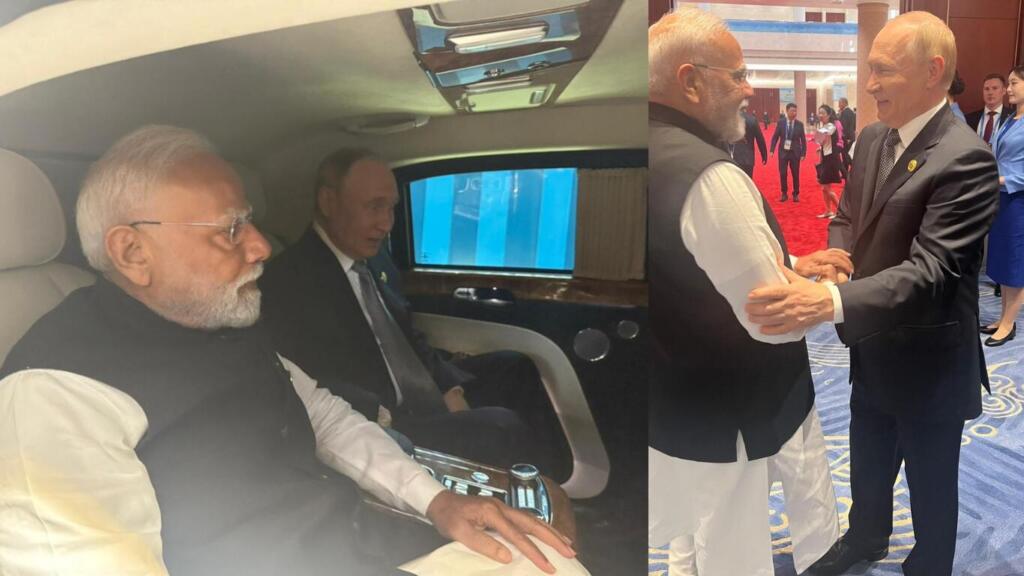
In a powerful display of personal camaraderie and diplomatic symbolism, Prime Minister Narendra Modi and Russian President Vladimir Putin chose to travel together in the same car to their bilateral meeting on the sidelines of the Shanghai Cooperation Organisation (SCO) Summit in Tianjin. The two leaders were seen riding in a sleek Aurus sedan, a “Made in Russia” luxury vehicle, which served not just as transport but as a moving statement of the deep and enduring partnership between New Delhi and Moscow.
Aurus Sedan Ride Becomes Symbol of India-Russia Camaraderie
The moment, captured by cameras, highlighted the close personal rapport that has often defined Modi and Putin’s interactions. As both leaders headed towards the Ritz-Carlton hotel for their bilateral meeting, their shared ride made headlines, underscoring a strategic partnership that continues to thrive even as India navigates mounting pressures from Washington. Recently, the United States imposed steep 50 per cent tariffs on Indian goods in retaliation for New Delhi’s decision to continue importing Russian crude. Against this backdrop, the visuals of Modi and Putin side by side in the Aurus carried weight far beyond ceremonial optics—it was a signal to the world that India and Russia remain firm strategic allies.
Taking to X, Prime Minister Modi described the car ride as yet another enriching conversation with the Russian leader. “After the proceedings at the SCO Summit venue, President Putin and I travelled together to the venue of our bilateral meeting. Conversations with him are always insightful,” Modi wrote, while also sharing photographs of their warm handshake and exchange at the summit venue. This marked their first face-to-face meeting since the imposition of U.S. tariffs, amplifying its significance on the global stage.
Personal Rapport Shines Amid Trade Tensions with the U.S.
The summit also saw rare and closely watched interactions between Modi, Putin, and Chinese President Xi Jinping. The three leaders were photographed exchanging greetings, handshakes, and smiles, reflecting the complex yet crucial trilateral dynamic within the SCO framework. In a separate bilateral with Xi that lasted more than 50 minutes, Modi emphasized India’s commitment to building ties with China “based on mutual trust, respect, and sensitivity.” This was a particularly notable engagement given the deterioration in India-China relations following the Galwan clashes of 2020.
For Modi, this was his first visit to China in seven years and his first direct in-person meeting with Xi since those violent border clashes. The dialogue underscored New Delhi’s attempt to balance firmness on border issues with pragmatism in keeping channels of communication open with Beijing.
Geopolitical Optics at SCO: Modi-Putin Bond, Xi Talks, Sharif Isolated
Adding to the diplomatic theatre was an awkward moment involving Pakistan Prime Minister Shehbaz Sharif. As Modi and Putin walked past him engaged in an animated conversation, Sharif was left standing alone, wearing a grim expression. The image of Sharif’s isolation contrasted starkly with the visible warmth between Modi and Putin, reinforcing Pakistan’s marginalization within the SCO fold.
Ultimately, the car ride in Tianjin was far more than a courtesy gesture—it was a calculated message. At a time of shifting global alignments, the optics of Modi and Putin travelling together reinforced the resilience of the India-Russia partnership, showcased India’s diplomatic assertiveness, and underlined the Prime Minister’s ability to navigate the complexities of great power politics with confidence.