
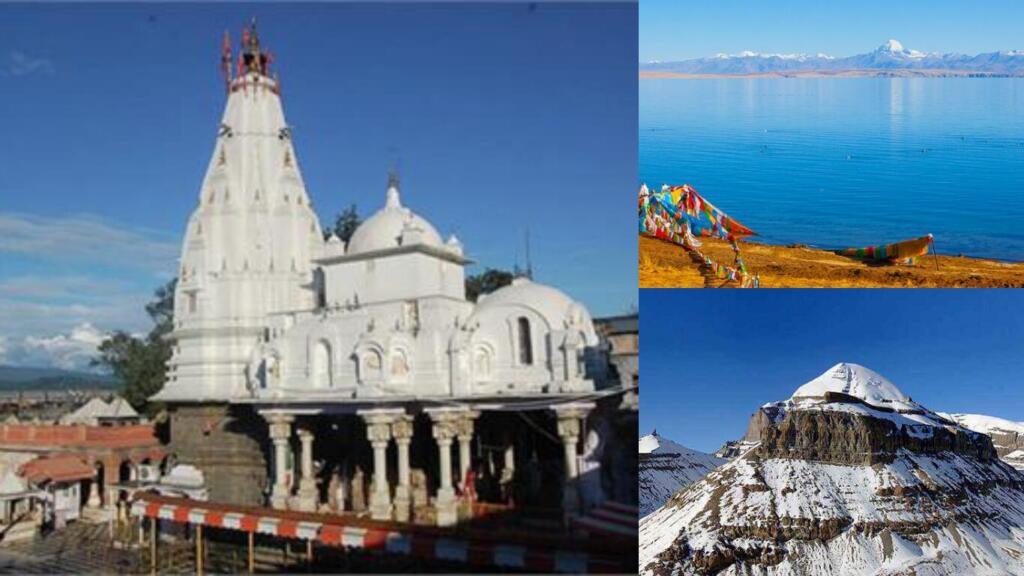
Manasa Shaktipeeth also known as Maa Dakshhayani Shaktipeeth is located in Tibet on the banks of Kailash Mansarovar. It is situated at a height of 21,000 feet above sea level. Goddess Sati’s right palm is said to have fallen here at Kuggu, located at the southwestern foot of Mansarovar. Lord Shiva’s family is represented by a GOMPHA (a Tibbati Math).
Because the idol of Devi has been given different names at different shaktipeeth, the name given to this particular idol of Devi is known as Dakshayani (Durga). Lord Shiva is often referred to as Amar (Immortal) in India. This is one of the most pure and pious places on the planet, where people can have all of their aspirations realised. There is no temple or divinity there, only a large boulder that is being worshipped. This temple is among 51 Shaktipeeth Temples.
Story Behind Manasa Shaktipeeth
The goddess of Dakshayani, Sati, Parvati, or Durga—Hinduism’s most important woman and most powerful deity—is called Shakti. Durga Devi, Mahakali, and Gowri are the three main manifestations of Shakti, the power goddess. She is Adi Shakti’s avatar.
Sati was the Prajapati Daksha’s daughter, and she married Lord Shiva despite her father’s wishes. Prajapati Daksha once put together a massive yagya, but he didn’t call his daughter and son-in-law. Sati was very saddened by Her father’s actions. When she got there, her father ignored the Sati and insulted her. She could not bear the insult of his husband (Lord Shiva) and she jumped into the fire of Yagya and committed suicide. She passed away, but her body didn’t burn.
Lord Shiva had taken His Virabhadra Rupa out of rage. Daksha’s head was cut off by him, but in the end, He forgave him by bringing him back to life. Lord Shiva, devastated, had taken Sati’s body and wandered the universe. Finally, Lord Vishnu used His Chakra to break Sati’s body into pieces. Each body part transformed into Shakti Pitha. The temple had emerged where the body part had fallen to the ground. In order to safeguard the Shakti Pitha, Lord Shiva created 51 Bhairava for each one.
The sacred Kailash Manasarovar Lake is thought to be the home of the Hamsa, or Swan of Lord Brahma. The lake is also thought to be one of the fifty-one Shakti Peethas where Goddess Sati’s right hand fell to Earth after the Daksha Yagna story of Hindu mythology.
History of Manasa Shaktipeeth
According to historical writings, anyone who bathes in the holy Mansarovar Lake and circumambulates the summit is cleansed of their sins for generations and attains salvation. Kailash Manasarovar Lake is said to have healing properties. The Hamsa or Swan of Lord Brahma, one of the Holy Trinity, is said to reside at Kailash Manasarovar Lake. The lake is also thought to be one of the 51 Shakti Peethas.
The well-known Gauri Kund, also known as the Parvati Sarovar, is located on the way to Mount Kailash.
The architecture of Manasa Shaktipeeth
The Tibet Manasa Shaktipeeth Temple is a wonderful sanctuary cherished by followers worldwide. It is a site of enormous spiritual energy and heavenly grace, and it is regarded as one of Hindu mythology’s most potent centres of worship. The temple is a must-see for anybody interested in learning about Tibet’s rich cultural legacy and spiritual traditions, as well as those seeking to experience the heavenly energy that surrounds this hallowed site.
The Goddess is known as Dakshayini in this temple. The Shakta branch of Hinduism holds the location in high regard. Mount Kailash is described in the Vishnu Purana as having four sides made of Crystal, Ruby, Gold, and Lapis-Lazuli (deep blue semi-precious ancient stones). Mount Kailash is also known as the World’s Axis Mundi. This indicates that the Mount serves as a link between the physical and spiritual worlds. It is the axis around which the Gods constructed the world. A visit to Mount Kailash is regarded as particularly sacred because it is located near the origins of some of Asia’s longest and holiest rivers.
Facts about Manasa Shaktipeeth
- Manasa Shaktipeeth temple is dedicated to Mother Goddess Shakti located at Manas in Tibet and is among the 51 Shakti Peeth temples.
- The shrine is referred to as Manasa Devi Peetha as the Goddess here fulfils the desire of the devotees.
- There is no actual temple here a big boulder is the object of worship. It symbolically represents Goddess Shakti.
- In ancient times, Brahma is said to have applied his spiritual power to form Lake Manasarovar as a gift to his acetic sons in order that they would have a place to bathe following tapas on Mt Kailash.
- The cold water is certain to cleanse each and every weary soul. Puranas record that the waters of Lake Manasarovar, like the Ganges, will cleanse every sin and purify body and mind.
- The sacred Trisul and Dumaru (drum) of Shiva are reported by the celebrated Karnataka Siddha, Sri Swami Kaleshwar, to have been placed by Shiva himself in the depths of Lake Manasarovar, massively increasing the overall energy vortex of the region.
Festivals In Manasa Shaktipeeth
- Durga Puja. (Winter) – Devotees celebrate Navaratri at this temple in the month of Ashwin (Sep-Oct).
- Navaratri. (Summer) – They celebrate other Navaratri in the fortnight of the Chaitra (March-April). Every nine days, they worship Navadurga (nine Durgas).
- Mahashivratri– A grand fair is organized at the temple during the occasion of Maha Shivratri.