














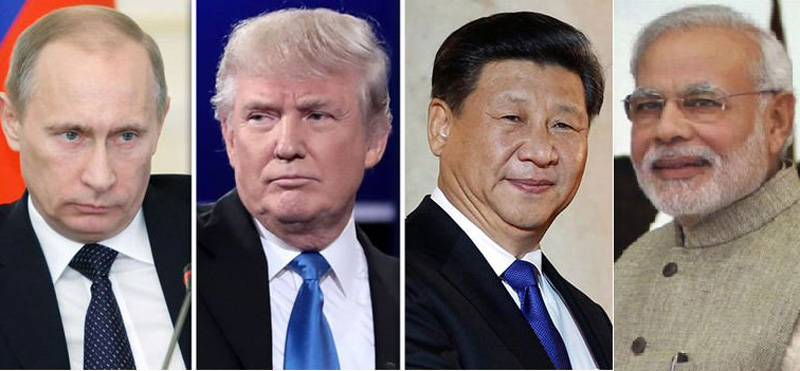
US President Donald Trump seems visibly worried in his recent Truth Social post, declaring that “India and Russia are lost to deepest, darkest China.” His outburst reflects not India’s weakness but America’s frustration. Having imposed 50% tariffs on Indian goods, the US president now appears caught in his own trap either he should be worried about losing India’s trust, or he should be restless about his miscalculated economic bullying backfiring. For India, the message is clear: strategic autonomy under Prime Minister Modi is stronger than ever.
Trump’s Tariff Gambit Backfires
The United States has long viewed India as a critical partner in countering China’s rise in the Indo-Pacific. From Quad summits to defense agreements, Washington has invested heavily in building trust with New Delhi. Yet, Trump’s decision to impose 50% tariffs on Indian exports has created unnecessary friction. Rather than drawing India closer, it has only reinforced India’s resolve to look beyond American diktats.
New Delhi has already started exploring alternative markets in Russia, the Middle East, and Southeast Asia. Russia, in particular, has assured India of increased access to its markets if U.S. tariffs make trade difficult. China, sensing an opportunity, has also extended offers to import more Indian products, signaling an economic outreach. Trump’s so-called tariff “pressure” is achieving the opposite—it is pushing India to diversify trade partners and rely less on the United States.
India’s Balancing Act with Russia and China
For decades, India has followed a policy of strategic autonomy. Unlike many countries, New Delhi has refused to be a junior partner to any global power. Its relationship with Russia is historic, rooted in defense, space, and energy cooperation. Even today, India continues to procure advanced weaponry from Moscow, while also collaborating on nuclear energy projects.
Trump’s frustration seems to stem from India’s refusal to abandon Russia despite Western sanctions. But expecting India to cut ties with Russia is unrealistic. Russia remains a reliable strategic ally, one that stood by India during critical times.
At the same time, India maintains measured engagement with China. Trade between the two countries, despite tensions along the border, continues to grow. China’s willingness to open its markets to Indian goods indicates a pragmatic approach. For India, this is not about choosing China over the U.S. but about ensuring that its economic interests are not held hostage to another country’s political demands.
Why Trump Should Be Worried
Trump’s declaration that America has “lost” India reflects a misunderstanding of India’s foreign policy priorities. India has not drifted away; rather, it has reaffirmed its long-standing principle of multi-alignment.
What Trump should be worried about is the erosion of trust his policies may cause. The Quad—comprising India, the U.S., Japan, and Australia—has been touted as a counterweight to Chinese assertiveness. If Washington’s approach alienates India, the credibility of this alliance could weaken.
Moreover, Trump’s rhetoric seems driven by domestic political considerations. Painting India and Russia as slipping into China’s orbit allows him to rally his base by projecting America as under threat. However, such statements risk damaging a partnership that has been painstakingly built over the last two decades. If America begins to treat India with suspicion rather than respect, it may lose a critical ally in Asia.
India’s Strategic Confidence Under Modi
Under Prime Minister Narendra Modi, India has displayed remarkable strategic confidence. Modi’s government has deepened ties with the U.S., securing advanced defense deals, technology transfers, and intelligence-sharing agreements. At the same time, it has maintained a strong partnership with Russia and kept trade lines open with China, all while strengthening bonds with Europe, the Middle East, and Africa.
This multi-pronged strategy has elevated India’s global standing. The West cannot dictate terms to India as it once did. Today, whether it is oil imports from Russia, defense cooperation with France, or trade agreements with the UAE, India chooses its partners based on national interest, not external pressure.
Trump’s latest remarks only reinforce India’s position: strategic autonomy is non-negotiable. If the U.S. tries to arm-twist India with tariffs or public rebukes, New Delhi will simply deepen ties elsewhere. Far from losing, India is gaining leverage by showing it cannot be boxed into one camp.
The Restless America, the Resolute India
US President Trump’s claim that India and Russia are “lost” to China is less about India drifting away and more about America losing its ability to control narratives. India has not abandoned the U.S.; it has simply refused to be a pawn in Washington’s great power rivalry. By imposing tariffs and issuing warnings, Trump has created his own anxiety.
For India, the path forward is clear. Under Prime Minister Modi, the country will continue to walk the path of strategic autonomy, strengthening partnerships on its own terms. Trump may remain restless, but India remains resolute—guided not by foreign pressure, but by the interests of 1.4 billion citizens and a vision of global leadership in the decades ahead.