
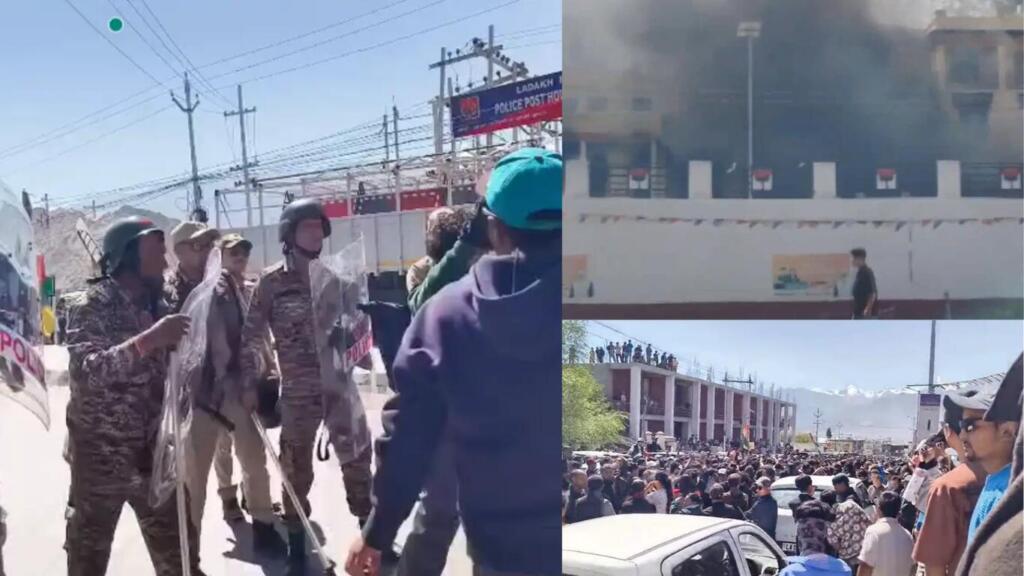
Massive protests rocked Leh on Wednesday as demands for statehood and inclusion of Ladakh under the Sixth Schedule of the Constitution escalated into violent clashes.
Demonstrators pelted stones at the Bharatiya Janata Party (BJP) office, which was subsequently set on fire. A police van was also torched during the unrest, marking a serious escalation in the ongoing agitation.
The protest was called by the youth wing of the Leh Apex Body (LAB) in support of environmentalist Sonam Wangchuk, who is currently on the 14th day of a hunger strike to press for the region’s long-standing demands.
Authorities responded by deploying additional paramilitary forces. Four companies of the Indo-Tibetan Border Police (ITBP) and four units of the Central Reserve Police Force (CRPF) have been sent to Leh. A flag march was also conducted to restore order.
The Union Ministry of Home Affairs (MHA) had recently announced the resumption of talks with Ladakhi leadership, with the next round of dialogue scheduled for October 6. This comes after months of silence since the last round of discussions, held on May 27, which led to the introduction of a domicile policy in the Union Territory.
A high-powered committee was constituted by the MHA on January 2, 2023, following persistent demands by the LAB and the Kargil Democratic Alliance (KDA) for statehood and constitutional safeguards under the Sixth Schedule.
Speaking on the situation, Sajad Kargili, leader of the Kargil Democratic Front, wrote on X, “Whatever is happening in Leh is unfortunate. Ladakh, once peaceful, is now gripped by frustration & insecurity due to Govt’s failed UT experiment. The onus lies on the Govt—resume dialogue, act sensibly & fulfill Ladakh’s demand for Statehood & Sixth Schedule without delay. Also I appeal people to remain peaceful and steadfast.”
Both the LAB and KDA were formed in the aftermath of the abrogation of Article 370 in August 2019, and have since emerged as the principal voices representing Ladakh’s political aspirations.
As tensions continue to mount, local leaders and civil society groups are urging the Centre to act decisively and without delay, warning that the current unrest is a symptom of growing disillusionment in the region.
Who is Sonam Wangchuk?
Sonam Wangchuk, widely known as an engineer, innovator, education reformist, and climate activist, has emerged as a central figure in Ladakh’s ongoing agitation. Often cited as the inspiration behind the character portrayed by Aamir Khan in the film 3 Idiots, Wangchuk has long been involved in educational and environmental initiatives in the region.
His father, Sonam Wangyal, was a Congress leader and former minister in the erstwhile Jammu and Kashmir government. Wangchuk has historically maintained close ties with the Congress party. In 2004, under the UPA government led by then Prime Minister Manmohan Singh, he was appointed to the Drafting Committee of the Ladakh Hill Council’s Vision Document Ladakh 2025, where he was responsible for formulating policies on education and tourism.
In recent days, Wangchuk and his supporters had announced a march to Delhi in an attempt to push the central government to resume stalled talks on Ladakh’s political and constitutional demands. However, the Delhi Police detained him at the Singhu border before he could enter the capital.
A key demand in the current movement is the inclusion of Ladakh under the Sixth Schedule of the Constitution, which would grant the region enhanced autonomy and legal safeguards to protect its tribal identity and fragile ecology.
Supporters argue this inclusion is essential for sustainable resource management in the face of increasing development pressures. However, constitutional experts point out that the Sixth Schedule currently applies only to select tribal areas in the Northeast, and its extension to Ladakh would require a significant policy shift by the central government.
Wangchuk has also voiced strong opposition to large-scale construction activities by the Indian Army and other agencies in the ecologically sensitive region, warning of long-term environmental consequences.
While his Ice Stupa project a technique for water conservation in arid mountain regions—received international recognition, particularly from Western media, it has also faced scrutiny and skepticism from some within the local community.
Wangchuk, currently on the 14th day of his hunger strike, continues to be a prominent face of the Ladakhi people’s demand for constitutional protection and sustainable development.