



















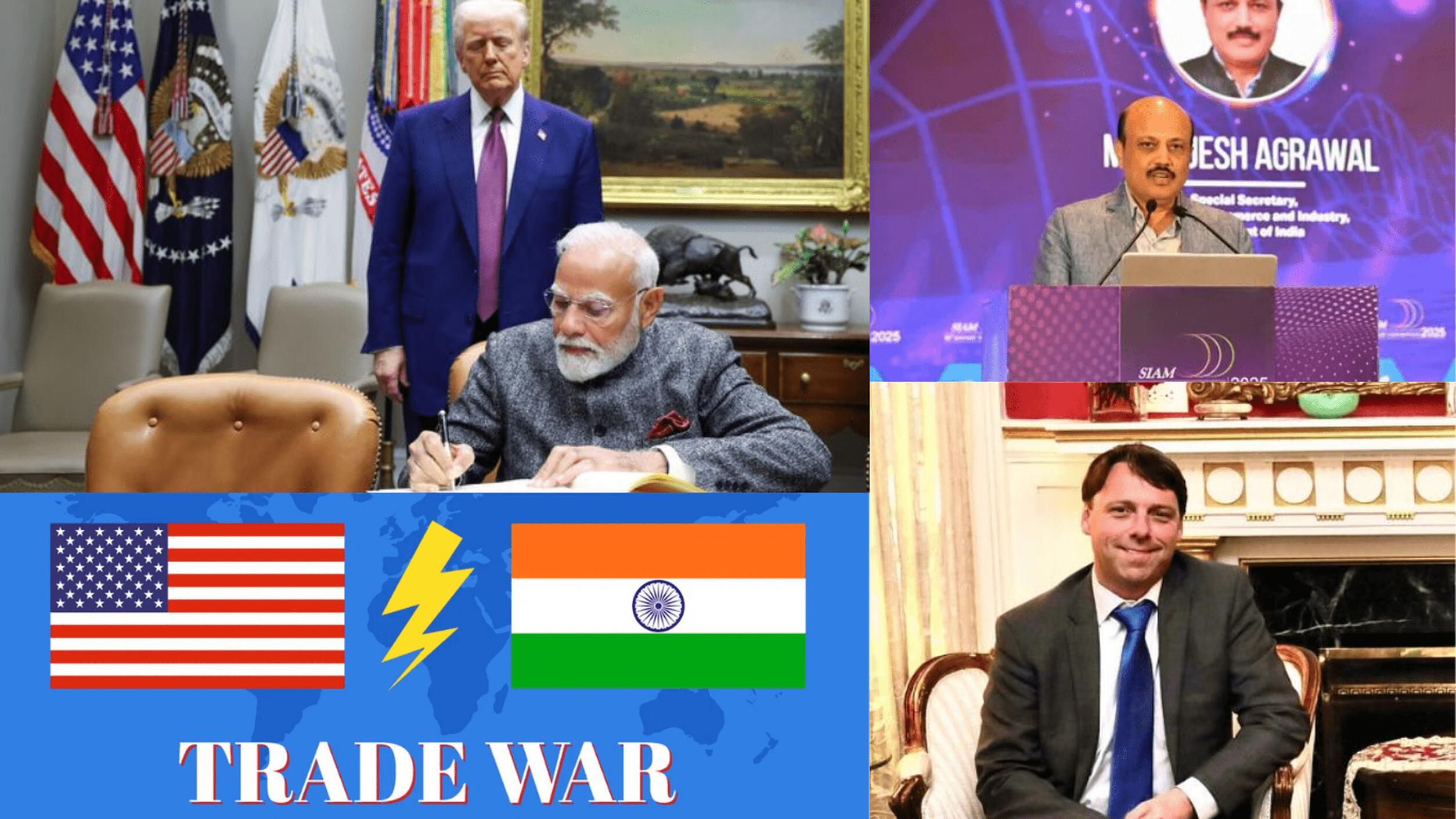
India and the United States, the world’s two largest democracies, are once again back at the negotiating table over a long-awaited bilateral trade agreement. Days after US Commerce Secretary Howard Lutnick claimed Washington would “sort out” trade with India, senior American negotiator Brendan Lynch landed in New Delhi to hold fresh talks. On India’s side, the responsibility lies with seasoned IAS officer Rajesh Agrawal, who brings with him years of experience in trade, commerce, and diplomacy. Despite tariffs, pressure over Russian crude oil, and political noise from Washington, India is determined to secure a just, balanced, and mutually beneficial deal.
India’s Steadfast Approach to Trade Talks
The upcoming round of discussions between Assistant US Trade Representative for South and Central Asia, Brendan Lynch, and India’s chief negotiator Rajesh Agrawal, comes at a time of heightened economic friction. The United States, under the Trump administration, imposed steep tariffs on Indian goods 50 percent in total citing India’s purchase of Russian crude oil. This move hit Indian exports hard, with shipments to the US falling from $8.01 billion in July to $6.86 billion in August. Yet, India has made it clear that its sovereign energy security cannot be compromised, and that negotiations must focus on fairness, not pressure tactics.
Rajesh Agrawal: India’s Point Man for Global Trade
Rajesh Agrawal, the Special Secretary in India’s Department of Commerce, represents the country as the lead negotiator in these high-stakes discussions. An accomplished IAS officer, Agrawal holds a Bachelor’s degree in Statistics and a Master’s in Operations Research from Delhi University, along with an Executive Diploma in International Business from the Indian Institute of Foreign Trade. His career spans senior roles in Manipur as Principal Secretary (Power) and Chief Electoral Officer, as well as positions in the Ministry of Skill Development and ITPO. Importantly, he has led negotiations for ASEAN free trade reviews, Indo-Pacific Economic Framework (IPEF) talks, and pacts with Australia and Peru credentials that make him one of India’s most formidable trade minds.
Washington’s Demands vs. India’s Red Lines
The United States has consistently pressed India to open its agriculture and dairy markets, reduce oil imports from Russia, and cut back on defense purchases from Moscow. However, New Delhi has resisted these demands, citing its farmers’ livelihoods, its strategic autonomy, and its broader national interest. Prime Minister Narendra Modi has reiterated that India’s trade policies must be “balanced, just, and mutually beneficial.” For India, the goal is not to succumb to Washington’s arm-twisting but to build a partnership rooted in respect for each other’s priorities. This reflects the larger principle of “Atmanirbhar Bharat” (self-reliant India), where global engagement must align with domestic stability.
Brendan Lynch’s Visit: A Turning Point?
Brendan Lynch’s arrival in New Delhi marks the first in-person engagement after several weeks of virtual discussions. As the Assistant US Trade Representative for South and Central Asia, Lynch oversees US trade policy with 15 countries and has deep expertise in agriculture, manufacturing, services, and intellectual property rights. Notably, he has worked as the USTR’s Director for India in the past, making him well-versed in the complexities of the bilateral trade relationship. His visit signals that despite harsh rhetoric from Trump administration officials, Washington recognizes India’s indispensability in global trade. Whether this visit unlocks progress towards the long-delayed bilateral trade agreement (BTA) remains to be seen, but the timing suggests cautious optimism.
The Tariff War’s Impact on Indian Exports
The punitive US tariffs have already made their impact felt on India’s economy. In August, India’s exports dipped to $35.10 billion, down from $37.24 billion in July, marking a nine-month low. The trade gap narrowed slightly, but only because imports also slowed. For India, the stakes are high: the US remains one of its biggest trading partners, and American tariffs risk affecting sectors ranging from textiles and pharmaceuticals to information technology services. However, India has held firm, refusing to give up its energy security by halting Russian oil purchases. This firmness underscores India’s message to the US: trade cooperation cannot come at the cost of national sovereignty.
Modi’s Vision for a Comprehensive Partnership
Prime Minister Narendra Modi has continued to strike a positive and forward-looking tone on India-US ties. In a recent post on X, he said he “deeply appreciates and fully reciprocates” President Trump’s sentiments, while describing the relationship as a “Comprehensive and Global Strategic Partnership.” For New Delhi, trade is just one part of a larger geopolitical and strategic partnership that includes defense cooperation, technology sharing, and people-to-people ties. By keeping the tone constructive even amid disagreements, India demonstrates maturity and resilience qualities that ensure the partnership moves beyond transactional disputes towards long-term cooperation.
A History of Stalled Talks, But Renewed Optimism
India and the US began bilateral trade talks in March with hopes of completing the first stage by October-November. Five rounds have been held, but the sixth round scheduled in August was postponed after tariffs soured the atmosphere. Still, regular weekly engagements at ministerial and diplomatic levels have kept the momentum alive. Earlier in the year, both sides had spoken of expanding bilateral trade to $500 billion by 2030, reflecting the sheer scale of ambition. Commerce Minister Piyush Goyal has also been in close touch with American counterparts, and depending on the outcome of Lynch’s visit, he could soon travel to Washington for the next round of talks. This continuous dialogue underscores that despite hurdles, both sides recognize the immense potential of this partnership.
Why India Holds the Stronger Hand
Unlike in the past, India today is negotiating from a position of strength. Its economy is the fastest-growing among major nations, it has become a global technology and manufacturing hub, and its role in global supply chains is expanding. For the US, India is not just another trading partner it is a strategic counterbalance to China in Asia. Washington cannot afford to alienate New Delhi, especially as it seeks reliable partners for supply chains, defense cooperation, and regional stability. This geopolitical reality gives India greater leverage in trade talks, ensuring that it can defend its red lines while still pursuing deeper engagement with the US.
India’s Road Ahead in US Trade Talks
India’s approach to trade talks with the United States reflects maturity, confidence, and clarity of vision. By entrusting Rajesh Agrawal, a seasoned and highly skilled negotiator, New Delhi has signaled its determination to secure a fair and balanced deal. While Washington may attempt to pressure India on Russian oil and agricultural access, the reality is that India’s strategic importance and economic resilience make it an indispensable partner for the US. Going forward, the challenge will be to bridge differences without compromising sovereignty. Under Prime Minister Modi’s leadership, India has positioned itself as a nation that engages globally on its own terms, ensuring that trade partnerships serve the interests of its people and its vision of becoming a global economic powerhouse.