
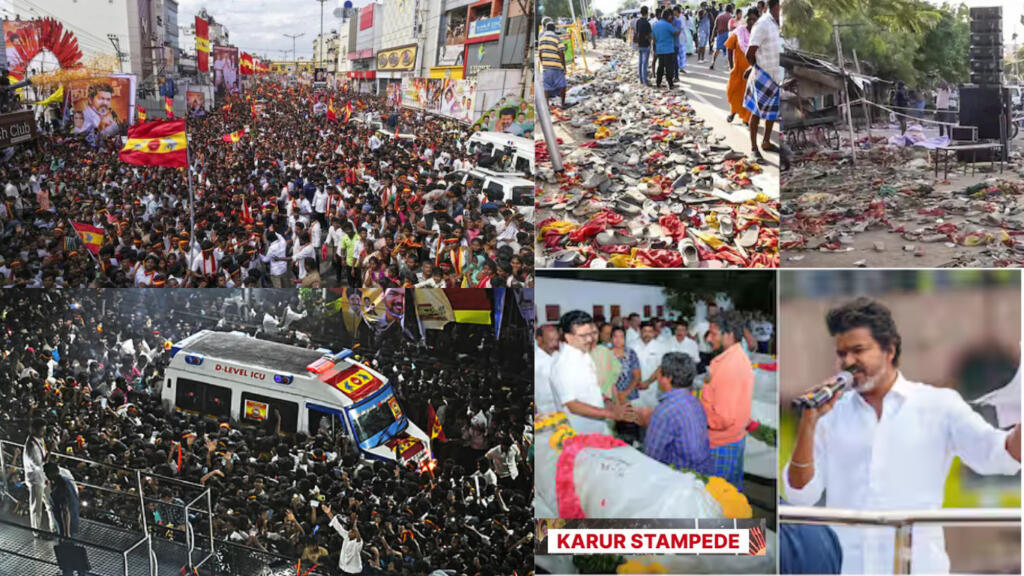
The tragic stampede at actor-turned-politician Vijay’s Tamilaga Vettri Kazhagam (TVK) rally in Karur has left Tamil Nadu in deep shock, with 41 lives lost and over 60 injured. Among the dead were women and children who had gathered in thousands to see their leader, but returned only as names in hospital lists and condolence messages. What should have been a celebratory political campaign turned into a horrifying night of chaos and grief. Yet, even as families mourn, political circles are engaged in an unending blame game. TVK cadres and several opposition voices point fingers squarely at the ruling DMK government, accusing it of gross negligence in crowd control and inadequate arrangements. On the other hand, the state government insists all security measures were followed in line with requests from TVK, arguing that the tragic deaths were the result of overcrowding and mismanagement by the organisers themselves. Between these conflicting claims, the million-dollar questions remain unanswered who will take responsibility, will governments finally learn how to handle mammoth crowds at political gatherings, and most importantly, will this tragedy be the last of its kind in Tamil Nadu’s turbulent political history?
The Stampede That Claimed 41 Lives
On September 27, 2025, thousands of TVK supporters gathered at Veluchamipuram in Karur, eager to catch a glimpse of their leader, Vijay. But what started as anticipation quickly turned deadly. As Vijay’s arrival was delayed for several hours, restlessness grew. Witnesses recounted that the crowd surged forward around 7 pm, coinciding with a brief power cut. In the narrow lanes with open drainage lines, people tripped, fell, and were trampled. Entire families were torn apart parents separated from children, young ones suffocating in the melee, and mothers unable to rescue their kin. Postmortem reports confirmed that suffocation was the primary cause of death. The visuals of lifeless children being carried to ambulances shocked entire Nation, while survivors recounted harrowing details of the chaos that unfolded.
Power Cut or Generator Failure? The Conflicting Claims
The controversy deepened when a letter surfaced showing that TVK itself had sought a brief power shutdown during Vijay’s speech, citing public safety concerns. Tamil Nadu Electricity Board officials confirmed receiving such a request but stated it was denied. The government, however, dismissed allegations of a deliberate power cut, asserting that the brief dimming of lights was due to generator failure in TVK’s own arrangements. Eyewitnesses contradicted the official version, claiming the power outage lasted nearly half an hour, worsening panic in the already restless crowd. TVK cadres went further, alleging conspiracy, accusing local politicians and police of colluding with anti-social elements to sabotage the rally. With both sides standing firm, the truth behind the power disruption remains one of the unresolved mysteries of the tragedy.
Police Deployment and Crowd Management: Adequate or Negligent?
Another focal point of the debate has been the adequacy of police deployment. The Tamil Nadu government claimed nearly 500 personnel were deployed for an expected crowd of 20,000, maintaining a ratio better than national standards. Yet local residents insisted that police presence was far weaker compared to similar rallies held by AIADMK leaders in the same venue days earlier. Critics argue that permission was sought for 10,000 attendees but close to 50,000 thronged the site, making the venue dangerously overcrowded. The narrow road and inadequate barricades turned into death traps when the surge began. Police officials defended their role, stating that no number of officers could have prevented the chaos once panic set in, while TVK sources allege that repeated warnings for more personnel were ignored by authorities. This tug-of-war over numbers has only intensified the blame game.
The Political Blame Game Intensifies
As condolences poured in, so did political accusations. Former BJP state president K Annamalai openly blamed the DMK government for negligence, pointing to the state’s failure in ensuring public safety. He drew attention to how the ruling party deploys massive forces for its own rallies while neglecting opposition gatherings. The DMK, however, countered by saying all arrangements were made in accordance with TVK’s requests and that it was the organisers’ mismanagement and delayed scheduling that triggered the surge. Deputy CM Udhayanidhi Stalin highlighted that hundreds of doctors and nurses were rushed to treat the injured, portraying the government as swift and responsive. Meanwhile, TVK chief Vijay expressed personal anguish, calling the deaths “indescribably painful” and offering financial aid to victims’ families. But opposition leaders and cadres remained unconvinced, arguing that mere compensation cannot substitute for accountability.
Inquiry Commission and the Question of Accountability
The Tamil Nadu government constituted a single-person Commission of Inquiry led by Justice Aruna Jagadeesan to investigate the tragedy. She has since visited hospitals and the venue, interacting with victims and officials. Chief Minister Stalin has assured that any legal action, even against Vijay himself if warranted, would depend on the commission’s findings. But skepticism lingers among the public will this inquiry bring genuine accountability or fade into the long list of probes whose recommendations gather dust? For families who lost loved ones, the assurance of “further reports” offers little solace. Instead, they want answers to the pressing question who is responsible for the death of 41 innocent people?
Public Anger and Emotional Fallout
The tragedy has stirred deep emotional outrage across Tamil Nadu. Grieving families continue to demand justice, while residents of Karur remain shaken by the sheer scale of the disaster. On social media, visuals of children crying for their parents and relatives breaking down have sparked waves of anger. Hashtags blaming the DMK government trended alongside calls for TVK’s organisational accountability. Vijay’s personal image as a beloved actor-politician has taken a dent, as critics question whether his entry into politics is backed by the necessary administrative discipline to handle such mammoth crowds. For many, the tragedy also served as a stark reminder of the fragile line between political spectacle and public safety.
Lessons for the Future: Will Political Rallies Change?
The Karur stampede has reignited debates on how India manages mass gatherings, especially in politically charged states like Tamil Nadu. Despite decades of experience with massive crowds during elections, processions, and festivals, governments still fail to prevent avoidable tragedies. Experts suggest stricter caps on venue capacities, staggered entry systems, professional crowd control mechanisms, and dedicated disaster management teams for large-scale events. Yet, political leaders, driven by optics and mass appeal, often ignore safety advisories to maximise turnout. The question haunting Tamil Nadu today is whether the Karur tragedy will finally push the government and opposition alike to prioritise human lives over political showmanship. Or will the cycle of condolence messages, inquiry commissions, and forgotten promises repeat once more?
The Million-Dollar Questions Remain
The Karur rally stampede has turned into more than just a tragic event; it has become a litmus test for political accountability in Tamil Nadu. TVK cadres blame the DMK government for negligence, while the ruling party insists that it followed due process and that the organisers themselves are responsible. But amid this political ping-pong, the lives of 41 citizens including children have been lost forever. No inquiry, no compensation, no political speech can bring them back. What remains is the pressing need for systemic reforms in how rallies are organised and secured. Will this tragedy be the last of its kind? Will governments learn to put people’s safety above political grandstanding? Or will Tamil Nadu continue to mourn preventable deaths in the name of political mobilisation? These million-dollar questions hang heavy in the air, demanding not rhetoric but genuine responsibility.