
















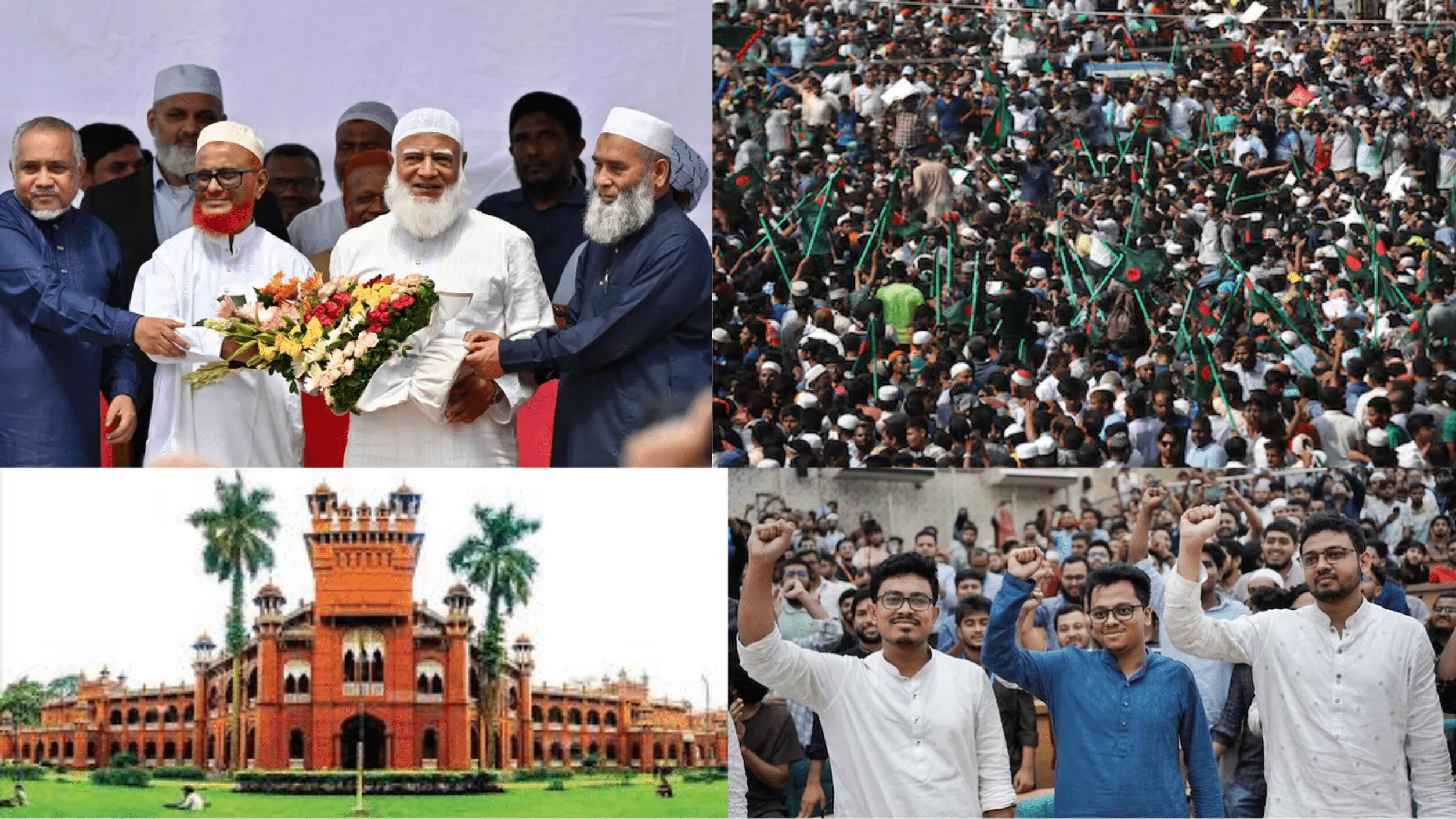
The sweeping victory of Jamaat-e-Islami’s student wing in the Dhaka University Central Students’ Union (DUCSU) elections has triggered intense debate in Bangladesh’s political circles. For the first time since the country’s independence in 1971, an Islamist group has emerged triumphant in student politics at the nation’s premier university. The result is being seen as a potential game-changer for Bangladesh, where general elections are due in February next year.
The Islami Chhatra Shibir (ICS), Jamaat’s student arm, secured nine out of 12 positions in the DUCSU elections held on Tuesday. This historic victory has not only unsettled secular parties but also opened a new chapter in Bangladesh’s evolving political dynamics, with Dhaka University once again becoming the focal point of larger national debates.
Jamaat’s Resurgence Through Student Politics
Jamaat-e-Islami has long been marginalised from mainstream politics in Bangladesh, with its activities tightly monitored and restricted over the years due to allegations of extremism and its controversial role during the 1971 Liberation War. However, the ICS victory signals that the party’s organisational network among students is still intact and capable of delivering electoral results.
Observers note that Jamaat has steadily invested in mobilising students on issues of governance, corruption, and social justice, which appears to have resonated with young voters disillusioned by the collapse of established student groups. With the Awami League’s student wing, the Bangladesh Chhatra League, disbanded by the interim government following last year’s “July Uprising” that toppled Sheikh Hasina, the ICS found the perfect opening to regain political ground.
Political commentators stress that Dhaka University has historically served as a barometer for the nation’s direction. From the 1952 Language Movement to the anti-Ershad protests of the 1990s, student politics at the university has often been the starting point of nationwide transformations. The ICS victory, therefore, is more than a campus contest it reflects a shifting undercurrent in Bangladeshi politics.
Opposition Parties Cry Foul
The outcome, however, has not gone uncontested. The Jatiyatabadi Chhatra Dal (JCD), student wing of former Prime Minister Khaleda Zia’s Bangladesh Nationalist Party (BNP), outrightly rejected the results, branding the entire exercise a “farce.” Its candidate, Mohammad Abidul Islam, took to social media, accusing the authorities of deliberate manipulation: “Put the numbers as you like. We have rejected the farce.”
The Students Against Discrimination (SAD) group, which played a pivotal role in last year’s anti-Hasina movement but later fragmented due to internal rifts, also failed to make an impact. SAD candidate Abdul Qauder alleged irregularities in the voting process, while a dissident leader, Umama Fatema, dramatically withdrew from the race midway, citing corruption within her own camp.
Despite these accusations, Chief Returning Officer Prof Mohammad Jasim Uddin hailed the elections as a “model,” pointing out that Dhaka University has always been a stage where national crises find their first expression. The very fact that the vote was held after years of dormancy was seen as a step toward reviving democratic practices.
Interim Government and New Alignments
The rise of ICS also coincides with the vacuum created after the disbanding of the Awami League’s student wing and the uncertain future of BNP’s political clout. In this fluid situation, the interim government led by Nobel laureate Muhammad Yunus has sought to project the DUCSU polls as part of its broader democratic transition.
The National Citizen Party (NCP), considered sympathetic to Yunus, welcomed the outcome. Its leader, Hasnat Abdullah, urged all parties to respect the verdict and described the victory as a “turning point” in Bangladesh’s political journey. Analysts argue that by backing the results, the interim government is trying to strengthen its credibility and show neutrality, even as critics question whether Islamist forces are being inadvertently legitimised.
Implications for the 2026 General Elections?
The ICS victory at Dhaka University could have far-reaching implications beyond campus politics. Elections are scheduled at three more major universities in the coming months, which will test whether Jamaat can replicate its success on a broader scale. If repeated, this could pave the way for Jamaat to re-emerge as a serious player in the upcoming general election.
Analysts believe that the DUCSU results demonstrate a shift in youth sentiment, reflecting disillusionment with traditional secular parties and opening the door for Islamist organisations to expand their influence. For Bangladesh’s political elite, this development is a warning that the familiar electoral script may no longer apply.
A Watershed Moment for Bangladesh Politics
The Dhaka University results underline a watershed moment for Bangladesh’s political trajectory. The triumph of Jamaat’s student wing signals the return of Islamist forces to the mainstream at a time when the nation is grappling with leadership vacuums and shifting alliances. While critics fear this could polarise politics further.
As the general election approaches, one thing is clear: the student vote, often underestimated, could play a decisive role in reshaping Bangladesh’s future. The message from Dhaka University is unmistakable the ground realities of Bangladesh’s politics are changing. But only time will tell us whether New Delhi will Face a Rising Islamist Tide Next Door? or not.