





















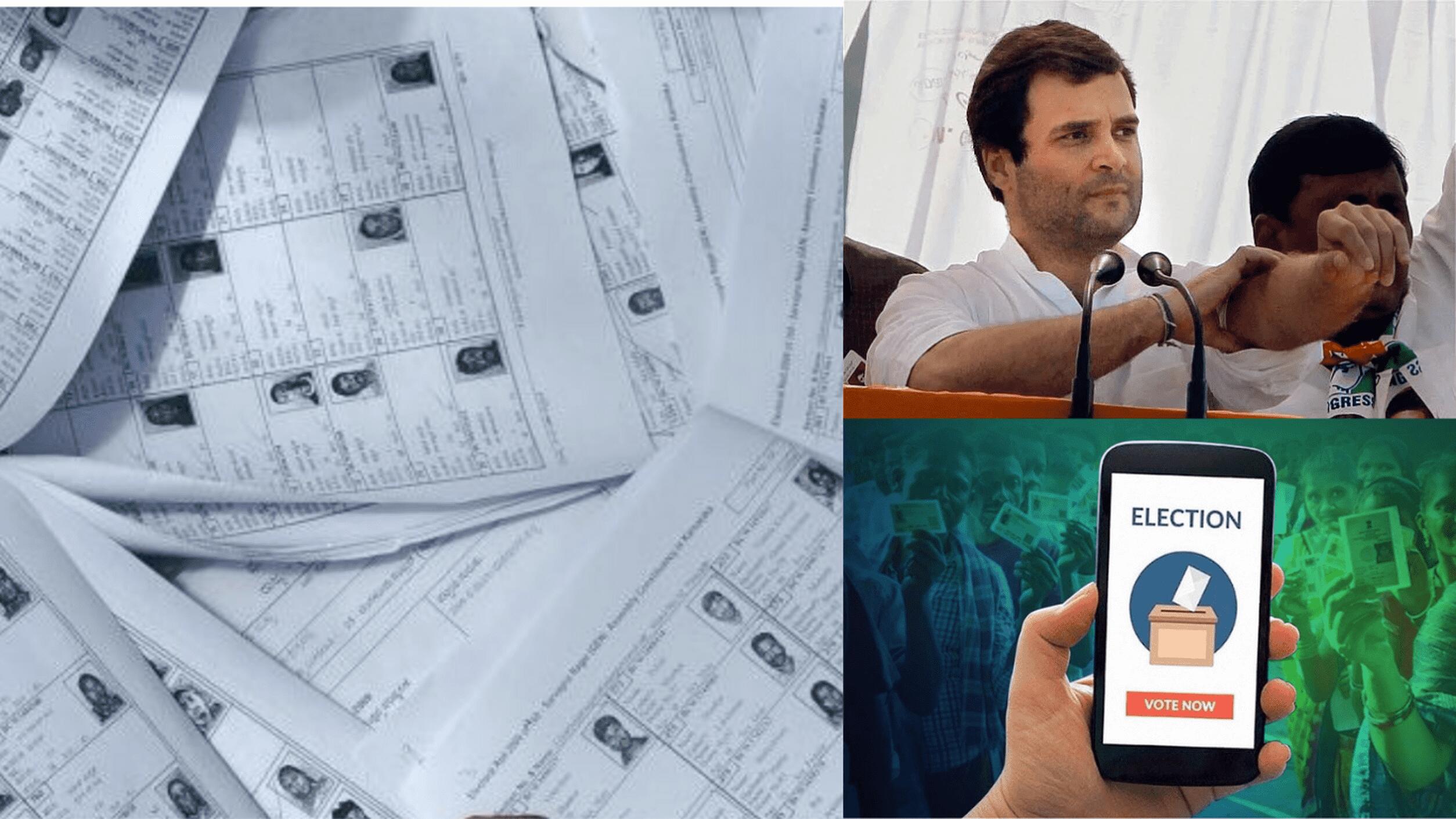
Congress leader Rahul Gandhi has sharpened his attack on the Election Commission, accusing it of shielding what he calls “vote thieves.” At a press conference on Thursday, he claimed that during the 2023 Karnataka Assembly elections, thousands of Congress supporters’ names were targeted for deletion through a centralised, software-based operation.
In Aland constituency alone, he said nearly 6,000 names were picked out by a programme that automatically used the “first voter in every booth” to impersonate an applicant seeking deletions. He paraded on stage both a voter whose name was attempted to be deleted and the neighbour whose details were misused, both of whom denied filing any request.
Why Software Or Automation Striking Off Votes is Not Possible?
Rahul Gandhi has alleged that thousands of applications were filed through an automated system using fake mobile numbers and OTPs. However, under the rules:
- Online portals only accept applications; they cannot delete names on their own.
- Each case still requires verification and a hearing.
- Even in cases of suspected bulk manipulation, the ERO must follow due process.
- If software-driven impersonation were attempted, it would amount to fraud and criminal conspiracy, but would not itself bypass the legal safeguards.
Software can flood the system with applications; it cannot, by itself, erase names from the rolls.
Rahul Gandhi argued that the same system was being used in multiple states. In Maharashtra’s Rajura constituency, he alleged 6,815 names were fraudulently added, suggesting the software was capable of both deletions and additions. He said the method was not limited to Karnataka and Maharashtra, but extended to Haryana and Uttar Pradesh. Gandhi demanded that the Election Commission release within a week the data on mobile phones and OTPs used in these applications.
The ECI categorically denied Gandhi’s allegations. It said no deletion of votes can be done online “as misconceived by Rahul Gandhi.” Portals and apps only allow applications to be filed, which then go through scrutiny. It stressed that no deletion can take place without issuing a notice and giving the voter an opportunity to be heard.
On the Aland case, the Commission clarified that it was the poll body itself that flagged anomalies in 2023 and lodged an FIR. It pointed out that the Congress in fact won the Aland seat in 2023, undercutting claims of systematic targeting. The EC underlined that voter roll deletions are governed by law, not by technology.
Voter Deletion Process?
The Representation of the People Act, 1950, and the Registration of Electors Rules, 1960 lay down the framework for how a voter’s name can be removed from the rolls. The process is designed to prevent misuse and ensure that no one loses their vote without being informed or given a chance to contest it.
- If someone wants a voter’s name deleted, or objects to an entry in the electoral roll, they must submit Form 7 to the Electoral Registration Officer (ERO). This form is also used by voters themselves if they have shifted to another constituency. It requires key details such as the constituency name, the voter’s EPIC number, the reason for seeking deletion, and the applicant’s own details and signature. Once submitted, the local Booth Level Officer (BLO) issues an acknowledgement.
- The law specifies only a handful of reasons: the voter has permanently shifted to another constituency, is not found at the registered address, has been entered twice, has died, or is not an Indian citizen. Deletions cannot be sought on arbitrary or political grounds.
- Every application is entered into official records. If a form is incomplete or defective, it can be rejected at the preliminary stage itself.
- If a deletion is proposed, the ERO is required to serve a notice to the voter, specifying the date, time, and place of a hearing. This notice can be delivered personally, by registered post, or by affixing it at the person’s residence.
- A BLO visits the address in question to check whether the voter is still living there, has passed away, or if the entry is a duplicate. The findings are reported back to the ERO.
- Both the applicant who sought deletion and the voter whose name is under question have the right to be heard. The ERO may ask for documents, demand personal appearance, and even record statements under oath before taking a decision.
- After considering the evidence, the ERO either rejects the application or approves the deletion. If approved, the name is struck off and reflected in the next updated roll.
- A voter who believes their name has been wrongly deleted can challenge the ERO’s order. They can also apply afresh for inclusion by filing Form 6 with proof of residence and identity. False declarations made in a Form 7 application are punishable under Section 31 of the Representation of the People Act, 1950.
Legally, any elector in the same constituency can file Form 7 objecting to another voter’s name. But this does not automatically delete the vote.
The ERO is required to issue notice, carry out verification, and provide a hearing before passing any order. Without these steps, a deletion is unlawful. Filing a false application is a punishable offence.