
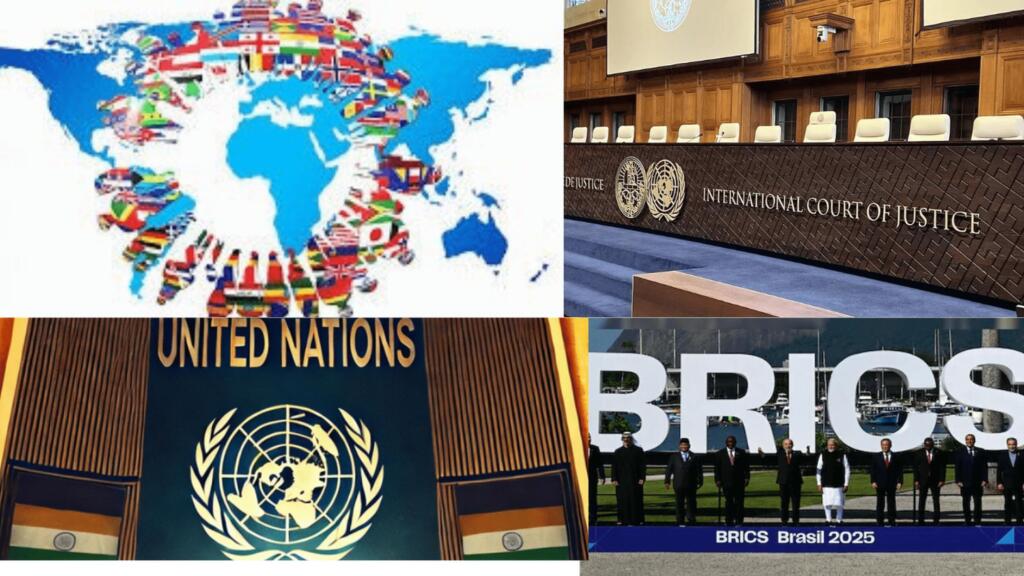
International law, designed and shaped by colonial powers through the UN, ICJ, ICC, IMF, and World Bank, shields colonisers and the Church from accountability for genocide, plunder, and forced conversions. Laws like non-retroactivity and sovereign immunity block justice and reparations. If India and other ex-colonial nations quit the UN and BRICS builds its own anti-colonial tribunal with economic leverage, the West can finally be tried, isolated, and forced to answer for centuries of crimes.
Introduction
The end of formal colonial rule did not mark the end of colonialism. It merely changed its tools. Where once European powers used gunboats, inquisitions, and plantations, today they rely on international laws, treaties, and institutions. These are hailed as guardians of peace and justice, but in practice, they extend the privileges of colonisers, shield their crimes, and deny reparations to the nations and peoples who endured centuries of slavery, forced conversions, massacres, and cultural annihilation.
This essay exposes how the UN and its subsidiaries, along with parallel international institutions like the IMF, World Bank, and ICC, function as continuations of colonial architecture. It explains the legal doctrines used to protect former colonisers and the Church, analyses the consequences if ex-colonial nations such as India withdraw from these frameworks, and presents a roadmap for BRICS and the Global South to dismantle this colonial legal order and replace it with one built on justice.
How International Law Protects Colonial Powers
1. The UN Charter and Sovereignty Shields
The UN Charter (1945) enshrines principles of sovereign equality and territorial integrity. At first glance, this appears fair. But hidden within are legal shields that protect former colonial powers. Article 2(7) prevents the UN from intervening in matters “essentially within the domestic jurisdiction” of states. This means that atrocities committed during colonial rule—forced famines in India, the Congo massacres, the Goa Inquisition, or mass enslavement—are legally insulated, since they occurred under the “sovereignty” of colonial rulers.
When colonisers transferred power to new nations, sovereignty doctrines made the new states legally responsible, not the old masters. Britain, Portugal, France, Spain, and the Vatican walked away clean, their crimes effectively erased by the UN’s legal framework.
2. Vienna Convention on State Immunity
The Vienna Convention on Diplomatic Relations (1961) and doctrines of sovereign immunity prevent lawsuits against states for past crimes. This is why Britain could be sued for the Mau Mau torture camps in Kenya only under exceptional circumstances, and even then compensation was limited. Normally, such suits are blocked: colonisers claim immunity.
Thus, Portugal cannot be sued in Indian courts for the Goa Inquisition. The Vatican cannot be prosecuted for mass conversions and torture in Asia, Africa, and the Americas. The law shields perpetrators instead of victims.
3. The International Court of Justice (ICJ)
The ICJ only hears cases where states consent. Former colonisers never consent to trials over colonial crimes. India cannot drag Portugal to the ICJ for the Goa Inquisition, nor can African nations prosecute Belgium for Congo atrocities. The system is built on voluntary jurisdiction—a tool that lets the guilty escape.
4. The International Criminal Court (ICC)
The Rome Statute (1998) created the ICC, but its jurisdiction began only from 2002. This single clause erases centuries of colonial crimes: the transatlantic slave trade, the destruction of indigenous peoples, and forced conversions all fall outside its reach. The ICC prosecutes Africans, Asians, and weaker nations, while European colonisers and American generals remain untouchable.
5. IMF, World Bank, and Debt Colonialism
The IMF and World Bank were established in 1944, before most of the Global South gained independence. Voting rights were based on financial contributions, ensuring Western dominance. These institutions impose conditional loans that replicate colonial extraction—forcing African and Asian nations to cut social spending, privatize industries, and export raw materials cheaply to the West.
Debt repayment becomes a new form of tribute, a continuation of colonial exploitation through financial law.
6. UNESCO and Cultural Property
While UNESCO claims to safeguard world heritage, its conventions have been used to freeze stolen colonial artifacts in European museums. The British Museum still displays looted Indian, African, and Greek treasures. UNESCO conventions emphasize “preservation” but not restitution. Colonisers keep what they stole.
7. Papal Sovereignty
The Vatican’s recognition as a sovereign state (1929, Lateran Treaty) means its crimes cannot be prosecuted in international courts. The Inquisition, forced conversions, child abuse scandals, and residential schools are legally untouchable. The Church hides behind statehood and moral ambiguity.
Why Direct Legal Action Against Colonisers Is Blocked
The structure of international law itself was designed by colonisers. Principles like non-retroactivity (“you cannot punish crimes that weren’t illegal at the time”) and state succession (new governments inherit old obligations) ensure colonisers escape responsibility. This is why India pays World Bank dues but Britain never paid reparations for draining trillions from India.
In short: the laws protecting colonisers were written by the colonisers themselves.
What If India and Other Nations Quit the UN?
If India, China, and major African nations withdraw from the UN and related institutions, several colonial shields collapse:
- ICJ jurisdiction irrelevant – Cases cannot be blocked by Western consent, since new tribunals can be established under BRICS treaties.
- ICC authority void – Without Global South membership, the ICC becomes a hollow court prosecuting only weak states.
- IMF/World Bank pressure reduced – BRICS’ New Development Bank and alternative financial systems can bypass debt colonialism.
- UNESCO monopoly broken – BRICS nations can demand restitution of cultural property through their own cultural charters.
- Papal immunity challenged – BRICS states could derecognize the Vatican as a sovereign entity, exposing it to lawsuits.
In short, quitting the UN doesn’t weaken the Global South—it liberates it from colonial legal chains.
BRICS as the New Anti-Colonial Commission
If BRICS forms its own Anti-Colonial Justice Commission, it can:
- Put Colonisers on Trial: Establish tribunals to hear cases against Portugal, Spain, Britain, France, Belgium, and the Vatican for genocide, plunder, and forced conversions.
- Issue Reparations Orders: Demand monetary compensation, return of artifacts, and restoration of destroyed heritage.
- Enforce Judgments via Supply Chains: Use BRICS’ control of critical resources (energy, food, minerals, manufacturing) to impose boycotts and sanctions on non-compliant colonisers.
- Create Alternative Financial Systems: Expand BRICS’ New Development Bank into a debt-free financing tool, ending IMF-World Bank monopoly.
- Mandate Historical Truth: Require member states to include colonial crimes in school curricula, ensuring future generations know the truth.
Economic and Political Weapons Against Colonisers
- Boycott and Isolation: Suspend trade, cultural, and diplomatic ties with nations refusing to acknowledge colonial crimes.
- Control of Resources: Africa and Asia supply critical minerals, energy, and food. Restrict exports to exploitative states.
- Digital Archives of Crimes: Publish every record of atrocities online, shaming colonisers with undeniable evidence.
- Seizure of Assets: Confiscate colonial-era wealth stored in BRICS banks until reparations are paid.
- Media and Culture: Produce films, books, and campaigns exposing colonial crimes, countering Western propaganda.
- Legal Innovation: Draft BRICS treaties that reject sovereign immunity and retroactivity for colonial crimes.
Why This Moment Matters
Western economies are collapsing:
- France and the UK are flirting with IMF bailouts.
- Germany’s industry is in tatters.
- Africa has stopped exporting vital resources to Europe.
- India and China dominate global manufacturing.
- The U.S. is fractured, its politics destabilized by Trumpism.
Meanwhile, BRICS is rising—weakening the UN, IMF, WTO, and ICJ. This is the historic opportunity to tear down the colonial legal system and replace it with one that delivers justice.
Conclusion: Justice Cannot Wait
International law as it stands is not justice—it is the continuation of colonialism by other means. It shields the colonisers, protects the Church, denies reparations, and silences the Global South. But the tide is turning. With the West in economic decline and BRICS on the rise, the time has come to rewrite the rules.
India and the Global South must:
- Quit colonial institutions like the UN and ICC.
- Build BRICS tribunals to try colonisers.
- Use economic leverage to isolate and punish the guilty.
- Rewrite history in schools and public life.
- Demand reparations and restitution, not apologies without accountability.
Justice delayed is justice denied. For the victims of the Goa Inquisition, the African slave trade, indigenous genocides in the Americas and Australia, and countless others, the world owes a debt. That debt will not be repaid through Western law. It will only be repaid when the Global South takes justice into its own hands.