















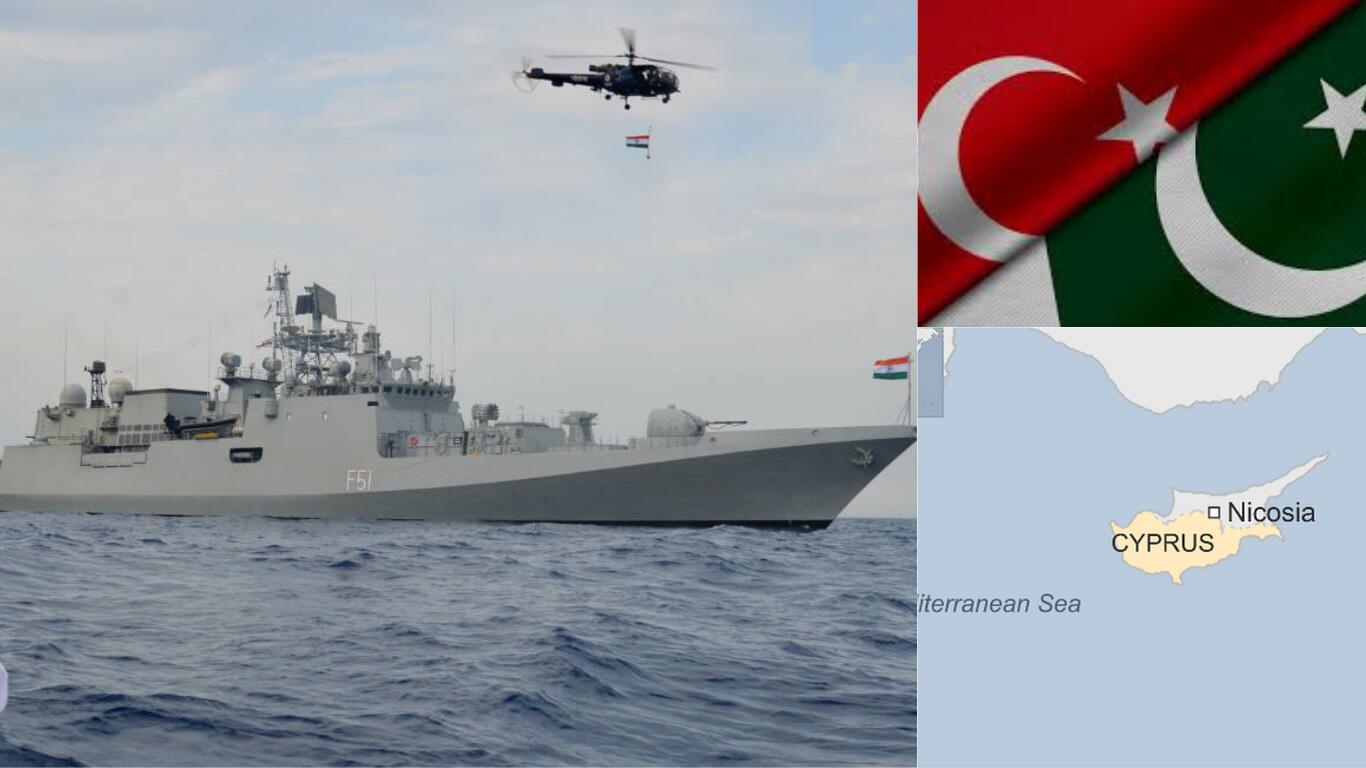
India’s naval diplomacy has once again sent ripples across the Mediterranean. The arrival of INS Trikand, one of the Indian Navy’s most advanced stealth frigates, at the Limassol Port in Cyprus, is not merely a routine port call. It is a calculated geopolitical message to nations aligning with Pakistan, especially Turkey, which has openly backed Islamabad in its anti-India posturing. Coming just months after the Pahalgam terror attack and Turkish Navy’s warship docking in Karachi, India’s move signals that it too has global reach and knows exactly where to exert pressure when others side with a terrorist state.
Modi’s Cyprus Visit and the Message to Turkey
Prime Minister Narendra Modi’s visit to Cyprus in June 2025 the first by an Indian PM in 23 years was already being seen as a clear diplomatic signal. Turkey has occupied one-third of Cyprus since 1974, refuses to recognize the Republic of Cyprus, and has long backed Pakistan on Kashmir and terrorism issues. During Operation Sindoor in May, Ankara openly supported Islamabad, further straining relations with New Delhi.
By making Cyprus one of his first foreign stops after the Pakistan crisis, Modi conveyed India’s solidarity with Cyprus, an EU member state that has consistently stood with India at global forums. The visit was not just symbolic it laid the foundation for a four-year action plan to expand cooperation on defence, maritime security, and training. This alignment also feeds into India’s broader Mediterranean strategy, countering Turkish assertiveness and the Turkey-Pakistan axis.
The docking of INS Trikand in Cyprus is thus part of a wider playbook India showing both strength and intent. If Turkey chooses to back Pakistan, India can strengthen ties with Cyprus, Greece, and other Mediterranean powers that have their own disputes with Ankara.
INS Trikand: A Symbol of India’s Naval Strength
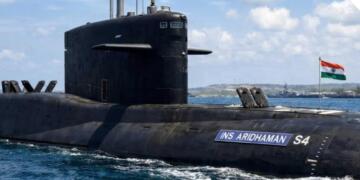
The Indian High Commission in Nicosia described INS Trikand as a “true symbol of India’s naval power and commitment to global peace and security.” Built with stealth features, state-of-the-art weapons, and advanced sensors, the ship reflects India’s growing capability to operate far from home waters.
The warship’s deployment to the Mediterranean has been intensive. Before reaching Cyprus, it took part in Exercise Bright Star 2025 hosted by Egypt, where Indian Army, Navy, and Air Force contingents operated alongside forces from the United States, Saudi Arabia, Qatar, Greece, and Italy. Following this, INS Trikand engaged in the first-ever bilateral maritime exercise with the Hellenic Navy of Greece, held between September 13 and 18.
The frigate’s presence at Limassol is therefore not an isolated stop but part of a strategic arc Egypt, Greece, and now Cyprus forming a Mediterranean outreach that strengthens India’s defence diplomacy. During its Cyprus stay, the ship’s crew is scheduled to hold interactions with Commodore Minas Solomonides, commander of the Cyprus Navy, and participate in professional as well as cultural exchanges. These activities deepen not only naval cooperation but also people-to-people connect.
Cyprus: India’s Mediterranean Gateway
Cyprus is no ordinary partner in this chessboard of geopolitics. Its location in the eastern Mediterranean, close to Turkey and Syria, and its membership in the European Union, make it strategically invaluable. For India, Cyprus is both a diplomatic ally and an economic bridge.
After the April 22 Pahalgam terror attack, Cyprus condemned the act unequivocally and promised to raise the issue of Pakistan’s cross-border terrorism at the EU level. This firm support contrasts sharply with Turkey’s repeated attempts to internationalize Kashmir and defend Pakistan. Cyprus has also backed India’s push for UN Security Council reforms, further cementing the bond.
Economically, Cyprus is emerging as India’s gateway to the EU. Eurobank, one of Cyprus’s biggest banks, has opened a representative office in Mumbai to facilitate Indian businesses looking to enter European markets. The island’s advanced financial services sector, favourable tax regime, and strong shipping industry make it a natural partner for India’s global trade ambitions. More importantly, Cyprus is part of the planned India-Middle East-Europe Economic Corridor (IMEC), which will reshape connectivity between Asia and Europe.
By placing a stealth frigate at Limassol, India is reminding the world that its Mediterranean outreach is not limited to trade it is backed by hard power.
Countering the Turkey-Pakistan Nexus
For decades, Turkey has been one of Pakistan’s most consistent international backers, whether on Kashmir or during India-Pakistan hostilities. But now, India is responding with smart diplomacy and visible power projection. By strengthening ties with Cyprus, Greece, and Egypt, New Delhi is building a counterbalance to Turkish influence in the Mediterranean.
INS Trikand’s docking comes soon after Turkey deployed its own warship to Karachi, a move seen as symbolic solidarity with Islamabad. India’s response is sharp: if Turkey plays the Pakistan card in South Asia, India will play the Cyprus card in Turkey’s backyard. This is a strategic pressure point that Ankara cannot ignore.
The visit also demonstrates India’s ability to sustain military deployments in distant waters. In today’s world, presence matters as much as firepower, and INS Trikand’s Mediterranean journey underscores India’s rising role as a global maritime power capable of defending its interests beyond the Indian Ocean.
India’s Mediterranean Strategy Comes of Age
The arrival of INS Trikand in Cyprus is not a routine naval exercise it is a strong geopolitical message. It signals India’s determination to counter the Turkey-Pakistan axis, deepen ties with Mediterranean allies, and expand its strategic footprint in Europe’s neighbourhood. Cyprus, already a trusted partner on terrorism and global reforms, is now firmly part of India’s defence diplomacy.
By docking one of its most advanced warships at Limassol, India has shown that it is no longer confined to the Indian Ocean it is an emerging power in the wider Indo-Mediterranean theatre. For Turkey, the message is unambiguous: siding with a terrorist state like Pakistan comes with costs, and India has the means to strike where it hurts most.