
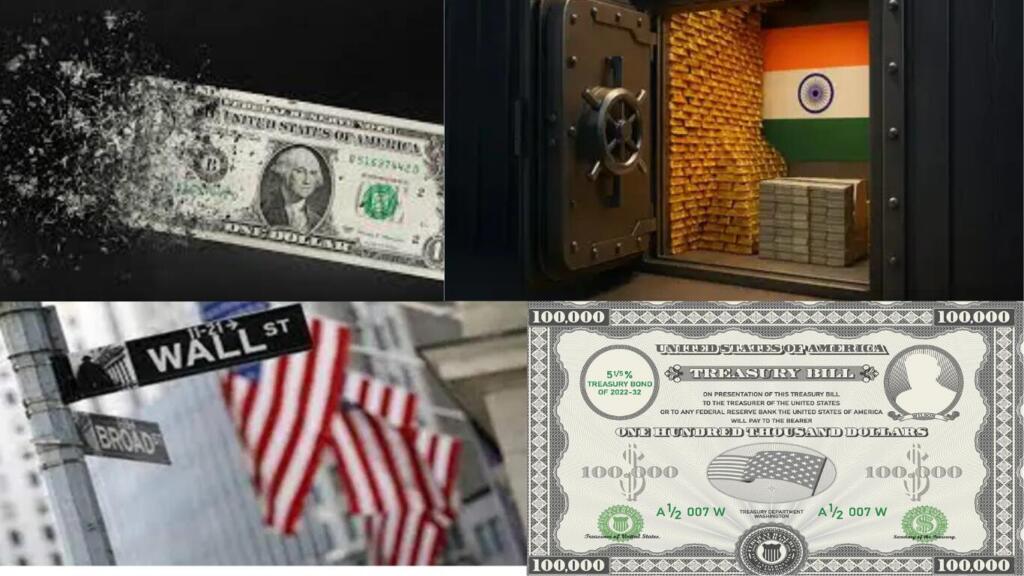
India is quietly scripting a new chapter in its economic playbook, one that strengthens its financial sovereignty while reducing overdependence on the US dollar. In a world shaken by geopolitical tensions, debt crises, and trade rivalries, New Delhi’s strategic decision to trim exposure to American Treasury bills and expand its gold reserves marks a bold and forward-looking approach. This shift not only reflects India’s growing confidence in its economic fundamentals but also signals its determination to shield its forex wealth from global volatility. With $690 billion in reserves, India is balancing prudence with power.
India Cuts US Debt Exposure, Boosts Gold Holdings
Fresh data from the Reserve Bank of India (RBI) and the US Treasury Department show a clear trend: India is reducing its reliance on US Treasury bills (USTs) while stepping up its gold stockpile. India’s holdings of US T-bills declined to $227 billion in June 2025, down from $242 billion a year earlier. Despite this decline, India continues to remain among the top 20 investors in American debt, ahead of Saudi Arabia and Germany.
During the same period, the RBI made significant additions to its gold reserves, purchasing 39.22 metric tonnes. As a result, India’s gold stockpile stood at 879.98 metric tonnes as of June 27, 2025, compared with 840.76 metric tonnes a year earlier. This measured rebalancing shows India’s intent to diversify its foreign exchange reserves away from dollar-dominated assets, securing itself against potential risks arising from the US economy.
Diversification Strategy to Protect Against Risks
Economists have hailed this move as a calculated diversification strategy. By reducing dollar-linked assets and increasing exposure to gold, India is insulating its reserves from volatility in the American financial system. The US economy is currently burdened with worsening fiscal deficits and elevated bond yields, making Treasuries less attractive than before.
Gaura Sengupta, economist at IDFC First Bank, noted that “India’s holdings of UST reduced by $14.5 billion over one year, despite a decline in yields, indicating a clear diversification strategy.” She added that this strategy also helps mitigate risks of revaluation losses due to US-specific fiscal concerns.
Gold, on the other hand, remains a time-tested store of value that offers stability when currencies fluctuate. By expanding gold holdings, India is effectively creating a stronger safety net, one that aligns with global best practices in reserve management.
Global Trend Towards De-Dollarisation
India is not alone in reshaping its forex portfolio. Globally, several nations are moving away from an overdependence on the dollar. China, the third-largest holder of US Treasuries after Japan and the UK, cut its holdings from $780 billion in June 2024 to $756 billion in June 2025. Similarly, other emerging economies are increasing gold purchases to diversify their reserves and shield themselves from dollar volatility.
Interestingly, while China and India trimmed their Treasury exposure, Israel went the other way, expanding its American debt holdings during this period. This divergence highlights that India’s choices are driven by long-term prudence rather than short-term trends.
The RBI’s preference for gold underscores India’s commitment to ensuring resilience against global financial uncertainties. At a time when the US is facing fiscal challenges and growing political unpredictability, India’s strategy of reserve diversification strengthens its credibility on the world stage.
A Stronger and Safer Forex Position
Despite reducing exposure to US debt, India’s overall foreign exchange reserves remain robust, standing tall at $690 billion as of August 22, 2025. The bulk of India’s Treasury holdings are still part of this stockpile, ensuring a strong dollar buffer. However, by steadily increasing its gold share, India is not only hedging risks but also boosting global investor confidence in its financial management.
Madan Sabnavis, chief economist at Bank of Baroda, explained that India’s reserves have risen both through higher gold holdings and a reallocation of foreign currency assets. This reflects confidence in India’s rising economic strength under the current government’s stewardship, which has consistently worked to safeguard India’s macroeconomic stability.
For India, this is more than just numbers. It signals financial maturity and independence an acknowledgment that the country is preparing for uncertainties while capitalizing on opportunities. With initiatives like Atmanirbhar Bharat and India’s growing stature in global trade, building resilience in forex management is an extension of its broader economic vision.
India’s Golden Future in Global Finance
India’s steady reduction in US Treasury exposure and increase in gold reserves is not a retreat but a repositioning. By safeguarding its $690 billion forex war chest with a stronger mix of assets, India is demonstrating financial foresight and strategic autonomy. This policy ensures that global volatility, US fiscal pressures, or geopolitical uncertainties will have a limited impact on India’s economic stability.
At a time when the world is searching for new centers of economic strength, India’s prudent reserve management highlights its rise as a responsible global power. With the government’s commitment to long-term stability and growth, New Delhi is sending a strong message: India is not just participating in the global economy it is shaping it.