
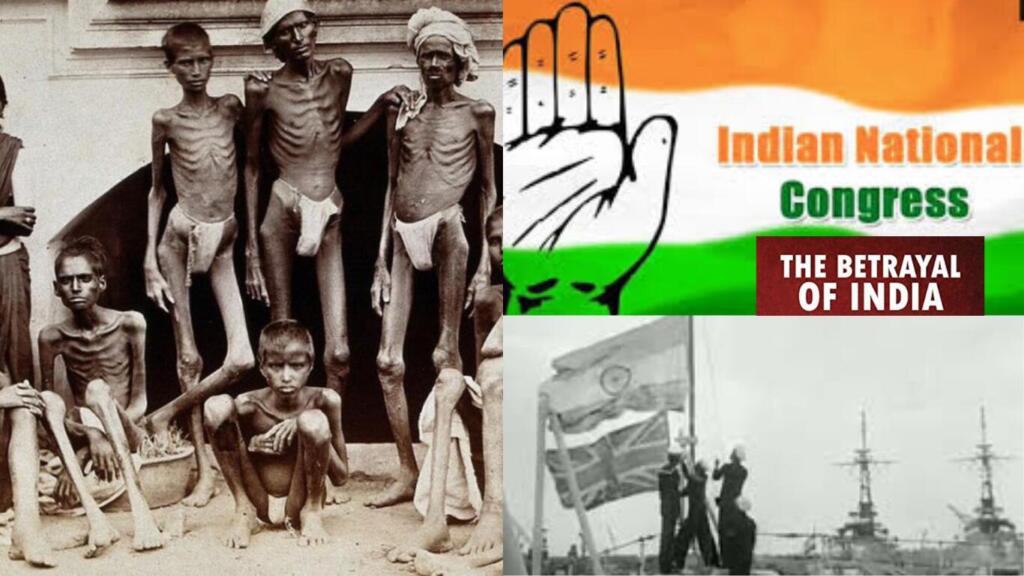
The Indian National Congress was never India’s true representative; it was the British Raj’s B-team, designed to absorb dissent, suppress armed revolts against the British Raj and protect imperial interests. From promoting ahimsa to opposing Subhas Chandra Bose’s military strategies, Congress ensured Indians remained subjugated, supported Britain in WW I and WWII, and ignored mass suffering like the Bengal famine. It criminally claimed its role in India’s freedom in 1947, deceptively white washing the real heroes : the Naval Mutiny of 1946, that led to independence. Its leadership prioritized British advantage over Indian lives, economy and culture, betraying the very people it claimed to serve. And it still continues to do so.
Congress: A Colonial Construct
The Indian National Congress, often mythologized as the voice of India’s nationalist struggle, was in fact a colonial creation and instrument designed to serve British interests. Formed in 1885 under the guidance of British officials like Allan Octavian Hume, its ostensible purpose was to provide a forum for Indians to air grievances and participate in governance. For many decades, the Congress presidents were from the British Isles.
The Congress was never intended to empower Indians in any meaningful sense; rather, it acted as a safety valve, ensuring that political dissent could be managed, controlled, and prevented from turning into large-scale armed resistance. The catastrophic rebellion of 1857 had shown the British the existential risk posed by mass uprisings, and Congress was an institutional mechanism to channel aspirations into petitions, debates, and incremental reforms that did not threaten the colonial establishment. In this sense, Congress functioned as the B-team of British rule, moderating nationalist sentiment and ensuring the empire’s longevity.
Early History and Objectives
From its inception, Congress operated under the implicit constraint of loyalty to the British Crown. The leadership, drawn largely from the English-educated elite, was often sympathetic to British civilizational rhetoric, seeing the empire as a stabilizing and modernizing force. The party’s early objectives were modest: it sought representation in administrative councils, legal reform, and gradual inclusion in governance, but never direct confrontation with imperial authority. This moderate approach was deliberate; it created a perception of Indian participation without challenging the fundamental structures of colonial control. Even in its campaigns for reform, Congress leaders avoided any strategy that could mobilize mass uprisings or threaten the British monopoly on military and administrative power. The organization’s very existence reflected a strategic alignment with imperial priorities: a channel to absorb discontent, preventing it from exploding into violent revolt.
The Congress and Armed Resistance
The role of Congress during periods of potential mass rebellion highlights its complicity further. Leaders such as Gandhi, who became synonymous with Indian independence, actively discouraged military approaches to liberation, emphasizing ahimsa (nonviolence) even when circumstances might have justified armed resistance. Gandhi’s opposition to Subhas Chandra Bose’s militarized vision illustrates this clearly. Bose, who advocated for a decisive military confrontation to expel the British, faced constant resistance from Gandhi and the top Congress leadership. Gandhi feared that an armed revolt would lead to massive bloodshed and undermine his moral approach, but the practical effect was neutralizing any serious challenge to British authority. Even lower-rung Congress cadres, who could have organized localized armed initiatives, were guided by a culture of compliance with British-imposed strategies, demonstrating that the party’s organizational ethos was aligned with imperial priorities rather than Indian self-determination.
World War II and Congress’ Collaboration
The Second World War further underscores Congress’ complicity with the British. Despite nominal opposition to colonial rule, Congress acquiesced to British demands for Indian manpower, encouraging recruitment into the British army and support for the Allied war effort. This was not merely passive cooperation; it was a strategic decision to align Indian resources with British military objectives, ensuring the continued survival of the empire. By mobilizing soldiers, providing material support, and suppressing dissent against wartime policies, Congress actively enabled British wartime logistics and colonial continuity. The party’s acquiescence facilitated the British capacity to divert Indian food and resources abroad, including the grain exports that worsened the Bengal famine. In effect, Congress became a conduit through which colonial priorities were implemented domestically, even when these directly harmed millions of Indians.
The Bengal Famine and Political Inaction
The Bengal famine of 1943 provides a stark example of Congress’ failure to act as a representative of Indian welfare. Millions starved while Churchill’s policies prioritized military logistics over local survival. Congress had both the networks and the organizational capacity to organize relief or pressure British authorities effectively, yet it refrained from mobilizing mass political action. Gandhi and other leaders limited themselves to appeals and moral exhortations, which the British could and did ignore. The party’s reluctance to confront imperial power, even in the face of mass starvation, reflects its structural alignment with British authority rather than its duty to protect Indian lives. Congress’ inaction during the famine demonstrates how the party’s philosophy and organizational culture, emphasizing negotiation, petitioning, and nonviolent moral pressure, served imperial stability at the expense of Indian lives.
Congress’ Ideological Complicity
Beyond specific events, Congress’ ideology further entrenched its complicity. By promoting ahimsa and moral restraint, the party instilled a passive acceptance of British rule, discouraging direct, forceful challenges that could have destabilized the Raj. Leaders cultivated the notion that India’s path to freedom must be gradual, civil, and ethical—implicitly endorsing the status quo. The leadership’s focus on elite negotiation over mass mobilization meant that British economic and political dominance continued unchallenged, even as millions suffered from policies like wartime grain diversion and famine neglect. Congress’ philosophical and strategic choices perpetuated colonial exploitation, ensuring that Britain remained well-fed, politically secure, and economically extractive throughout the war years.
The Independence of India : Mutiny by the Royal Indian Navy
India’s independence was not the work of congress, though congress lied to the nation. Gandhi’s ‘peaceful’ protests were just shows for public attention and deflating public anger against Britishers. It was the 1946 Royal Indian Navy Mutiny that shook the British, forcing Prime Minister Atlee of Britain to concede that India’s independence was largely a result of military revolt, not Congress’ actions. Gandhi’s ahimsa was not only not working, it was helping in perpetuating the British Raj.Yet Congress deceptively claimed credit, presenting itself as the nation’s savior. History books were rewritten to glorify its role, masking its insignificance and misleading generations of Indians about the true drivers of freedom.
Post-Independence Continuity
The pattern of complicity did not end with independence. After 1947, Congress leaders maintained British-friendly economic policies, administrative structures, and trade arrangements, ensuring that the former colonial power continued to benefit from Indian resources. The continuity of bureaucratic frameworks, favorable trade relationships, and elite-aligned governance reflects that Congress’ role extended beyond colonial management it embedded imperial interests into independent India’s institutional fabric, preserving British advantage while presenting a veneer of nationalist governance.
Betrayal Continues
The Congress Party continues the role assigned by Britain: blocking India’s rise. Its leaders, as reports show, have looted public funds through endless scams, robbing the poor of social welfare. The Nehru-Gandhi family remains central, with vast unexplained wealth. A 1991 Schweizer Illustrierte report alleged Rajiv Gandhi held USD 2.2 billion in Swiss accounts. Congress has fueled Muslim appeasement, crippled Armed Forces through corrupt arms deals, falsified history to glorify invaders and colonialists, and consistently pursued Britain’s agenda against India. Congress betrayed India by colluding with its enemies, China and Pakistan, solely to grab power. It even sought Pakistan’s help to topple the sitting government and signed a secret pact with the Chinese Communist Party to consult on India’s national and international issues—despite Congress Government losing vast territories to both, still under occupation.
Conclusion
From its formation in 1885 to its wartime actions and post-independence policies, the Indian National Congress demonstrates a persistent alignment with British interests. Its structure, ideology, and strategies were designed to absorb dissent, suppress armed resistance, and maintain imperial stability. The leadership’s insistence on nonviolence, cooperation with the British war effort, and inaction during catastrophes like the Bengal famine reveal that Congress was far from an organic representative of India; it was a colonial instrument, a managerial elite ensuring that Britain retained control and Indian resources remained accessible. Understanding this complicity is essential to contextualize both the failures of nationalist leadership under colonialism and the enduring legacy of British influence in India’s post-independence political economy