
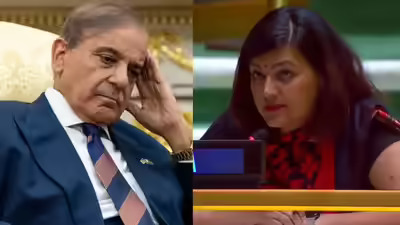
India has once again called out Pakistan’s duplicity on terrorism at the global stage after Prime Minister Shehbaz Sharif’s address at the United Nations General Assembly (UNGA). In a strongly worded right of reply, Indian diplomat Petal Gahlot described Sharif’s remarks as an “absurd display of theatrics,” accusing Islamabad of glorifying terrorism while attempting to distort international opinion. At a time when the world is grappling with multiple conflicts and humanitarian crises, India made it clear that Pakistan continues to weaponize religion and terror as part of its foreign policy.
Pakistan’s Distorted Narrative at the UN
Pakistan Prime Minister Sharif used his UNGA speech to blame India for regional instability, accuse New Delhi of aggression, and even make tall, unverified claims of Pakistan’s military “victory” over India in May. He alleged violations of international law, accused India of suspending the Indus Water Treaty illegally, and tried to project Islamabad as a victim of Indian actions. Sharif even claimed that the Pakistani Air Force destroyed seven Indian fighter jets during the recent conflict, a statement India described as “bizarre” and detached from reality.
Sharif further alleged that India sought to exploit the Pahalgam terror attack of April 22, which killed 26 civilians, for “political advantage.” He accused New Delhi of launching strikes on civilian areas and dismissed India’s suspension of the Indus Waters Treaty as an act of war. His rhetoric reflected Pakistan’s consistent attempt to internationalize bilateral disputes despite existing agreements.
India’s Firm Counterattack
Responding to Sharif’s speech, India’s Petal Gahlot dismantled Pakistan’s claims point by point. She reminded the UN that Pakistan’s history with terrorism is long and bloody, rooted in its policy of sheltering and exporting jihadists. “This assembly witnessed absurd theatrics in the morning from the Prime Minister of Pakistan, who once again glorified terrorism that is central to their foreign policy,” Gahlot said. She emphasized that no degree of lies or drama could erase the reality of Pakistan’s role in global terrorism.
Gahlot recalled that Pakistan blocked accountability for a terror group responsible for the April 2025 attack in Jammu and Kashmir that targeted tourists. She pointed out that Islamabad had long sheltered global terrorists, including Osama bin Laden, who was found near Pakistan’s military headquarters. She also reminded the world of Pakistani ministers openly admitting to running terror camps evidence of the state’s complicity in terrorism.
Operation Sindoor and Pakistan’s Embarrassment
India highlighted its recent counter-terror operations, especially Operation Sindoor, which struck major terror complexes in Bahawalpur and Muridke. “A picture speaks a thousand words,” Gahlot declared, citing publicly available images of slain terrorists and destroyed terror hubs. She noted that while India was eliminating threats, Pakistani officials continued glorifying these very terrorists, proving the regime’s dangerous proclivities.
On Pakistan’s claims of military success against India, Gahlot exposed the contradiction. She reminded the UN that while Islamabad boasted of victories on May 9, by May 10 its military had pleaded with India for cessation of hostilities after multiple Pakistani airbases were destroyed by Indian forces. “If destroyed runways and burnt-out hangars look like victory, Pakistan is welcome to enjoy it,” she said.
India’s Call for Zero Tolerance on Terrorism
India reiterated its longstanding position that all issues with Pakistan must be resolved bilaterally, leaving no scope for third-party mediation. Gahlot underscored that Pakistan must first dismantle its terror infrastructure and hand over wanted terrorists if it seeks peace. She made it clear that New Delhi will not allow terrorism to thrive under the cover of nuclear blackmail.
Gahlot stressed that India’s right to defend its people is non-negotiable. “Where terrorism is concerned, there will be no distinction between terrorists and their sponsors. Both will be held accountable,” she warned, reinforcing India’s determination to neutralize threats from across the border.
India’s Message to the World
India’s sharp response at the UNGA reaffirmed its firm stance against Pakistan’s repeated attempts to peddle lies and glorify terrorism on the global stage. By exposing Islamabad’s duplicity harboring terrorists while pretending to fight them New Delhi ensured that Pakistan’s theatrics were met with facts.
Sharif’s narrative of victimhood and fabricated victories found little traction, while India projected strength, clarity, and resolve. The message from India was unambiguous: terrorism will be fought relentlessly, its sponsors will be exposed, and there will be no compromise on national security. For the world community, this episode once again highlighted the urgent need for zero tolerance toward terrorism, especially when propagated as state policy.