
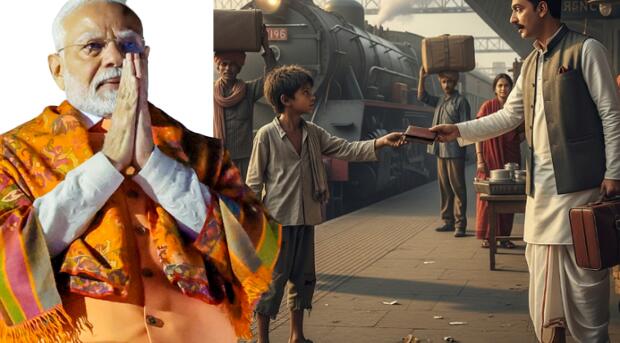
Along with Indian Prime Minister Narendra Modi, the whole of India celebrates his 75th birthday today. The world is quite familier to how the Prime Minister overcame all odds and rose in his journey of life from selling tea at Vadnagar’s railway station to being the leader of the largest democracy . But often it is his humble tales from his childhood days that present his truest face and answer why people still look up to him. There is one such tale never much mentioned from his early days serving his father’s tea stall. It is a tale neither about politics nor power but about integrity and honesty attributes that would later characterize his career. As a young boy in Vadnagar, Narendra Modi regularly assisted his father, Damodardas Modi, who ran a tea stall at the railway station. Life was simple, modest, and full of hardship. But even then, young Narendra’s instincts stood out.
One day, as the story goes, a passenger at the stall enjoyed his tea and, while leaving in haste to catch a train, accidentally dropped a packet of money. The packet went unnoticed by everyone else, but Narendra, quick-eyed and alert, spotted it. Now, most children in that situation might have been tempted to quietly pocket the money. After all, his family was not wealthy, and such an amount could have been useful. But the young Narendra did not think twice. He immediately picked it up and ran after the man, catching him just before he boarded the train. With folded hands, he returned the packet. The passenger, startled and touched, looked at the boy with admiration. He blessed Narendra, reportedly saying, “You will go far in life because you value honesty over greed.” That moment left a mark on the boy who would one day lead India.
It showed that even in childhood, Modi’s instinct was to uphold honesty, not personal gain. Why This Story Matters This story is not just about a child returning a lost packet of money. It is about values the invisible foundation on which leadership is built. For Narendra Modi, it reflected a way of life that emphasized integrity, self-restraint, and service above self. Years later, these very qualities came to define his political career. As a pracharak in the Rashtriya Swayamsevak Sangh (RSS), he was known for his discipline, rising before dawn to clean ashram grounds and stitching his own torn clothes rather than asking for new ones. As Gujarat’s chief minister and later as India’s prime minister, he repeatedly emphasized the importance of a corruption-free administration, frugality in public life, and dedication to duty. The tea stall story illustrates how leadership is not built overnight, nor only through big political decisions. It is shaped in small, unnoticed moments, when choices reveal character. For Modi, those choices consistently leaned towards honesty and responsibility.
A Life of Service As Narendra Modi reaches his 75th year, India and the world regard him as a statesman and a world leader. But behind the politics and the power is the same boy from Vadnagar, who respected honesty even when nobody’s eyes were upon him, who felt service superior to selfishness. It is possibly such a moral compass developed in his early years that has kept him steady against odds, controversies, and years of public life. The tea stall anecdote and lost money is more than a tale; it is an indication of why Narendra Modi earns respect even among his critics because he has a spirit within him that is earthed in integrity. On his 75th birthday, as India celebrates his journey, it would be good to recall that a leader’s greatness often becomes manifest not through mighty orations or policy but through a child’s honesty who returned something that didn’t belong to him.