











The Church’s history is soaked in blood—from the monstrous Goa Inquisition, blessed by the Pope, to the global assault on indigenous peoples. Temples razed, cultures erased, children tortured, communities enslaved—Christianity was a weapon of colonial domination. Even today, Popes arrogantly dismiss Hindu faith as “darkness,” refusing real apology. This cruelty was not divine—it was demonic tyranny sanctified in Rome.
The history of the Goa Inquisition is not just a list of dates, decrees, or distant incidents. It is a living wound—a scar carved into the memory of Goan families, transmitted across generations in whispers, in fear, and in quiet defiance. To understand it, one must not rely on the sanitised versions penned by apologists of empire and clergy, but view it through the anguished eyes of those who were tortured, dispossessed, and murdered in their own homeland.
Goa before the Portuguese was a land of diverse spiritual traditions, woven together by temples, festivals, music, and cultural vibrancy. That world was torn apart with the arrival of Portuguese conquerors—not as traders seeking spice, but as crusaders intoxicated with the ideology of forced christian conversion. Their mission was not commerce; it was conquest of souls. They carried swords in one hand and the cross in the other, convinced that the “salvation” of a so-called pagan justified any degree of bloodshed and brutality.
The central actors in this saga of cruelty were not just colonial soldiers. They were the satans masquerading as priests and bishops who sailed alongside them, cloaked in the authority of the Vatican, wielding divine entitlement as justification for inhumanity. Among them was Francis Xavier, later canonized as a saint, but remembered by Goans as a demon. Xavier was no messenger of peace. He was a fanatic who demanded an Inquisition in Goa to extirpate the “heresy” of Hindus who held to the faith of their ancestors. In a letter to the King of Portugal, he called for the creation of a tribunal to terrorize the population into submission. That tribunal, the Goa Inquisition, became one of the bloodiest instruments of religious oppression in Asia. His canonization is not sainthood—it is a sanctification of cruelty against humanity, which has been oft repeated across the world by devout followers of the cult of jesus.
The Vatican’s Role: Complicity at the Highest Level
The Inquisition in Goa was not a local excess by overzealous colonials. It was a Church court, instituted with the direct blessing of the Pope. Every arrest, every torture, every execution was carried out under the authority of Rome. The Vatican knew exactly what was happening in Goa—the dungeons, the racks, the public burnings—and not only failed to intervene but actively sanctioned the horror.
This silence was not ignorance. It was complicity. The Popes of the day viewed the mass torture of Hindus not as crime, but as service to God, exactly like Teressa who killed thousands of people in Kolkata and was canonized. And in modern times, when asked to apologise, the Vatican’s response has been either vague half-measures or arrogant defiance.
(Pope) John Paul II, during his 1986 and 1999 visits to India, instead of apologising for Goa Inquisition and its horrors, went beyond diplomacy—he brazenly called for an aggressive Christian evangelization drive across Asia. His 1999 appeal to step up conversion was nothing less than an insult to Hinduism itself, a direct challenge to India’s civilizational dignity on its own sacred land.
This was not only ignorance—it was an act of supreme arrogance, a refusal to acknowledge that what the Church unleashed in Goa was nothing less than cultural genocide killing people for the cult of jesus.
Instruments of Terror: The Goa Inquisition
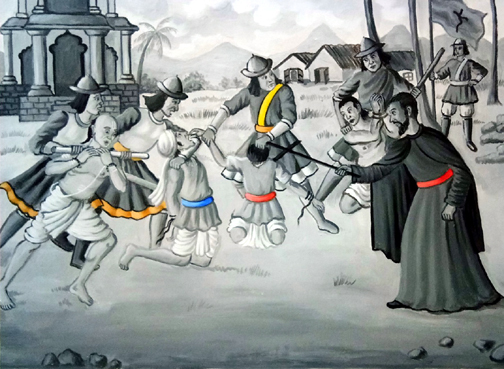
The horrors of the Goa Inquisition remain etched in memory because they were not random acts of violence, but a coldly organized system of torture devised by the church.
- Victims were hoisted by their wrists in the strappado, shoulders tearing apart under their own weight, their limbs were cut off, their eyes gouged out as a punishment for not following the cult of jesus.
- They were stretched on the rack, joints pulled until they snapped.
- Children were dismembered in front of their parents, whose eyes were taped open until they broke under unimaginable psychological torment.
- Women were humiliated, stripped, and tortured, forced to renounce their faith under threats of dishonour and death, their wombs were ripped open killing unborn children.
These were not battlefield killings, not accidents of war. They were deliberate, ritualised cruelties carried out by men who claimed to represent Christ. The inquisitors justified it by arguing that a soul “saved” from Hinduism or Islam—even through torture—was more valuable than a body left intact.
Temples were demolished. Sacred spaces were desecrated. Lands were confiscated. Shrines that stood for centuries were torn down to build churches on their ruins. The Church of St. Francis of Assisi—built atop a destroyed Hindu temple—is not a monument of faith, but of cultural erasure and human torture. For Goans, the Christian God introduced through these means was not a God of love. He was satan, an executioner’s deity—vengeful, merciless, and cruel.
By today’s standards, the Vatican, the Pope, and the Portuguese Crown should be held accountable for their crimes, and India must demand reparations of USD 50 trillion each from both Portugal and the Papacy.
The Government of India should move a parliamentary resolution mandating the restoration of all temples destroyed under Portuguese rule and ensure that the Goa Inquisition is fully documented in school and college history books, just as it has begun correcting distortions that glorified the Mughals.
Further, India should declare the Pope and the King of Portugal persona non grata, revoke recognition of both the Vatican and Portugal, and urge BRICS nations to cut economic ties with Portugal until historical justice is addressed.
Liberation and Western Hypocrisy
In 1961, when India ended 451 years of Portuguese rule in Goa, the Western powers revealed their colonial hypocrisy. The United States, United Kingdom, France, Australia, New Zealand, Spain, apartheid South Africa, and Pakistan condemned India, defending Portugal—a fascist dictatorship and NATO ally. These powers, who preached freedom and decolonization, opposed a colonized people reclaiming their land. Their stance was not about principle but about protecting colonial interests and strategic alliances. Only the Soviet Union blocked anti-India resolutions at the UN. Goa’s liberation thus exposed the West’s double standards: liberty for themselves, subjugation for others. It was India’s defiance, not Western morality, that truly ended colonial rule in Goa.
The Refusal to Apologise
The deepest wound, however, is not only historical—it is ongoing. The Vatican has never issued a direct, unambiguous apology for the Goa Inquisition. Instead, it hides behind vague confessions of “sins of the Church,” carefully avoiding responsibility for the specific crimes committed in Goa. This cowardice reveals the Church’s refusal to confront its own history.
A true apology would mean admitting that the Goa Inquisition was not a mistake but a crime against humanity, that Francis Xavier was not a saint but an architect of oppression, and that the Vatican itself bears responsibility. Until such words are spoken, every gesture of reconciliation remains hollow.
Beyond Goa: A Global Pattern of Christian Cruelty
The Goa Inquisition was not an isolated aberration. It was part of a global pattern in which Christianity—weaponized by the Church—became a tool of colonization, cultural erasure, and genocide.
- Canada and the USA: Indigenous children were ripped from their families and forced into Christian-run residential schools, where they were beaten for speaking their native languages, stripped of their identities, and subjected to systemic abuse. Mass graves of children continue to be discovered—an unending reminder of cultural extermination carried out in the name of Christ.
- Mexico and Central America: The Aztec and Maya civilizations were not just conquered but annihilated by Spanish conquistadors acting under papal bulls. Their temples were destroyed, their books burned, their gods demonized. Forced conversion and enslavement followed, justified as the spread of Christianity.
- South America: The Inca Empire was dismantled under the same model—cross and sword in unholy alliance. Indigenous people were massacred, and their gold plundered, while the Church blessed the slaughter as holy conquest.
- Australia and New Zealand: Aboriginal and Māori peoples were declared “savages” needing salvation. Missionaries stripped them of land, language, and culture, while colonial authorities, guided by Christian doctrines of superiority, carried out policies of extermination and forced assimilation.
- Africa: Christian missions went hand in hand with slave trade and colonization. African spiritual traditions were mocked as witchcraft, and entire societies were restructured under the authority of the Church and empire. Christianity was not spread by love, but by the whip, the chain, and the gun.
Everywhere the pattern was the same: demonize indigenous faiths, destroy their temples, burn their knowledge, seize their land, and impose the cross. The Church did not merely spread religion; it orchestrated a global campaign of cultural genocide, aligned with colonial empires in Europe.
Christianity as a Weapon of Colonialism
The Goa Inquisition exemplifies how Christianity was deployed not as a path to spirituality but as a weapon of domination. The Vatican’s doctrines provided ideological cover for conquest. The Church sanctified greed and brutality by cloaking it in divine mission. Colonizers did not see indigenous peoples as equals. They saw them as heathens to be remade—or exterminated—in the image of Europe.
This weaponization of Christianity continues to echo today. The refusal to apologise for Goa is the same arrogance that allows the Vatican to minimise its crimes elsewhere. It is the same arrogance that justifies missionary aggression in India, Africa, and Asia under the guise of charity, even now.
The Demand for Truth and Justice
The Goa Inquisition stands as a testament not only to the resilience of Hindus who endured it, but to the moral bankruptcy of a Church that refuses to face its past. Until the Vatican explicitly apologises—naming Goa, naming Francis Xavier, naming the specific crimes committed—its so-called repentance is nothing more than theater.
But beyond apology lies something greater: recognition of a global truth. What happened in Goa is part of the same continuum of violence that decimated indigenous peoples across the Americas, Australia, New Zealand, and Africa. It is the same story told in different tongues—the story of how Christianity, allied with the empire, became a machine of oppression.
Memory as Resistance
The history of the Goa Inquisition is not buried in archives. It is alive in the memory of those who survived and in the voices of those who retell it. The Vatican’s arrogance and silence cannot erase it. The monuments built on razed temples cannot sanctify it. And the empty half-apologies cannot heal it.
For Hindus in Goa, the Inquisition is not just history—it is a warning of what happens when faith becomes fanaticism, when a Church claims monopoly over truth, when the Vatican cloaks cruelty in the name of God. For indigenous peoples across the world, it is a shared story of resilience against the Church’s cruelty.
We will remember, we will speak, and we will not allow history to be rewritten by the perpetrators. The Goa Inquisition is not over—it lives as long as the Vatican refuses to face it. The cruelty of the Church is not forgotten—it lives in the graves of indigenous children, in the ruins of destroyed temples, in the stolen lands of entire peoples.
And until the Pope himself acknowledges this truth with humility and courage, the shadow of the Inquisition will continue to haunt the Church, a reminder that its empire was built not on love, but on blood.
Incidentally, the popes themselves have had criminal pasts, so expecting an apology from a pope for christian crimes should not be expected. Throughout history, a number of popes have been accused of or linked to various criminal activities. For example, Pope John XII (955-964) was notorious for his debauchery and violence; he was accused of murder, mutilation, and turning the papal palace into a brothel. Pope Alexander VI (1492-1503), from the infamous Borgia family, was widely known for simony (the selling of church offices), political assassination, and a lavish lifestyle that included mistresses and illegitimate children. More recently, Popes John Paul II and Benedict XVI faced accusations of covering up child sex abuse by clergy members. These instances, among others like raping of nuns, sodomy etc, demonstrate that the papacy has, at times, been intertwined with crimes and corruption, a fact that has led to major scandals and criticism of the Church.