
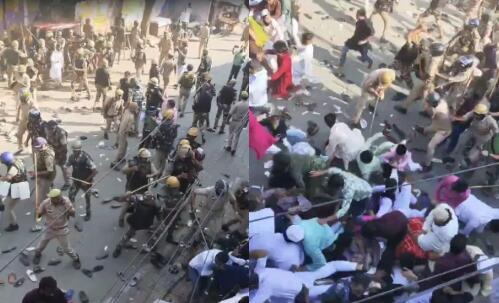
India has always prided itself on being the land of open debate, dialogue, and diverse traditions. Saints, sages, philosophers, and reformers have for centuries expressed their views freely. The Upanishads thrived on questioning, Bhakti saints challenged orthodoxy, and reformers like Swami Vivekananda spoke fearlessly about India’s dharmic identity before the world. But in modern times, this spirit of free expression is under assault. A systematic campaign is being waged by Islamist groups that seek to silence Hindu voices by weaponising religious sensitivities, organising violent protests, and issuing chilling threats under the guise of protecting “faith.” The most recent incidents from Bareilly show how this playbook is being deployed. After Friday prayers, a large crowd carrying placards with “I Love Mohammad” slogans marched into public areas, quickly turning into a mob that pelted stones and clashed with police. What looked like devotion was in fact a show of power aimed at establishing dominance over public spaces.
The same pattern was visible earlier in Kanpur, Sambhal, and even cities outside Uttar Pradesh, where posters and graffiti proclaiming loyalty to the Prophet were forcibly imposed on marketplaces and intersections. Whenever authorities attempted to regulate these acts, mobs erupted in anger, using violence as a weapon of intimidation. The message was unmistakable: any attempt to question or resist would be met with brute force.
This trend is not confined to symbolic displays. It has increasingly morphed into direct threats against Hindu freedom of speech. The most disturbing example came during the Nupur Sharma controversy in 2022. When the BJP spokesperson made remarks during a television debate, Islamist groups erupted in violent protests across multiple states. Instead of countering words with words, mobs took to the streets with calls of “sar tan se juda” – openly threatening beheading as the only punishment for alleged blasphemy. In Udaipur, Kanhaiya Lal, a Hindu tailor, was brutally murdered inside his shop by Islamists who filmed the act and justified it as a defense of the Prophet’s honour. Similar scenes unfolded in Amravati, where pharmacist Umesh Kolhe was killed for supporting Nupur Sharma online. These were not isolated murders; they were political messages delivered through bloodshed to terrorise Hindus into silence.
Maharashtra too saw chilling echoes of the same slogan. In 2023, demonstrations in different towns of the state saw processions raising “sar tan se juda” slogans, openly threatening anyone who dared to speak critically about Islam or its prophet. Yet, little accountability followed. Many of the accused were released quickly, and political parties hesitated to confront the menace for fear of losing vote banks. The silence of the state emboldened these groups, confirming in their minds that violent intimidation was an effective tool to suppress dissent.
The use of blasphemy as a weapon has become a recurring tactic. Across India, whenever a Hindu makes a remark on social media or expresses devotion to Sanatan symbols, cases of “hurt sentiments” are filed. What follows is often mob violence. In Bareilly, the outburst over “I Love Mohammad” placards was accompanied by angry protests against Hindu slogans like “I Love Sanatan.” In Gujarat’s Gandhinagar, Hindus celebrating Garba were attacked after one youth posted “I Love Mahadev” on his account. His shop was burnt, and his family forced into hiding. In each case, Islamist groups projected even simple affirmations of Hindu faith as provocations, responding with violence meant to instill fear.
This climate of intimidation has one goal: to create a chilling effect where Hindus hesitate to speak freely about their gods, their dharmic identity, or even political opinions concerning Islamist radicalism. By threatening bloodshed, radicals attempt to curb constitutional freedoms. What is alarming is the tacit success of this strategy. Many Hindu voices, from students to journalists to common citizens, often delete posts, issue apologies, or avoid commenting on sensitive issues for fear of reprisals. The Indian state, instead of fully confronting this radicalism, has sometimes appeared hesitant, caught between law and order concerns and political appeasement.
The economic and social cost of this intimidation is also severe. Riots triggered by blasphemy controversies destroy markets, businesses, and livelihoods. In Kanpur, Bareilly, and other towns, stone pelting and arson led to immense property damage, forcing traders to shut their shops. Fear of violent eruptions hangs over festivals, with police often having to impose curfews or restrict Hindu processions while Islamist groups test limits with their demonstrations. The asymmetry is stark: Hindus are told to exercise “restraint,” while radical slogans and threats are tolerated in the name of minority rights.
It is important to understand that this is not about religion itself but about political power. Historically, radical groups have used blasphemy as a rallying cry to mobilise masses. In Pakistan, mere accusations have led to lynchings and mob killings. That same mindset is now visible in India. When mobs chant “sar tan se juda,” they are not expressing devotion; they are delivering a political warning to the majority – that Islamists will dictate what can and cannot be said in the public sphere. This is nothing less than an assault on the sovereignty of the Indian state.
But history also shows that intimidation cannot silence India forever. The same land where Aurangzeb destroyed temples is the land where Ram Mandir now stands. The same country that endured centuries of invasions is the one where saints like Guru Tegh Bahadur gave their lives defending freedom of worship. Today, slogans like “I Love Sanatan” and “I Love Mahadev” are rising as counter-voices to remind that Hindus will not be cowed down.
The state must recognise that freedom of speech is non-negotiable. Appeasement of violent groups only fuels their ambitions. Firm action is needed against those who threaten violence in the name of blasphemy, be it through street protests, social media threats, or actual killings. India’s democratic fabric rests on the ability of every citizen to speak without fear, whether about their faith, their politics, or their identity.
The battle playing out in Bareilly, Kanpur, Udaipur, Amravati, and Maharashtra is therefore not just about local disputes. It is about whether India remains a free nation where speech cannot be censored by mob fury. Islamist groups are testing the state, warning it to be fearful of their anger. The answer must be clear: the Indian state bows to no mob. It stands with Sanatan values of tolerance, freedom, and truth. Because in the end, no matter how many times radicals shout “sar tan se juda,” the deeper voice of India will always reply with “Sanatan is eternal.”