
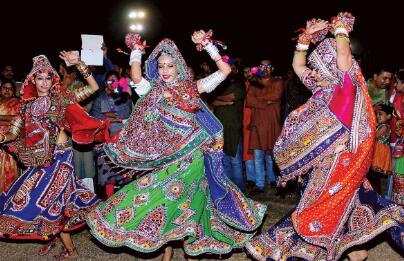
A peaceful Garba celebration in Bahiyal village of Dehgam municipality in Gandhinagar district of Gujarat turned into a nightmare on Wednesday, September 24, when a large mob launched a violent attack on Hindu devotees. The spark for the violence was reportedly a social media post by a Hindu youth declaring “I Love Mahadev.” What followed was a shocking display of intolerance and brutality. According to eyewitness accounts, thousands of armed individuals stormed into the village, vandalising shops, torching vehicles, and pelting stones at Hindus gathered for the Garba festivities. Women participating in the event were not spared, and even police personnel who attempted to bring the situation under control were targeted. Two police vehicles were set ablaze, forcing officers to resort to tear gas to disperse the mob.
The violence had a selective and targeted nature. Hindu owned shops and establishments were deliberately attacked while those belonging to Muslims were left untouched. One shopkeeper, whose business was destroyed, estimated losses of around ten lakh rupees. “We saw shops being set on fire but nobody could gather the courage to resist since the mob was in thousands,” he said.
Temples too were not spared. Attackers desecrated the Mahadevji temple, stealing the donation box, and also targeted the Ambe Mata temple. Eyewitnesses recalled hearing chants of “I Love Muhammad” as the mob carried out the violence, directly mocking the Hindu youth’s original post that had triggered the incident. Authorities have since deployed two companies of the State Reserve Police Force along with two hundred police personnel in the area. District Magistrate and senior officials visited the village to review the situation. SSP Ayush Jain confirmed that at least four shops were set ablaze, several vehicles were destroyed, and about sixty arrests had been made so far. Investigations are ongoing.
This eruption of violence in Gujarat follows a disturbing trend of “I Love Muhammad” demonstrations in Uttar Pradesh, Uttarakhand, Maharashtra and other states in recent weeks, often escalating into communal clashes. The Gandhinagar incident is not an isolated one but part of a disturbing pattern where Hindu religious festivals are marred by violence. Over the past few years, Ram Navami processions across states like West Bengal, Jharkhand and Bihar have been repeatedly attacked with stone pelting mobs. Idols of Maa Durga have been desecrated in various parts of the country during Navratri. Even during Hanuman Jayanti processions, reports of clashes and deliberate targeting of Hindu groups have surfaced time and again.
A common thread runs through these incidents. Hindu festivals that are meant to be occasions of joy, devotion and community bonding often end in chaos and suffering for the devotees. Rather than being allowed to celebrate freely, Hindus find themselves at the receiving end of targeted aggression.
One of the most controversial aspects of Navratri celebrations in recent years has been the deliberate attempt to infiltrate Garba events by groups of young Muslim men. Garba is not just a cultural dance but a deeply devotional act dedicated to the worship of Maa Durga. It is inseparable from the spiritual essence of Navratri. Yet, in the name of secular participation, there have been repeated efforts to allow young Muslim boys entry into these events.
The intent, as many Hindu organisations and families have pointed out, is not devotion but disruption. These boys, who do not worship Maa Durga, enter the celebrations with ulterior motives, luring Hindu girls, making them uncomfortable, and at times leading to dangerous incidents of harassment. This is not a matter of interfaith harmony but of deliberate cultural encroachment.
The Gandhinagar violence has only reinforced these concerns. What began as a cultural and religious festival turned into a communal flashpoint. The mob not only attacked devotees but also temples, openly mocking the sanctity of the occasion. This raises a serious question. Why should Hindu religious spaces and festivals be turned into arenas for confrontation.
Part of the problem is the way Islamist groups and sections of the Leftist ecosystem attempt to frame such incidents. Whenever Hindus raise concerns about security at their religious events, they are quickly dismissed as communal or intolerant. Demands to restrict Garba to genuine devotees are painted as exclusionary. Yet, the harsh reality is that these so called inclusive gestures often pave the way for violence.
The slogans of “I Love Muhammad” heard during the Gandhinagar violence were not just provocative but a direct challenge to the Hindu assertion of devotion to Mahadev. They reflect how Islamist radicalisation uses religion as a weapon to intimidate and humiliate Hindus. The Leftist denial of these patterns only emboldens such forces further.
The recurring attacks on Hindu festivals are not merely law and order issues but questions of civilisational integrity. Every time a Ram Navami procession is stoned, every time a Maa Durga idol is desecrated, and every time Garba celebrations are disrupted, the Hindu community is reminded of its vulnerability. The state must step in firmly to safeguard Hindu festivals. Strict vetting at Garba venues, harsher penalties for rioters, and proactive protection of temples are urgent needs. Equally important is social awareness. Hindus must remain vigilant against attempts to infiltrate, distort or disrupt their festivals. Navratri and Garba are meant to celebrate the triumph of Maa Durga over evil. To allow these celebrations to be marred by violence is a betrayal of that very spirit. The Gandhinagar violence should be a wake up call. Hindus must not be made to suffer in their own homeland, at their own festivals, in front of their own temples.