
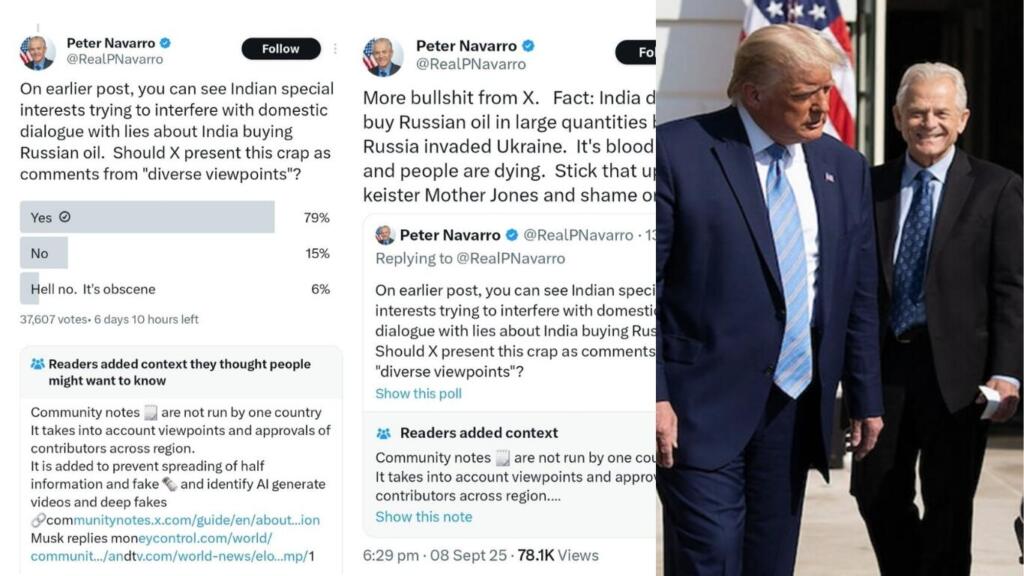
When cornered by facts, Western propagandists often resort to theatrics. Peter Navarro, US President Donald Trump’s trade adviser, has once again shown how double standards dominate Washington’s narrative. After being repeatedly fact-checked on his anti-India claims, Navarro turned his anger toward the BRICS alliance, calling its members “vampires.” His meltdown came after a humiliation on X (formerly Twitter), where Community Notes exposed his lies about India’s oil imports from Russia. Now, instead of addressing his own misinformation, Navarro is lashing out at India, China, Brazil, and Russia, claiming the bloc is doomed. But beneath the noise lies a classic case of frustration disguised as diplomacy.
Navarro’s Old Rhetoric: India as the “Maharaja of Tariffs”
Peter Navarro has long carried a grudge against India’s independent trade policy. In his recent tirade, he accused New Delhi of being the “Maharaja of tariffs,” insisting that India imposes the highest trade duties against the United States. He even threatened that “it won’t end well for India” if it does not fall in line with Washington’s trade expectations. But this claim conveniently ignores how the US itself shields its markets with subsidies, barriers, and tariff walls when it suits American industries.
Navarro’s arguments also exposed his selective memory. While the US routinely presses its economic dominance through sanctions and trade restrictions, it expects developing economies like India to bow down and play by American rules. In reality, India’s tariffs are a measure of protecting domestic interests and ensuring level competition. Yet, in Navarro’s rhetoric, they become “unfair practices.” Such double standards have become the cornerstone of his attacks against India.
The Russian Oil Lie and the Community Notes Blowback
Perhaps the most glaring example of Navarro’s misinformation campaign was his claim that India never imported Russian oil before the Ukraine war and was now profiteering at America’s expense. The truth, as even US officials have admitted, is far more nuanced. India increased its oil imports from Russia only after Western nations imposed sanctions and capped Russian crude prices at $60 per barrel. By buying discounted oil, India ensured its own energy security while stabilizing global supply chains.
Navarro’s attempts to portray this as profiteering collapsed when fact-checkers and X’s Community Notes corrected his statements. The public humiliation deepened when he ran a poll to rally support for his claims only to see 75% of voters reject his narrative. Instead of reflecting on his mistakes, Navarro lashed out, accusing Indian “special interests” of manipulating American discourse. This baseless charge was no different from his earlier divisive comment about “Brahmins profiteering,” an ugly attempt to stoke caste divisions in India.
The meltdown showed one thing clearly: Navarro cannot digest the fact that India’s foreign policy is working in its favor, while Washington’s pressure tactics are losing steam.
The “Vampire” Remark: Attacking BRICS Out of Frustration
Cornered and exposed, Navarro turned his ire toward the BRICS alliance. Calling its members “vampires sucking America’s blood dry,” he dismissed the grouping as doomed because “historically they all hate each other.” He ridiculed Russia-China ties, mocked India’s border tensions with China, and jeered at Brazil’s economy. Such remarks revealed less about BRICS and more about Navarro’s anxiety over America’s waning influence.
What he ignores is that BRICS has grown precisely because nations are tired of one-sided, US-dominated structures. India, under Prime Minister Narendra Modi, has skillfully used BRICS as a platform to push for multipolarity, alternative trade mechanisms, and south-south cooperation. Unlike Navarro’s caricature, BRICS today represents the voice of emerging economies demanding fairer terms in global governance. His “vampire” insult only shows how rattled Washington is by the bloc’s growing clout.
Double Standards in American Rhetoric
The contradictions in Navarro’s tirade are glaring. On one hand, he boasts that countries like Japan, South Korea, and the EU are signing “great trade deals” with the US. On the other hand, he admits Washington has imposed over 50% tariffs on China and routinely pressures Europe to cut energy deals with Russia. If high tariffs and protectionism are America’s right, why are India’s trade safeguards vilified?
Even more telling is his claim that BRICS cannot survive without selling to the United States. This statement reeks of colonial-era arrogance. India and other BRICS nations are increasingly diversifying their markets, strengthening intra-bloc trade, and exploring alternative payment systems. The very fear that Navarro expresses that the world is moving away from America’s economic orbit explains his bitterness.
India Will Not Be Lectured
Navarro’s outburst is not just a personal meltdown it is symptomatic of Washington’s struggle to accept a multipolar world. By calling BRICS a “failed alliance” and threatening India, Navarro only highlights America’s insecurity about losing its monopoly over global trade and diplomacy. India, however, remains firm in charting its independent course, balancing relations with Russia, the US, and other partners.
Navarro’s rhetoric may win him applause in echo chambers, but facts on the ground tell another story: India is no longer a pushover. BRICS is not a “vampire club” but a rising force in global economics. And as long as figures like Navarro continue to cry wolf, the gap between American perception and global reality will only widen.