
India hit out at Pakistan at the United Nations Human Rights Council on Tuesday and attacked the neighbouring country by saying that it bombs it own citizens and exports terror to cause instability globally.
Indian representative at the UNHRC, diplomat Kshitij Tyagi accused Pakistan of abusing the UNHRC forum with baseless and provocative statements against India.
Speaking during the Agenda Item 4 of the UNHRC session, Tyagi said, “A delegation that epitomises the antithesis of this approach continues to abuse this forum with baseless and provocative statements against India.”
The diplomat further said, “Instead of coveting our territory, they would do well to vacate the Indian territory under their illegal occupation and focus on rescuing an economy on life support, a polity muzzled by military dominance, and a human rights record stained by persecution (and) perhaps once they find time away from exporting terrorism, harbouring UN-proscribed terrorists, and bombing their own people.”
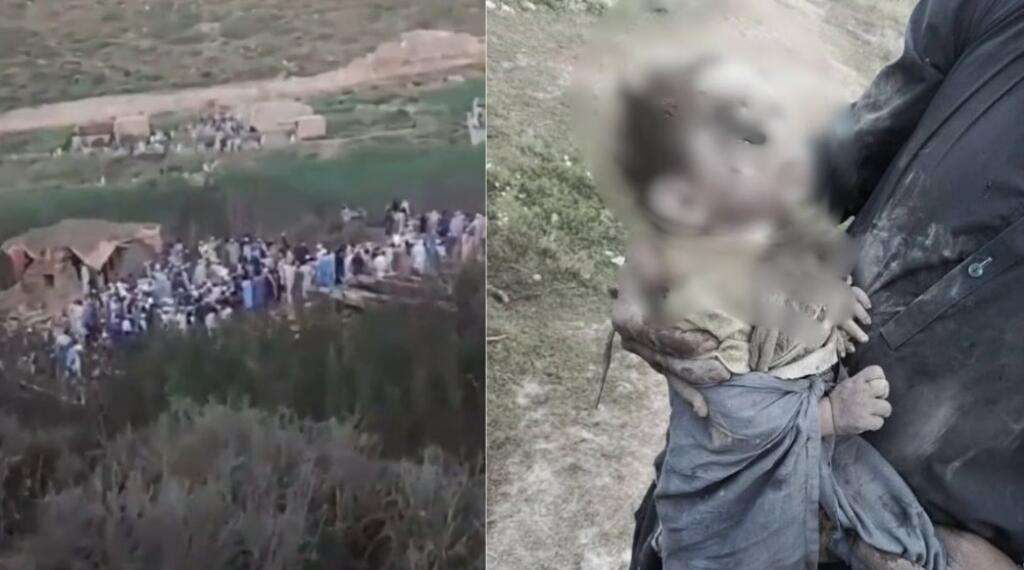
This comes two days after a devastating military operation conducted by the Pakistan Air Force in Khyber Pakhtunkhwa province resulted in the deaths of at least 30 civilians, including women and children.
The airstrike was conducted in the early hours of Monday when Pakistani fighter jets JF-17 dropped eight LS-6 bombs on the Matre Dara village.
A report by DD News said that 30 people, including women and children, were killed in that attack. It also said that disturbing images of civilian bodies strewn about were seen in the aftermath of the strikes.
Earlier, Amnesty International had also criticised Pakistan’s counter-terrorism operations in Khyber Pakhtunkhwa and described these operations as an “alarming disregard for civilian life.”
Eyewitnesses claimed that several houses collapsed and the bodies were pulled out of rubble after the alleged air strikes by the PAF.
The roots of insurgency in Pakistan’s Khyber Pakhtunkhwa and the former Federally Administered Tribal Areas (FATA) trace back to the early 2000s, when Al-Qaeda and Taliban fighters crossed into Pakistan to escape the US-led invasion of Afghanistan in 2001.
Seeking sanctuary across the porous Durand Line, these militants laid the groundwork for a violent insurgency that would escalate in the years to come.
By 2007, the formation of the Tehrik-i-Taliban Pakistan (TTP) under Baitullah Mehsud transformed the tribal belt into a stronghold of extremism, with frequent attacks targeting both security forces and civilians.
In response, the Pakistani military launched major counterinsurgency operations—including Operation Zarb-e-Azb in 2014 and Operation Radd-ul-Fasaad in 2017—claiming significant gains in dismantling militant networks.
However, recent developments suggest those gains may be unraveling. Following the Taliban’s return to power in Afghanistan in 2021, the TTP has regained momentum. According to a 2023 BBC report, the group has ramped up its activities in key areas such as Khyber, Bajaur, and Waziristan.
Security analysts, including Michael Kugelman of the Wilson Center, warn that insurgents have seized the initiative in several border districts. Despite substantial troop deployments, the Pakistani Army now faces mounting challenges in reasserting control over these volatile regions.