
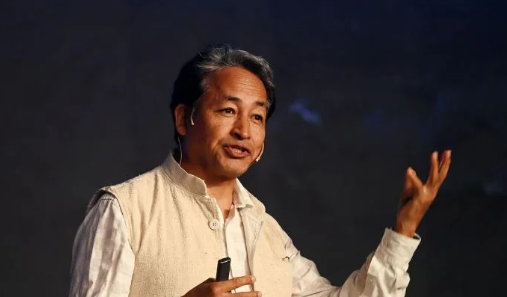
Ladakh, often celebrated for its serene landscapes and Buddhist monasteries, witnessed an unprecedented wave of anger and violence in Leh this week. In the first such incident during the ongoing statehood agitation, hundreds of protesters clashed with the police in Leh city, pelting stones, vandalizing property, and even burning down a police vehicle. The protest, which coincided with a complete shutdown and hunger strikes across the region, reflects the growing frustration among Ladakhis over the Centre’s refusal to grant statehood and constitutional safeguards. At the center of this agitation is Sonam Wangchuk, the engineer turned activist who has become the face of Ladakh’s protests. The violent outburst took place against the backdrop of upcoming talks between Ladakhi representatives and the Government of India, scheduled for October 6. The clashes are being seen as an attempt to mount pressure on the Centre after years of failed negotiations.
The demand for statehood and inclusion under the Sixth Schedule has been simmering since Ladakh was carved out as a Union Territory in August 2019, following the abrogation of Article 370 and the bifurcation of Jammu and Kashmir. At that time, many residents of Leh, including prominent activist Sonam Wangchuk, had welcomed the change. But within a year, optimism gave way to unease as Ladakhis began to feel the absence of an elected legislature, which they say has created a political vacuum under the Lieutenant Governor’s administration.
The statehood movement has gained strength as diverse groups from both Leh and Kargil set aside differences to unite under two umbrella platforms, the Apex Body of Leh and the Kargil Democratic Alliance. These groups, supported by religious and political leaders, have staged hunger strikes, marches, and mass protests to press their demands. In March, Ladakhi leaders met Union Home Minister Amit Shah in Delhi. But the talks collapsed when, according to NDTV, Shah reportedly rejected their demand for statehood and the Sixth Schedule. A leader present at the meeting even quoted the Home Minister as saying that carving Ladakh out as a Union Territory had been a mistake.
Sonam Wangchuk has been on multiple hunger strikes over the past two years and was recently detained by Delhi Police at the Singhu border while attempting to march to the capital with his supporters. His demand is straightforward: grant Ladakh statehood and protect its land, culture, and resources by bringing it under the Sixth Schedule of the Constitution. But the question arises, who really is Sonam Wangchuk, and does his activism truly serve Ladakh, or is there more to the story?
The Other Side of Sonam Wangchuk
While media often portrays Sonam Wangchuk as a visionary education reformist and climate activist, there are aspects of his career and associations that remain under-explored. His journey is filled with foreign connections, generous funding from global foundations, and political patronage that raise legitimate concerns. Unlike the image projected in popular culture, Sonam Wangchuk does not come from a humble background. His father, Sonam Wangyal, was a Congress leader and minister in the Jammu and Kashmir government. Far from being an outsider, Sonam Wangchuk grew up in an influential political household with access to networks of power.
In 1988, Sonam Wangchuk founded the Students Educational and Cultural Movement of Ladakh, and later Operation New Hope in 1995. These initiatives, while celebrated, were heavily funded by the Ford Foundation, Tata Trusts, Dan Church Aid, and other foreign organizations. This consistent foreign support has led many to question whether his activism is genuinely grassroots or largely donor driven.
A turning point in his life was his marriage to Rebecca Norman in 1996, an American citizen educated at Harvard University and the School for International Training. The School for International Training is an institution with deep ties to the US State Department and is funded by organizations like the Ford Foundation, George Soros’s Open Society Foundation, and the Bill and Melinda Gates Foundation. Rebecca Norman’s academic and political leanings, she has been an open supporter of President Joe Biden and critic of Donald Trump, further underline the foreign ideological currents surrounding Sonam Wangchuk’s life.
After this marriage, Sonam Wangchuk’s access to global recognition and foreign grants accelerated. In 2002, he was awarded the Ashoka Fellowship funded by the Skoll and Rockefeller foundations. By 2004, when Manmohan Singh became India’s Prime Minister, Sonam Wangchuk enjoyed unprecedented political patronage. He was appointed to the drafting committee of the Ladakh Vision 2025 document, formally launched by Singh himself in 2005. Later, Sonam Wangchuk served as an education advisor to a Danish NGO, further deepening his international links.
The Congress era proved especially fruitful for Sonam Wangchuk. In 2005, he was inducted into the National Governing Council for Elementary Education under the Ministry of Human Resource Development. Around this period, Congress also signed a controversial memorandum of understanding with China, raising suspicions about the party’s approach toward sensitive border regions like Ladakh.
Popular perception of Sonam Wangchuk is shaped by the Bollywood blockbuster “3 Idiots,” where Aamir Khan’s character Rancho was allegedly based on him. However, the truth is less romantic. The film was actually based on Chetan Bhagat’s novel “Five Point Someone,” and only later did a section of the media begin linking the character to Sonam Wangchuk. This narrative helped project him as a genius innovator, but in reality, the connection was tenuous at best.
From 2016 onward, Sonam Wangchuk’s global recognition soared. He won the International Fred M Packard Award in 2016, the TN Khoshoo Memorial Award in 2017, and the Ramon Magsaysay Award in 2018. While these accolades bolstered his reputation, they also highlighted his ties to international organizations often criticized for advancing Western strategic interests in developing nations. The Ford Foundation, which has funded many of the organizations connected to Sonam Wangchuk, has a long history of involvement in India’s political and social movements.
Sonam Wangchuk’s association with NGOs like LEAD India and the International Association for Ladakh Studies, both supported by foreign funding, further raises concerns. His climate project Ice Stupas, while praised abroad, faced criticism from locals who questioned its long-term sustainability.
Sonam Wangchuk initially welcomed the abrogation of Article 370 and Ladakh’s new Union Territory status. But he later criticized the move, demanding statehood and Sixth Schedule protections. This reversal allowed Pakistan to exploit his statements to question India’s policies in Ladakh. His recent calls to halt army infrastructure projects in the region, citing environmental concerns, have also sparked unease, given Ladakh’s sensitive position on the India-China border.
The violence in Leh is a stark reminder of Ladakh’s growing frustration with New Delhi. While the people’s demand for representation and safeguards deserves attention, it is equally important to scrutinize the individuals leading these agitations. Sonam Wangchuk is not just a local activist but a figure with deep foreign ties, political patronage, and shifting positions that raise valid questions. As Ladakh heads into another round of talks with the Centre, the people’s aspirations for dignity and self-rule must be respected. But India must also remain alert to the possibility of external forces and narratives influencing this fragile border region.