
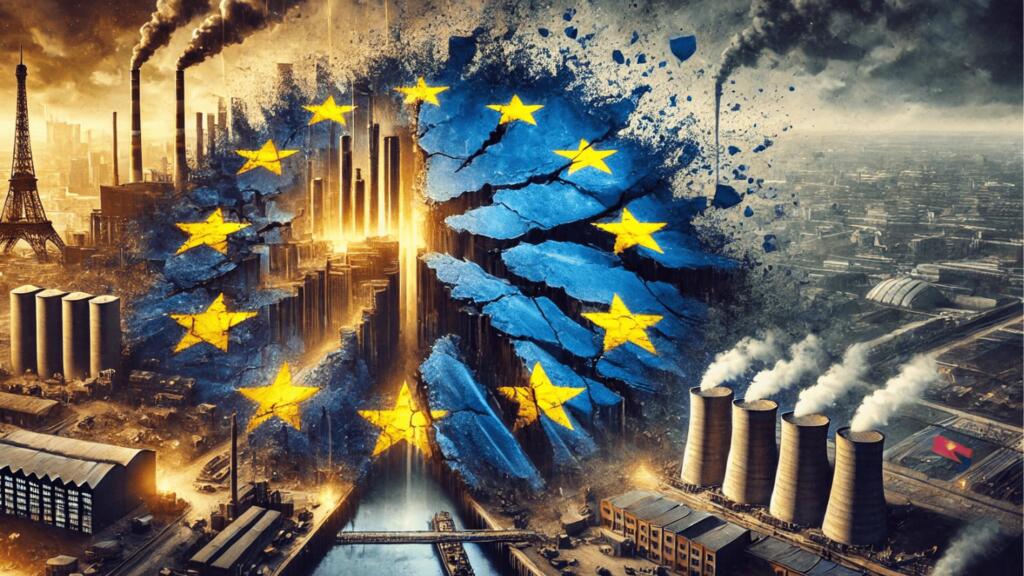
Europe stands on the edge of collapse—its debts unpayable, its currencies rigged, its industries hollowed, and its societies fractured by mass immigration and cultural surrender. Once colonial exploiters, now dependent, divided, and decaying, Europe drags NATO and the West down with it. What lies ahead is not revival but disintegration, as the Global South rises and Europe becomes history’s warning, not its leader. Consequently, India needs to be very careful about doing any business with Europe.
A Continent in Freefall
Europe today stands at the edge of a systemic unraveling. What we are witnessing is not a cyclical downturn or a temporary crisis, but the exposure of deep structural rot that has long been concealed by colonial plunder, American backing, and the illusion of unity. The end of transatlantic predictability, the assertiveness of the Global South, and Europe’s own hollowed-out industrial and demographic base are converging into a perfect storm.
The continent that once thrived on colonial exploitation now faces retaliation in the form of economic decolonisation, supply refusals, and mounting calls for reparations. The comfortable postwar decades, fueled by U.S. protection and cheap resources, are over. Europe’s future is not one of graceful decline—it is one of fragmentation, poverty, and geopolitical irrelevance.
America Turns the Knife – Trump’s New Order
Europe’s greatest external shock comes not from rivals, but from its supposed ally, the United States. Under a second Trump administration, Washington has abandoned all pretenses of partnership. What was once sold as a “shared values” alliance has been stripped down to a naked, zero-sum game where Europe is nothing more than a captive market and strategic vassal.
A 15% blanket tariff on European goods—unthinkable a decade ago—has been imposed, striking at the heart of the continent’s export economy. Cars, pharmaceuticals, semiconductors—all made more expensive and uncompetitive. The UK fares even worse under its separate deal, facing punitive 25% tariffs on steel, aluminum, and vehicles. These are not simple trade adjustments; they are acts of economic warfare, designed to shatter Europe’s industrial backbone while binding it to American energy and investment demands.
Europe is forced to buy $750 billion in U.S. LNG, oil, and nuclear products and to funnel $600 billion into American industries. In effect, Washington has chained Europe’s energy future and industrial investments to its own soil, reducing Brussels to the status of a client. The EU may dress these commitments up as “non-binding,” but Washington interprets them as firm promises. The message is clear: Europe is no longer a partner—it is a subordinate.
This shift unleashes uncertainty across the entire global system. Multilateral rules, once Europe’s shield, are being discarded. The predictability that underpinned decades of Euro-American prosperity is dead. What replaces it is volatility, weaponized tariffs, and American leverage at every turn.
The Global South Strikes Back – Economic Decolonisation
While the U.S. bleeds Europe through trade, the Global South is cutting off its historical lifeline: cheap raw materials. Africa, long plundered to feed European industries, has awakened. The African Union’s “Green Minerals Strategy” is not just a development plan—it is a declaration of independence. Lithium, cobalt, rare earths, manganese, copper—Africa will no longer export them as raw ores to European factories. Processing, beneficiation, and value-addition will now happen on African soil.
This is a strategic revolution. For centuries, Europe grew rich by extracting African wealth at bargain rates, leaving behind poverty, instability, and environmental destruction. Now, African nations are uniting under resource nationalism, rejecting conditional European deals, and aligning with BRICS+, China, and other South-South partners. Infrastructure-for-minerals swaps with Beijing, preferential supply chains within BRICS+, and harmonized tariffs under AfCFTA are locking Europe out.
The implications are catastrophic for Brussels. Without African cobalt and lithium, Europe’s dreams of a green transition collapse. Without rare earths, its clean energy industries and EV ambitions shrivel. Worse, Europe now faces active competition—Chinese firms undercutting EU suppliers, BRICS+ financing offering better terms, and Global South governments openly discussing reparations for centuries of European plunder.
Europe is not only losing access to resources—it is being forced to confront its colonial past as a present liability. The very regions it once exploited now demand payment, not partnership.
Europe’s Internal Rot – The House Divided
Even without external shocks, Europe is crumbling from within. Its economies are “sinking,” not in a dramatic crash, but in a grinding, relative decline. Growth lags at 1% while Asia grows at over 3%. The EU economy is projected to grow by only 1.1 percent in 2025 and 1.5 percent in 2026, with the euro-area at 0.9 percent in 2025 and 1.4 percent in 2026—down from previous forecasts of 1.3 percent and 1.6 percent, respectively.
Its demographic base is collapsing—fewer workers, more dependents, soaring pension burdens, and an aging, immobile workforce. Immigration could offer relief, but rising far-right politics and anti-immigrant hysteria make that solution politically impossible. By 2050, 22 out of 27 EU countries will see a declining working-age population; the share aged 85+ will more than double, from ~3% to ~6% by 2050.
Meanwhile, Europe has forfeited its competitive edge. For example, the EV market, once touted as Europe’s future, has been conquered by China. European innovation has flatlined—its tech sector relies on U.S. AI models and cloud systems, its EV industry on Asian supply chains, and its energy sector on Russian gas. Decades of underinvestment, austerity, and complacency have hollowed out the continent’s ability to compete in the industries of tomorrow.
Add to this the crushing costs of war. Europe’s reckless entanglement in Ukraine has bled it dry—energy crises, inflation, defense spending commitments draining budgets, and a euro weakened by overexposure.
The Circular Loop of Decline
The crisis is not a collection of isolated challenges—it is a circular loop spiraling downwards. U.S. tariffs weaken exports. African resource nationalism strangles supply chains. Rising Asian competitors seize Europe’s markets. Internal stagnation prevents recovery. War expenses drain public coffers. Demographics tilt further against sustainability.
Europe’s crises are self-reinforcing. Stagnant growth kills innovation, lost competitiveness breeds poverty, poverty fuels extremism, and extremism splinters the EU. The same colonial strategy Europe once used—impoverish and loot—now boomerangs upon itself.
Fault lines are widening: north versus south, east versus west, rich versus poor. What was sold as a grand project of integration was doomed from inception, something like what India or the USA did, has failed miserably—today it survives only as a bureaucratic shell, not a union of solidarity.
History warns: Spain’s 16th-century fall. Bloated by colonial bullion, it overspent on wars, hollowed its economy, and faded into irrelevance. Europe marches the same path—propped on debt, distracted abroad, blind at home. Already, Britain and France, the two big economies, edge toward IMF bailouts and Germany is in tatters, exposing Europe’s descent into a slow, humiliating collapse.
The World Without Europe
What does Europe’s decline mean for the world? The consequences will be brutal for Europeans themselves:
- Geopolitical fragmentation as EU states prioritize national survival over Brussels’ diktats. Even internal regional and ethnic separatist movements will be emboldened.
- Rising poverty and unemployment as industries collapse under tariffs and supply shortages. In 2024, 21 percent of people in the EU are at risk of poverty or social exclusion, with public debt already at 82 percent of GDP, projected to rise to ~84.5 percent by 2026.
- Decline in exports as Europe loses competitiveness to Asia, Africa, and Latin America. EU exports are expected to grow by only 7 percent in 2025, accelerating modestly to 2.1 percent by 2026.
- Food and energy insecurity as suppliers increasingly prioritize domestic needs or demand premium prices.
- Global isolation as nations bypass Europe in favor of multipolar South-South alliances.
- Reparations demands from Africa, Asia, and the Caribbean, no longer muted but central to global diplomacy.
The wider world will adjust. Supply chains will reroute through BRICS+, ASEAN, and India. Markets will gravitate toward younger, dynamic economies. Strategic influence will concentrate in Asia and the Global South. Europe, once the center of the world, will become a peripheral museum piece—wealthy only in memory, not in reality.
India’s Business with Europe
India is on the cusp of finalizing a free trade agreement (FTA) with Europe—a move that could reshape its export trajectory. In 2023–24, bilateral trade in goods between India and the EU reached $137.5 billion, marking nearly a 90% increase over the past decade. The EU accounts for approximately 12% of India’s total trade. However, growing economic fragmentation in Europe signals formidable risks.
Key Risks & Strategic Precautions for India
- Overdependence on Europe
Even as Europe remains a major market, India should cap EU exposure—ideally keeping it under 15% of export volume. Simultaneously, push forward with FTAs or expanded trade via BRICS+, ASEAN, Africa, and others to ensure alternative avenues. - Safeguard and Escape Clauses
Ensure the FTA includes real-time provisions like “snap-back” tariffs or escape clauses if the EU imposes sudden unilateral measures—such as carbon border adjustments or unilateral quotas. - Secure Settlement Mechanisms
As Europe faces potential debt or banking turbulence, India should negotiate INR–Euro swap mechanisms or use gold based mechanisms, escrow arrangements, or sovereign-backed payment guarantees to protect exporters. - Phase-in of Environmental and Carbon Rules
Climate-related EU tariffs—like the forthcoming CBAM—could crush Indian steel or cement exports. India must seek long grace periods (10–15 years) before these taxes apply fully and consider developing its own countermeasures. - Avoid Flooding by Subsidized EU Agricultural Goods
EU farm subsidies are staggering (over €50 billion under CAP). India should demand phased tariff reductions, protecting farmers and shielding critical sectors like dairy and grains from sudden competition. - Safeguard SMEs and Services Exports
Ensure the FTA has stringent IP and data provisions that allow Indian IT, pharmaceuticals, and services to compete. Avoid hidden non-tariff barriers like invasive certification or localization rules. - Mitigate Demand Collapse in Europe
With rising poverty and aging populations in Europe, reducing buying power, threatening consumption, India should pivot to essentials—pharma, medical devices, engineering goods—and not solely luxuries. - Leverage Geopolitical Bargaining Chips
Link the FTA to wider strategic cooperation—on issues like defense, digital governance, and India’s Indo-Pacific role—to avoid becoming a mere supplier in a fading European market.
India needs to embed these strategic safeguards, and by diversifying its trade portfolio, India can turn its FTA with the EU into a bridge for growth, not a liability in the face of Europe’s looming economic unraveling.
Scenarios for Europe’s Future
Europe faces two stark paths:
- Painful Reform.
A nearly impossible scenario requiring unity, deep restructuring, massive R&D investment, and genuine partnerships with the Global South built on equality, not arrogance. This will require at least 3 generations. - Managed Decline.
The likelier path—failing to adapt, losing markets, fragmenting internally, and slipping into second-tier status. Europe would become a buffer zone between American and Asian powers, a battleground rather than a power broker.
Conclusion: Reckoning With Hubris
Europe’s fall is not an accident—it is the inevitable outcome of centuries of plunder, complacency, and arrogance. The colonial model bred dependency and lethargy, and the postwar order insulated Europe from hard choices. Now both crutches are gone. The U.S. treats Europe as a captive, the Global South rejects its exploitation, and Asia outcompetes it.
The coming decades will not be kind to Europe. Poverty, irrelevance, and humiliation await unless it confronts its failures and reinvents itself. History is merciless: those who refuse to adapt are not remembered as leaders—they are remembered as ruins.