
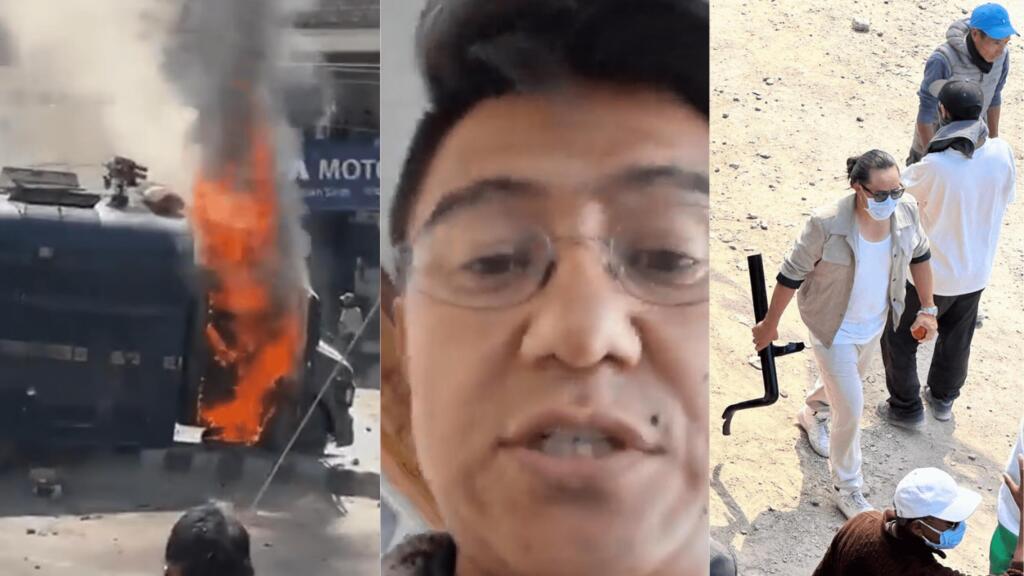
Ladakh, which has long been celebrated for its peace and serenity, witnessed one of its worst outbreaks of violence on 24th September 2025. A shutdown call given by the Leh Apex Body’s youth wing spiralled into chaos as mobs clashed with security forces, torched vehicles, and even set the BJP office in Leh on fire. The violence, which broke out in the name of demanding statehood and Sixth Schedule protections for Ladakh, has now taken a political turn, with BJP directly accusing Congress councillors of leading and instigating the mob. What unfolded in the heart of Leh was not merely spontaneous unrest but a politically charged incident that has left behind a trail of destruction, casualties, and deep divisions.
Congress councillor, Smanla Dorjey Norbu, was seen recording a provocative video during the protests, inviting more youth to come onto the streets. This has further raised suspicions that the violence was not merely spontaneous outrage but had direct political instigation from the Congress
The Role of Congress Councillors in the Clashes
While the agitation was projected as a people’s movement, disturbing visuals and reports quickly revealed the active involvement of Congress leaders. BJP IT Cell Chief Amit Malviya accused Phuntsog Stanzin Tsepag, a Congress councillor from Upper Leh Ward, of not only joining the mob but also leading it. Malviya alleged that Tsepag was clearly visible instigating the crowd that eventually set the BJP office and Hill Council premises on fire.
BJP has called it not just “Congress-sponsored violence” but “Congress’s violence,” pointing out the party’s desperation to create chaos in a region that has otherwise been peaceful since its separation from Jammu and Kashmir in 2019.
Even as these accusations surfaced, Sonam Wangchuk, the face of the ongoing protests, attempted to defend the Congress, saying the party did not have the influence to mobilize thousands of youths. Yet, the evidence of local Congress councillors actively fuelling the mob makes it difficult to dismiss BJP’s charge.
Wangchuk’s Narrative
Sonam Wangchuk, who has been spearheading the statehood agitation for over five years, described the unrest as a “Gen-Z revolution.” He argued that the younger generation’s frustration with the Centre’s inaction over Ladakh’s demands was behind the violent turn of events. According to him, the hospitalisation of two elderly hunger strikers became the immediate trigger for the youth to storm the streets.
However, Wangchuk’s attempt to shift the blame onto Gen-Z has been met with scepticism. The Same Sonam Wangchuk had earlier welcomed the idea of giving the UT status to Ladakh. Critics argue that by glorifying the unrest as a youth revolution, he was trying to cover up his own inability to maintain the peace during the protests. His 15-day hunger strike also ended abruptly after the violence, with him claiming that “peaceful protests had failed today.” His statements, however, inadvertently lent justification to the mob’s actions, further complicating the situation.
How the Violence Escalated in Leh
According to eyewitness accounts, the tension began simmering late on Tuesday when two elderly hunger strikers collapsed at the protest site and had to be rushed to the hospital. Their deteriorating condition sparked outrage among students and youth activists. On Wednesday morning, crowds began assembling near the hunger strike venue, and soon they marched toward the BJP office in Leh town.
Police and paramilitary forces had already been stationed in anticipation of unrest. Barricades were put up to prevent the crowd from storming sensitive locations. However, as protesters attempted to breach security barriers, stone pelting began. Security forces retaliated with teargas shells, but the mob turned more aggressive, torching a police van. In no time, the protesters stormed into the BJP office and set it ablaze while chanting slogans in support of activist Sonam Wangchuk and against what they termed the Centre’s “failed UT experiment.”
The violence also damaged several vehicles, and reports from the ground suggested dozens of injuries. There were also unverified claims that three to five protesters had lost their lives in police firing. The District Magistrate of Leh, Romil Singh Donk, was forced to invoke Section 163 of the Bharatiya Nagrik Suraksha Sanhita (BNSS) 2023, banning gatherings of more than four people, processions, and the use of loudspeakers.
Political Responses and the Blame Game
The violence in Leh has naturally drawn strong political responses. While the BJP accused Congress leaders of rioting and instigating the mob, opposition leaders sought to shift the blame onto the Union Government.
Meanwhile, BJP leaders have made it clear that Congress’s involvement cannot be brushed aside. Amit Malviya questioned whether this was the kind of unrest that Rahul Gandhi desired in Ladakh, directly tying the violence to Congress’s larger disruptive politics. The BJP’s stance highlights its concerns that local agitations are being politically hijacked to destabilize the region.
A Dangerous Shift in Ladakh’s Politics
The violence in Leh marks a dangerous shift for Ladakh, a region that was once considered peaceful and largely insulated from the unrest seen in other parts of Jammu and Kashmir. The fact that elected Congress councillors are directly accused of leading mobs, provoking youth, and torching political offices underscores the political motives driving this unrest. While the demands for statehood and Sixth Schedule protections may be legitimate points of debate, the method adopted riots, arson, and targeted violence cannot be justified.
For the people of Ladakh, the incident is a wake-up call to remain vigilant against political opportunism masquerading as public agitation. For the Centre, it signals the need to engage with Ladakhi aspirations while ensuring that peace is maintained. Ultimately, what unfolded on 24th September was not just a protest gone wrong it was a politically engineered assault on democracy, law and order, and the spirit of Ladakh.