
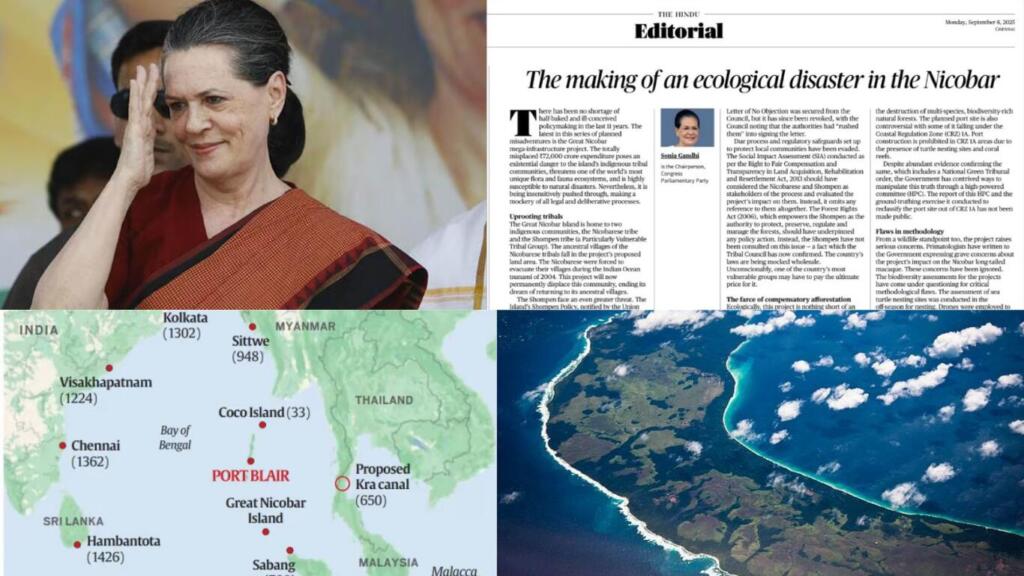
In geopolitics, timing often reveals the real motive behind political statements. Just days after India’s successful participation in the Shanghai Cooperation Organisation (SCO) Summit, Sonia Gandhi launched a sharp attack on one of India’s most important infrastructure and security ventures – the Great Nicobar Project. In her column in The Hindu, she painted the ₹72,000 crore initiative as an “ecological disaster,” accusing the Modi government of uprooting tribes, mocking due process, and endangering biodiversity.
When Medha Patkar stalled Gujarat’s lifeline by branding the Sardar Sarovar Dam an “ecological disaster,” India lost decades of progress. Now Sonia Gandhi seems desperate to audition for the sequel recycling the same script of fear, foreign-flavored activism, and selective outrage. From Narmada to Nicobar, it’s the same anti-development drama, just a different stage
But beneath the emotional rhetoric lies a deeper strategic question: why would the Congress leadership oppose a project that strengthens India’s maritime security, boosts economic potential, and directly addresses the Malacca Strait dilemma that keeps China awake at night? The answer is political posturing disguised as environmental concern, a strategy Congress has repeatedly deployed to stall transformative projects of national importance.
A Strategic Masterstroke?
Sonia Gandhi’s criticism rests on the claim that the Great Nicobar Project will destroy forests and permanently displace tribal communities like the Nicobarese and the Shompen. But a closer look dismantles this narrative. The development zones for the port, airport, and associated facilities have been demarcated after careful mapping to ensure minimum overlap with tribal settlements. The claim of entire communities being “uprooted” is exaggerated at best, misleading at worst.
It is also ironic that during the 2004 tsunami, entire Nicobarese villages were wiped out. Congress, which was then in power, did little to restore or integrate these communities with modern infrastructure. Today, when the Modi government proposes connectivity, power, healthcare, and communication facilities, Congress describes it as an “existential threat.” The contrast exposes the selective morality in Sonia Gandhi’s argument.
Moreover, this is not just about development for the sake of development. The Great Nicobar Project is India’s unsinkable aircraft carrier a strategic base positioned at the mouth of the Malacca Strait, the chokepoint through which nearly one-third of global oil shipments and 60% of Chinese imports pass. China has long been insecure about this vulnerability, and India’s ability to block or monitor traffic here gives it unmatched leverage in the Indo-Pacific. By opposing the project, Sonia Gandhi appears blind to the geopolitical stakes.
Foreign NGO’s At Play?
Any country that let NGOs and foreign funded think tanks play freely and does not stop their money flow will see democracy, development and peace in trouble. NGOs have already helped topple around thirty odd governments in the world. Asia and Africa are their grazing grounds. This whole NGO-think tank business runs with the collusion of govt officials, section of power elites and some internal disruptive forces. Mostly they raise environmental issues or fund protests to block our development projects, dams, factories, road construction, mining, drilling etc. Interestingly, the whole story of Germany and Britain own growth, the Industrial revolution itself, was written with coal and oil. They are angry as India has overtaken Britain’s economy and is now very close to Germany.
Due Process: Flawed Claims and the Reality of Review
Another core argument Sonia Gandhi makes is that the project has “trampled on legal safeguards” and made a “mockery of due process.” Yet the record shows the opposite. The proposal has been vetted by multiple agencies the National Green Tribunal (NGT), the Environment Ministry’s High-Powered Committee, and the National Centre for Sustainable Coastal Management (NCSCM). Ground surveys conducted by the NCSCM confirmed that Galathea Bay falls under CRZ 1B, where port construction is permissible, not CRZ 1A, where it would have been barred.
Sonia Gandhi also dismisses compensatory afforestation as a “farce.” But compensatory afforestation is not a BJP innovation it is a legal obligation under the Forest Conservation Act, a framework used by Congress-led governments for decades. To ridicule it now is not environmental purity; it is political convenience.
If due process was truly her concern, why was there silence when Congress governments in the past allowed ports, airports, and radar stations to be delayed or scrapped on similar “environmental” grounds? The truth is that due process has been followed scrupulously, but when the outcome does not suit Congress’ political interests, the process itself is labelled a failure.
The Economic Logic: From Colombo Dependence to Galathea Bay Advantage
What is most striking about Sonia Gandhi’s critique is what she chooses not to say. Nowhere in her article does she acknowledge that India currently routes nearly 25% of its cargo through foreign ports, losing billions annually. Colombo alone handles over 40% of India’s transshipment trade, and China’s growing control over Sri Lankan infrastructure including the Hambantota port and terminals at Colombo poses a severe strategic risk to India.
Galathea Bay changes this equation. With a natural depth of 18–20 metres, it is uniquely suited for large container vessels carrying over 165,000 tonnes—ships that cannot dock at most Indian east coast ports with their shallow 8–12 metre drafts. By building a deep-water port at Great Nicobar, India can capture traffic currently flowing to Singapore and Colombo, saving up to ₹4,500 crore annually while positioning itself as a global transshipment hub.
Phase 1 of the project, set for completion in 2028, will process 4 million TEUs. By 2058, capacity will rise to 16 million TEUs, placing Galathea Bay in the league of the world’s busiest ports. For a country aspiring to become a $10 trillion economy, this is not optional it is essential. And yet, Sonia Gandhi prefers to reduce this vision to a caricature of ecological destruction.
The National Security Blind Spot
Beyond economics lies the most compelling case: national security. The Andaman and Nicobar Islands are India’s eastern sentinel, its “unsinkable aircraft carrier” in the Indo-Pacific. With the commissioning of INS Baaz at Campbell Bay in 2012 and the recent upgrades in runways, radar facilities, and logistics infrastructure under the Modi government, India is building the capacity to dominate the Malacca Strait.
This is China’s nightmare. Over 80% of its oil imports pass through the Strait, and India’s growing ability to monitor or even blockade this route gives it enormous leverage. The Great Nicobar Project, with its port, airstrip, and surveillance installations, completes this strategic jigsaw.
Yet Sonia Gandhi’s article is completely silent on this dimension. She does not mention China, does not mention Colombo’s Chinese-controlled terminals, and does not mention the Indo-Pacific balance of power. By portraying the project purely as an environmental hazard, she erases the very factors that make it indispensable.
National Security or Political Rhetoric?
The Great Nicobar Project is not a reckless ecological gamble; it is a carefully planned strategic, economic, and security investment. With environmental clearances in place, phased development, and compensatory safeguards, the project is far from the “ecological disaster” Sonia Gandhi claims.
Her opposition must be understood in the context of Congress’ broader history of stalling infrastructure under the guise of “ecology.” By raising alarmist concerns while ignoring strategic realities, the Congress leadership risks undermining India’s position in the Indo-Pacific at a time when China’s assertiveness is growing, and Western unease with India’s independent stance is already evident.
To stall the Great Nicobar Project now would be to repeat the mistakes of the past when India’s Andaman and Nicobar Islands were left underdeveloped, strategically neglected, and economically stagnant. The Modi government’s vision is clear: transform the islands into a hub of maritime power, economic opportunity, and national security.
The real disaster would not be developing Great Nicobar. The real disaster would be allowing political short-sightedness to deny India its rightful place as a maritime leader in the Indo-Pacific.