
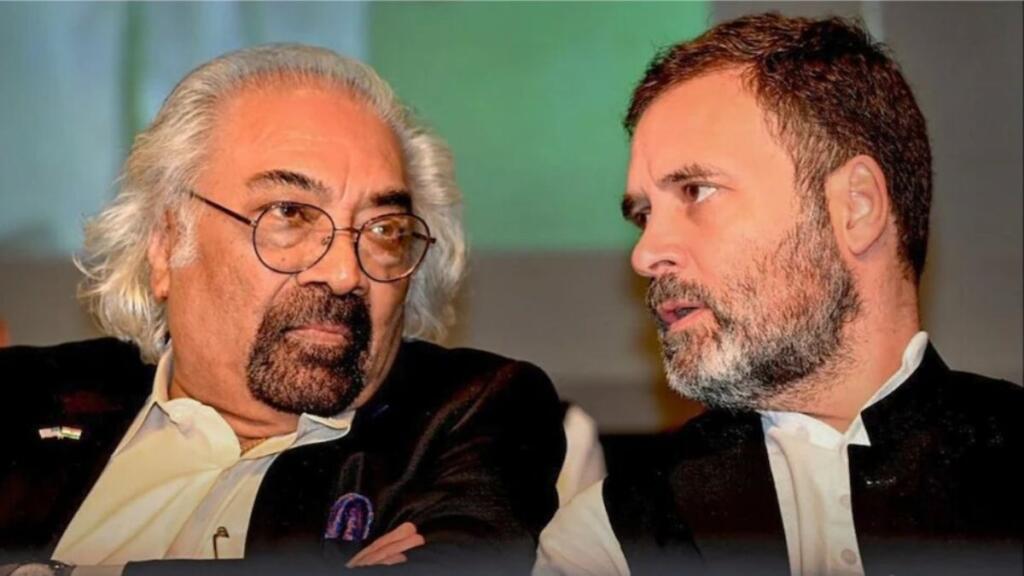
Indian Overseas Congress chief Sam Pitroda has once again stirred a hornet’s nest by declaring that when he visits Pakistan, Nepal, or Bangladesh, he never feels like he is in a foreign country. In his words, “I’ve been to Pakistan, and I must tell you, I felt at home.” Pitroda insisted that the Congress party’s foreign policy must first focus on strengthening ties with India’s neighbours. Such a statement, coming at a time when Pakistan continues to bleed India through terror attacks, only shows the Congress’s old habit of placing sentiment over national security and emotion over patriotism. For a party that once presided over India’s weakest years, Pitroda’s remark is just another reminder that Congress leaders feel more comfortable in Pakistan than in their own country.
This is not the first time the Congress ecosystem has displayed its soft corner for separatists, terrorists, and even hostile nations. During the UPA era, India saw a dangerous pattern of appeasement. One glaring example came when former Prime Minister Manmohan Singh indirectly lent legitimacy to separatist leaders like Yasin Malik, who was later convicted as a terrorist responsible for mass killings, terror funding, and driving Kashmiri Pandits out of the Valley. Instead of isolating such figures, Congress governments allowed them platforms and treated them as stakeholders in “dialogue.” This emboldened separatists and weakened India’s stance on Kashmir internationally. The Congress’s willingness to give respect to men like Yasin Malik shows the party’s moral bankruptcy and lack of spine against forces that openly wage war against India.
The Congress’s indulgence of separatists is part of a broader pattern where the party has repeatedly bled for terrorists rather than standing with the victims. Be it defending Afzal Guru in Parliament, demanding clemency for Yakub Memon, or raising questions against India’s surgical strikes, the Congress has often chosen to sympathize with those who harm India instead of those who defend it. At every step, Congress leaders from Digvijay Singh peddling conspiracy theories about the Batla House encounter to Salman Khurshid comparing Hafiz Saeed’s language to that of Hindus have shown their discomfort in confronting terror head on. It is not surprising that Pitroda today feels “at home” in Pakistan; after all, the party he represents has always considered terrorists and their patrons as people worthy of dialogue, not punishment.
Nowhere is this weakness more glaring than in Congress’s policy towards Pakistan itself. After the 26/11 Mumbai terror attacks, India witnessed the most brutal assault on its soil since Kargil. For three full days, terrorists trained and guided by Pakistan’s ISI and Lashkar e Taiba held Mumbai hostage, killing over 170 innocent Indians, including foreigners. The world stood with India, expecting strong retaliatory action. Yet, what did the Congress led UPA government do? It restricted itself to file sharing, dossier diplomacy, and candle marches. Pakistan paid no price. Terror masterminds like Hafiz Saeed roamed freely under ISI protection, mocking India in public rallies. The then Prime Minister Manmohan Singh, instead of taking decisive action, spoke of “peace processes” and “dialogues.” This monumental failure signaled to Pakistan that India under Congress would never retaliate militarily, thereby emboldening the terror state to keep bleeding India with impunity.
Compare this to later governments that chose to hit back through surgical strikes and Balakot air strikes, and the contrast is crystal clear. Congress’s foreign policy towards Pakistan was built on appeasement, dialogue at all costs, and bending under international pressure. It is no wonder Sam Pitroda finds Pakistan “homely.” His statement is not just a personal feeling; it reflects the party’s political DNA. For Congress, Pakistan is not an enemy state exporting terror, but rather an estranged cousin that must be hugged and pampered, no matter how many Indian lives are lost.
The real tragedy is that Congress has failed to learn from history. Time and again, it has undermined India’s security by giving political space to separatists, romanticizing dialogue with terrorists, and refusing to punish Pakistan for its actions. Pitroda’s remark, therefore, is not an isolated slip of tongue but the natural continuation of a dangerous tradition. Whether it was Manmohan Singh’s misplaced faith in separatists like Yasin Malik, Digvijay Singh’s defense of terrorists, or the UPA’s shameful inaction after 26/11, Congress has always stood on the wrong side of history.
Today, when Sam Pitroda says he feels “at home” in Pakistan, the country must ask: whose home does he really belong to, India’s or Pakistan’s? For millions of Indians who lost loved ones to Pakistan sponsored terror, such remarks are a cruel insult. For Kashmiri Pandits who were hounded out of their homes by men like Yasin Malik, Congress’s affection for separatists is a wound that never heals. And for every soldier who laid down his life defending the nation, Congress’s weak kneed approach to Pakistan remains a betrayal.
In the end, the Congress party’s foreign policy is clear: love Pakistan, sympathize with terrorists, ignore victims, and preach peace while India bleeds. That is why Pitroda feels at home in Pakistan, because his party has long abandoned the idea of making India secure and strong.