
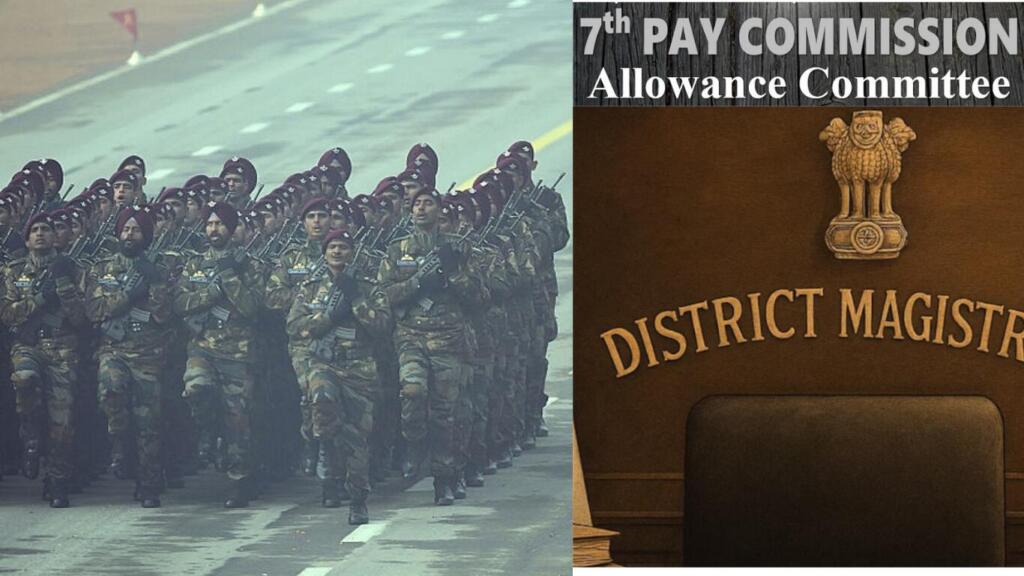
When the Seventh Central Pay Commission submitted its report in 2015, one anomaly stood out: soldiers posted to the Siachen Glacier, the world’s harshest battlefield, were awarded a fixed “Risk and Hardship Allowance” of Rs 31,500 for officers and Rs 21,000 for junior ranks. In the same report, officers of the All India Services, including the IAS and IPS, were granted a “Special Duty Allowance” amounting to 30 per cent of basic pay for postings in well-established and developed Northeast Indian cities such as Shillong or Aizawl. For many, this translated to sums exceeding Rs 60,000.
The contrast is an ideal example to depict the disparity between soldiers and civil servants, whether in allowances, promotion prospects, or the simple question of status. While the uniformed services operate under a sharply pyramidal promotion structure with limited avenues for career advancement, their civilian counterparts enjoy relatively assured progression, greater allowances, and, crucially, the benefit of mechanisms such as Non-Functional Upgrade.
Each time a Central Pay Commission is constituted, it is tasked with rationalising the salaries and allowances of India’s public servants. For the armed forces, however, these exercises have consistently ended in disappointment. The Seventh Commission, implemented in 2016, proved no exception.
What might look like routine adjustments in pay matrices has, in practice, institutionalised a system in which the bureaucracy thrives while the military feels steadily downgraded.
A tale of two services
The contrast between the armed forces and the All India Services is stark. Officers of the IAS and IPS enjoy structured progression, with almost every entrant assured of reaching senior positions such as Joint Secretary or Inspector General. They also benefit from provisions such as Non-Functional Upgrade (NFU), which ensures they move up the pay scale once a batchmate does, regardless of promotion bottlenecks.
The armed forces, by contrast, operate in a far steeper pyramid. Less than one-third of officers rise to the rank of Colonel, and only 1 per cent attain the military equivalent rank to a Joint Secretary: Major General. Most retire half a decade earlier than civil servants. By contrast, virtually every IAS officer can expect to retire at Joint Secretary rank or above, supported by steady pay progression and perks that outpace their military peers.
With NFU denied to them, stagnation translates not only into limited rank but also into lower lifetime earnings and diminished pensions. Lt Gen Vinod Bhatia, a former Director General of Military Operations (DGMO), has noted that the lifetime earnings of a soldier are almost half those of a Central Armed Police Forces (CAPF) constable.
This gap has only widened under the Seventh Central Pay Commission (CPC).
Status questions and representation
The discontent extends beyond pay to the matter of equivalence. Over the years, a series of Ministry of Defence circulars have diluted the relative standing of commissioned officers, equating Lieutenant Colonels with the lowest Group A designations and, in some cases, even with Group B officials.
What this means is that commissioned officers who are trained to lead combat units and historically treated on par with senior civil service officers, are now being ranked alongside middle-tier civilian supervisors. This is seen in the military community as a significant downgrading of their status.
There are functional consequences of this, too. In joint organisations under the ministry, officers accustomed to command are required to operate at lower notional levels than their civilian counterparts.
Part of the problem lies in process. No pay commission has included representation from the armed forces, despite the fact that they account for nearly a third of all central government employees. Instead, the commissions have been dominated by bureaucrats.
This has been a long-standing issue. Author and analyst Harsh Pant noted as early as 2008: “The Indian armed forces today are witnessing unprecedented turmoil and dissatisfaction[…]The armed forces feel they have never got their due from various Pay Commissions over the years but the government in its wisdom decided to keep the armed forces away from any representation in the latest Pay Commission. The dominance of bureaucrats meant that while the interests of the bureaucrats were well-recognised, the armed Services once again ended up getting a raw deal.”
Highlighting the scale of the discontent, he said it “is so serious that some of the best and brightest in our Services have refused to go for the Higher Command Course and more and more are seeking an early retirement.”
Morale and operational risk
For a profession where intangible rewards such as “izzat,” or honour, are central to motivation, the sense of being placed beneath civilian peers is corrosive. Lt Gen Bhatia had argued that the perception of degradation, rather than battlefield risk, is what most undermines morale. Veterans’ groups point to the growing number of officers opting for early retirement, or declining to pursue higher command training, as symptoms of the same malaise.
Moreover, the armed forces remain one of the most respected institutions in India, consistently called upon to deliver not only in conflict but in disaster relief, law and order, and national prestige. Persistent disaffection within their ranks is a matter with direct implications for the country’s security and stability.
Analysts and retired officers converge on a basic conclusion: reforms are overdue. That would mean representation of serving officers in future commissions, the extension of parity mechanisms such as NFU, and the correction of status anomalies that erode confidence in the system.
Until such steps are taken, the civil-military pay divide will remain an enduring fault line.
(Aritra Banerjee is a defence and strategic affairs columnist with a focus on India’s military, security, and geopolitical landscape. He writes extensively on veterans’ welfare and the challenges faced by service personnel, with a consistent commitment to bringing attention to issues of military welfare and ex-servicemen’s rights.)