
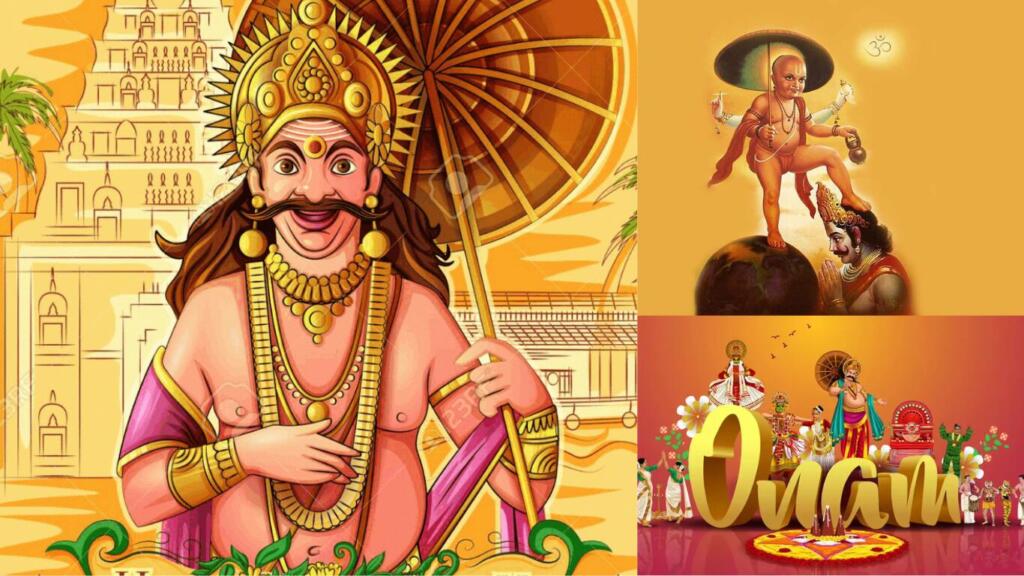
Once again, the secular-Abrahamic-Communist cabal is attempting to appropriate, distort, and secularise Hindu festivals. Their latest target is Kerala’s grand festival, Onam a celebration deeply rooted in Sanatan Dharma as Bhagwan Vaman Jayanti. From the Bhagavata Purana to Sangam literature, from Chera dynasty copper plates to colonial records, every source establishes Onam as a Hindu festival. Yet, the propaganda machinery is working overtime to brand it as merely a “secular harvest festival.” But the truth cannot be erased. Onam is not just a seasonal celebration it is the eternal story of Bhagwan Vishnu’s Vamana avatar and the dharmic humility of King Mahabali.
The Dharmic Story of Mahabali and Vamana
The origin of Onam lies in the eternal history of Sanatan Dharma. After the churning of the ocean (Samudra Manthan), nectar of immortality was obtained. The Asuras, led by Mahabali, attempted to seize it by deceit. To restore balance, Bhagwan Vishnu appeared as Mohini and handed the nectar to the Devas, sparking a cosmic war. Mahabali, grandson of the great devotee Prahlad and a descendant of Rishi Kashyap, rose as a formidable leader. Contrary to secular myths, Mahabali was a Brahmin king, blessed with wisdom and dharmic values. Through penance and yajna, he became so powerful that he displaced Indra and the Devas from heaven.
Unable to see her children suffer, Aditi, mother of the Devas, prayed to Vishnu for help. Vishnu promised to restore heaven to the Devas but vowed not to kill Mahabali, as He had once promised Prahlad that no one from his lineage would be slain. Thus, He incarnated as Vamana, the dwarf Brahmachari, born to Aditi and Rishi Kashyap in the month of Bhadrapad.
When Mahabali performed his Ashwamedha yajna, Vamana approached him and asked for three paces of land. Despite his guru Shukracharya’s warnings, Mahabali agreed, bound by his dharmic nature. Instantly, Vamana expanded into Trivikrama, covering the earth in one step and the heavens in the second. With no space left for the third, Mahabali humbly offered his head. Vishnu placed His foot upon it, sending Mahabali to Sutala but granting him the boon of returning once every year to visit his people. It is this divine return that is celebrated as Onam in Kerala.
Onam in Historical Records
The tale of Mahabali and Vamana is not mere folklore it is Itihasa preserved in scriptures and historical accounts. The Bhagavata Purana and Vamana Purana narrate this leela of Vishnu. Sangam literature from Tamil Nadu, such as the Maduraikanchi, describes Vishnu’s triumph over the Asuras, with Pandyan kings celebrating Onam as early as 1850 BCE.
Inscriptions also validate Onam’s dharmic origins. A 9th-century copper plate of Chera King Sthanu Ravi records annadana (mass feeding) to mark Onam celebrations. The Malabar Manual, written by a Scottish civil servant, identifies Onam as the day when Bhagwan Vishnu blesses the people along with Mahabali. Francis Day, a 17th-century East India Company official, also observed Onam as a festival celebrating Vishnu’s presence on earth.
Clearly, from sacred texts to foreign accounts, Onam has always been celebrated as Vaman Jayanti a Hindu festival, not a secular harvest carnival.
The Secular Narrative of Distortion
Yet, despite such overwhelming evidence, the Abrahamic-Communist-Dravidian cabal works tirelessly to erase the dharmic core of Onam. They project it as a “festival for all” while deliberately omitting the story of Bhagwan Vamana. This is the same distortion that Dravidianists attempt with Pongal, branding it as a mere “Tamil festival” and cutting it off from its Hindu essence as Makar Sankranti.
Why is this distortion so persistent? Because rooted Hindu festivals are living symbols of civilizational pride and cultural strength. A people who remember their Itihasa, who celebrate Bhagwan’s avatars and dharmic kings, cannot be easily broken or converted. By secularising festivals like Onam, the cabal seeks to weaken Hindu consciousness and alienate future generations from their scriptures and traditions.
Ironically, even the Church in Kerala once openly admitted that Onam is a Hindu festival. But as conversions gained momentum, the narrative shifted. Today, “secular Onam” is pushed in textbooks, media, and even government programmes turning a deeply spiritual festival into a shallow cultural showpiece.
The Eternal Dharmic Spirit of Onam
Despite this narrative theft, the dharmic memory of Hindus remains unbroken. Every year, Malayali families welcome King Mahabali with colourful pookalams at their doors, prepare grand Onasadya feasts on banana leaves, and celebrate Vallamkali boat races and Pulikali tiger dances all in honour of their beloved king and Bhagwan Vishnu’s blessing.
Hindu tradition even places Mahabali’s reign as far back as 11,160 BCE thousands of years before Abrahamic faiths were born. Onam therefore asserts not only the antiquity of Sanatan Dharma but also its unmatched cultural depth. Attempts to secularise Onam cannot erase the truth that it is, and will always remain, a Hindu festival celebrating Vishnu’s divine leela.
Reclaiming Onam from Secular Distortion
Onam is not a “secular harvest festival.” It is the eternal story of Bhagwan Vishnu’s Vamana avatar and the humility of King Mahabali. From Puranas to inscriptions, from Sangam poetry to colonial accounts, every piece of evidence affirms its Hindu roots. The secular-Abrahamic-Communist cabal may try to distort it, but Sanatan Dharma cannot be erased. As Hindus, it is our duty to protect, preserve, and proudly celebrate Onam in its true spirit as Bhagwan Vaman Jayanti, not as a hollow cultural carnival.
In 2025 and beyond, Onam must remain what it always was: a dharmic festival of devotion, humility, and Sanatan pride.