
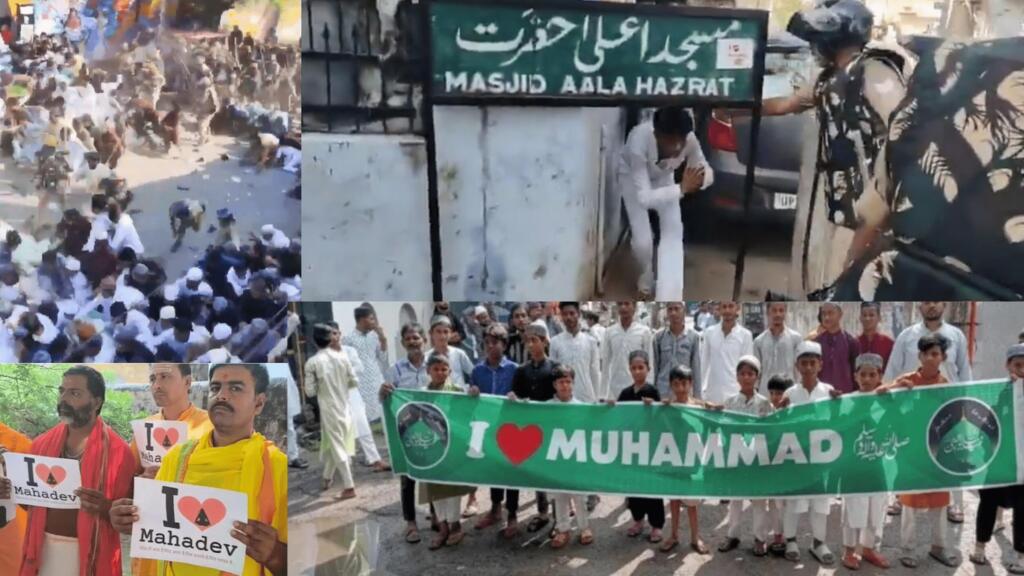
What unfolded in Bareilly after Friday prayers has once again exposed a systematic attempt to disrupt India’s social fabric under the guise of religion. A large crowd, holding placards that read “I Love Mohammad”, poured onto the streets, shouting slogans and creating a charged atmosphere. Soon, stone pelting began, forcing the police to respond with lathi charge as tension gripped the area.
This was not an isolated outburst of sudden anger but part of a larger pattern. From Kanpur to Bareilly, one can clearly see an emerging trend: the assertion of religious dominance in public spaces through new, aggressive forms of symbolism. Street prayers, mass processions, and now placards in marketplaces point to a deliberate strategy of displaying supremacy, often escalating into violence when authorities intervene.
Placards or Provocation? The Real Question
The central question is simple why were such posters needed at all? For centuries, Muslims in India have followed their religious practices within mosques and homes without interference. But this sudden trend of proclaiming “I Love Mohammad” on public streets is not a matter of devotion but an exhibition of political power.
If it was truly about love for the Prophet, it could have remained within personal or community spaces. Taking it to crowded markets, town squares, and main roads signals a different motive: to test the state’s authority and challenge social harmony. The pattern becomes clearer when one notes that whenever police attempt to enforce order, the response is violence, stone pelting, and chaos. It is not about faith—it is about demonstrating dominance.
From Where It Began?
The controversy began on September 4 during the Barawafat (Eid-e-Milad-un-Nabi) procession in Kanpur. On the day of the festival, a group of local youths marched with green flags and posters reading “I Love Muhammad”, singing naats. By evening, several banners with the same message appeared at traffic intersections and on shopfronts across Beconganj and Anwarganj.
However, local Hindu groups objected to this, claiming that a “new tradition” was being introduced in a space traditionally used for Barawafat celebrations.
Trouble began when police personnel allegedly removed some of the banners citing lack of prior permission. Video clips shared on social media showed heated arguments between residents and policemen, with a few scuffles reported. By nightfall, crowds gathered, raising slogans and demanding that the banners be restored. Police used mild force to disperse them, and ten people were detained.
Later, reports of similar disputes began emerging from other parts of Uttar Pradesh. In Bareilly, police stopped a group from hoisting a large “I Love Muhammad” hoarding near Dargah Ala Hazrat, fearing congestion during Friday prayers. In Sambhal, wall graffiti with the slogan was painted over by municipal workers, triggering late-night demonstrations in Sarai Tareen. Youths gathered outside the police station demanding action against those who erased it.
On September 9, Kanpur police registered cases against 24 people (9 named, 15 unknown) for allegedly introducing a new custom during the Barawafat procession and disturbing communal harmony. The case cited the removal of the traditional tent and placement of the banner at a new site.
The row gained wider attention after AIMIM chief Asaduddin Owaisi in a social media post asserted that saying “I Love Muhammad” was not a crime.
Kanpur Police Commissioner Ramkrishan Yadav defended the action: “The banners were obstructing traffic and had been put up without permission. Our action was aimed at maintaining public order, not hurting sentiments. We appeal to everyone to celebrate peacefully.”
Later, the row spread to different cities, including Nagpur, Mumbai, Hyderabad, Kashipur.
Islamic cleric Maulana Tauqeer Raza had announced a sit-in protest at Islamia Ground on Friday over the issue of “I Love Mohammad” posters, alleging instances of derogatory remarks against the Prophet in different parts of the country, including Shahjahanpur.
Saints Answer Back: “I Love Sanatan”
But India has never been a land where only one voice prevails. As placards of “I Love Mohammad” were waved in Bareilly, voices from Ayodhya, Varanasi, and Kanpur rose with chants of “I Love Mahadev” and “I Love Sanatan.” Saints and spiritual leaders declared that the true identity of this land lies not in imported slogans but in Ram, Krishna, and Sanatan Dharma.
Sant Suraj Tiwari and Sitaram Das Maharaj bluntly reminded that those who want to raise such placards in India have the freedom to move to Pakistan, for India belongs to Sanatan culture. The message was loud and clear—India is not defined by Aurangzeb’s legacy or foreign ideologies, but by the eternal voice of sages, saints, and dharmic traditions.
These counter-slogans are not just reactions; they represent India’s soul rising in self-defense. They remind the nation that its cultural identity cannot be altered, no matter how many placards are raised in public spaces.
In Bahiyal village of Dahegam, Gandhinagar district, Gujarat, on the night of September 24, 2025, Hindus were attacked during Garba celebrations. The violence was sparked by a social media post by a Hindu youth that read, “I Love Mahadev”. The post enraged a section of Muslim community, who then approached the man’s shop, forcing him to flee for safety. In his absence, the shop was vandalised and set ablaze, as CCTV footage later showed several Muslim men breaking into the premises and causing damage.
A Cultural Clash or a Fight for Survival?
Some critics will rush to call this a communal clash. But the truth is, it is not aggression—it is defense. When one community consistently asserts itself in public, occupying streets for prayers and displaying power slogans, should the majority community remain silent?
Tolerance has always been the bedrock of Indian society, but tolerance cannot mean surrender. The “I Love Sanatan” campaign is not about confrontation—it is about protecting India’s cultural roots from being diluted under the guise of religious assertion.
History itself provides context. From the Mughal era to the times of Aurangzeb, temples were destroyed and mosques were built as political symbols of dominance. Even then, India’s saints, sages, and warriors resisted. Whether it was Guru Tegh Bahadur, Maharana Pratap, or countless unknown freedom fighters, the struggle was always about protecting dharmic identity. The same spirit resonates today whenever such provocations take place.
From Aurangzeb to the Ram Temple: The Message of Resistance
The Bareilly episode is not new—it is a continuation of a centuries-old pattern. Aurangzeb thought demolishing temples would erase India’s dharmic spirit. The British believed conversions could uproot Sanatan. But both failed. Today, the construction of the Ram Temple in Ayodhya after 500 years is the loudest declaration that India’s soul cannot be erased.
The rise of placards saying “I Love Sanatan” is tied to that same spirit of revival. It signals that Hindus are no longer willing to remain silent spectators while others impose their identity on public life. The land of Ram, Krishna, and Shiva has once again stood up to assert its eternal character.
Sanatan Is the Soul of India
The Bareilly riots and the slogans raised in response from Ayodhya reveal a deeper truth about the current moment in Indian society. Attempts will continue to assert dominance in the name of faith, but India’s cultural soul always responds. Whether through temples rebuilt, saints leading the masses, or the echo of “I Love Sanatan” across towns and villages, the eternal character of this land cannot be suppressed.
This is not just about Bareilly or Ayodhya it is about the very idea of India. A nation whose essence comes from sages and saints, not from invaders or imported ideologies. A nation that stands today on the path of becoming a Hindu Rashtra, where dharmic identity is unapologetically protected.
No matter how many placards proclaim “I Love Mohammad,” the echo of “I Love Sanatan” and “I Love Mahadev” will always be louder, deeper, and everlasting. Because Sanatan is not just a slogan it is India’s destiny, its eternal truth, and its unshakable foundation.