
India’s Army Chief, General Upendra Dwivedi, recently reaffirmed the importance of theaterisation, describing it as an inevitable step in strengthening the nation’s defence preparedness and ensuring “unity of command” in modern warfare. His statement came during the launch of Lt Gen (retd) KJS Dhillon’s book Operation Sindoor: The Untold Story, where he underlined that wars today are not fought by the Army alone, but require the combined strength of all security and defence institutions of the nation. Theaterisation, he emphasised, would serve as the natural progression in India’s march toward integrated, future-ready military structures.
Theaterisation: The Natural Evolution of Joint Warfare
General Dwivedi highlighted that securing India’s vast borders is no longer the sole responsibility of the Army but requires a collective effort from several agencies. Apart from the Border Security Force (BSF) and the Indo-Tibetan Border Police (ITBP), effective defence involves the Navy, Air Force, cyber and space agencies, intelligence organisations, ISRO, civil defence bodies, and state administrations. To bring synergy among such a wide spectrum of stakeholders, theaterisation becomes indispensable.
At its core, theaterisation is about unifying the resources of the Army, Navy, and Air Force under integrated theatre commands. Each theatre command would be responsible for a specific geographical region, ensuring joint planning, seamless coordination, and faster operational response. The Army Chief made it clear: when India fights a war, it cannot afford fragmentation; unity of command is the key to victory.
The Origins of India’s Theaterisation Debate
The concept of theaterisation is not new. Its roots lie in the lessons of the 1999 Kargil War, when the Kargil Review Committee strongly recommended greater integration among the services. The subsequent creation of the Headquarters Integrated Defence Staff (HQIDS) was the first step towards building jointness.
The decisive moment came in 2019, when Prime Minister Narendra Modi, in his Independence Day address, announced the post of the Chief of Defence Staff (CDS). This was a transformative reform, aimed at breaking silos and ensuring that India’s military strength is used optimally. The late Gen Bipin Rawat, India’s first CDS, took the first concrete steps toward forming theatre commands in 2020. His successor, Gen Anil Chauhan, has carried forward this vision, initiating wide-ranging discussions to build a structure suited to India’s geography and security requirements.
Proposed Theatre Commands: Tailored to India’s Needs
Unlike Western or Chinese models, India’s theaterisation plan is designed to reflect the nation’s unique geography and threats. Multiple models have been examined over the years, but the emerging consensus points toward adversary-focused commands. These would likely include:
- A Northern Theatre Command, primarily to address challenges from China along the LAC.
- A Western Theatre Command, to tackle threats emanating from Pakistan.
- A Maritime Theatre Command, to safeguard India’s vast coastline and ensure dominance across the Indian Ocean.
- An Air Defence Command, to integrate India’s airspace security and missile defence capabilities.
Currently, the Army and Air Force each operate seven commands, while the Navy has three. Additionally, India already has two tri-service structures the Andaman and Nicobar Command and the Strategic Forces Command (SFC). The move to theatre commands would involve streamlining these into integrated units, cutting duplication, and allowing resources to be pooled effectively.
Why Theaterisation Is Critical for India’s Future Wars
Modern warfare is no longer restricted to land, sea, and air. Future conflicts are expected to be multi-domain, combining drone swarms, precision missile strikes, cyber-attacks, satellite warfare, and information operations. In such a scenario, each service working in isolation risks inefficiency. Theaterisation would ensure a single commander has all the tools of war from land formations and fighter aircraft to naval assets and cyber capabilities at his disposal.
Examples from other militaries highlight its importance. The United States, for instance, relies on its combatant commands, while China has restructured its armed forces into theatre commands to enhance speed and efficiency. India, however, is developing a customised system, keeping in mind both continental threats from Pakistan and China as well as maritime challenges in the Indo-Pacific.
By unifying command and removing duplication, theaterisation will enhance India’s deterrence capability, make crisis response swifter, and maximise combat potential. It also supports the vision of Atmanirbhar Bharat in defence, by ensuring indigenous assets are deployed optimally and without overlap.
Ongoing Deliberations and the Road Ahead
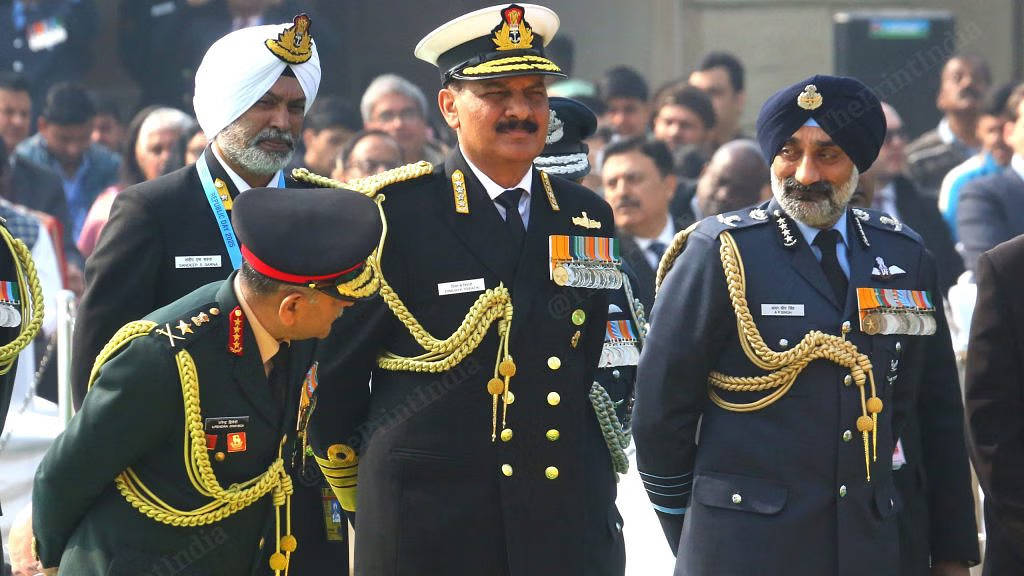
The debate on theaterisation has intensified in recent months. At the tri-service seminar Ran Samvad 2025 in Mhow, the services openly discussed differing perspectives, but all underlined their commitment to jointness. Air Chief Marshal A P Singh cautioned against rushing into structural changes, suggesting a phased approach with stronger joint planning mechanisms. Admiral Dinesh Kumar Tripathi reaffirmed the Navy’s commitment to aligning its command and control structures with the broader theaterisation vision. CDS Gen Anil Chauhan assured that all dissonance would be ironed out and the final structure would reflect consensus and national interest.
The government has not yet finalised the structure of theatre commands, but detailed studies, tabletop exercises, and deliberations are underway. Key questions include whether existing commands should be dissolved or integrated, where new headquarters should be located, and how responsibilities will be divided between the service chiefs and theatre commanders. Importantly, the spirit of reform remains intact, with consensus on the fact that future wars cannot be won without integrated planning.
A Step Towards India’s Military Transformation
Theaterisation is more than just a structural change it is the cornerstone of India’s military transformation in the 21st century. By creating integrated theatre commands, India will ensure that its armed forces fight as one cohesive unit, not as fragmented entities. While discussions are ongoing, the direction is clear: a unified, joint, and technologically advanced force, capable of tackling threats across land, sea, air, cyber, and space.
General Upendra Dwivedi’s call for unity of command captures the essence of this reform. Theaterisation is not a question of “if” but “when.” It is the natural evolution of India’s defence strategy, ensuring that when the nation is challenged, it responds with the full might of its integrated armed forces, ready to protect every inch of its sovereignty.