
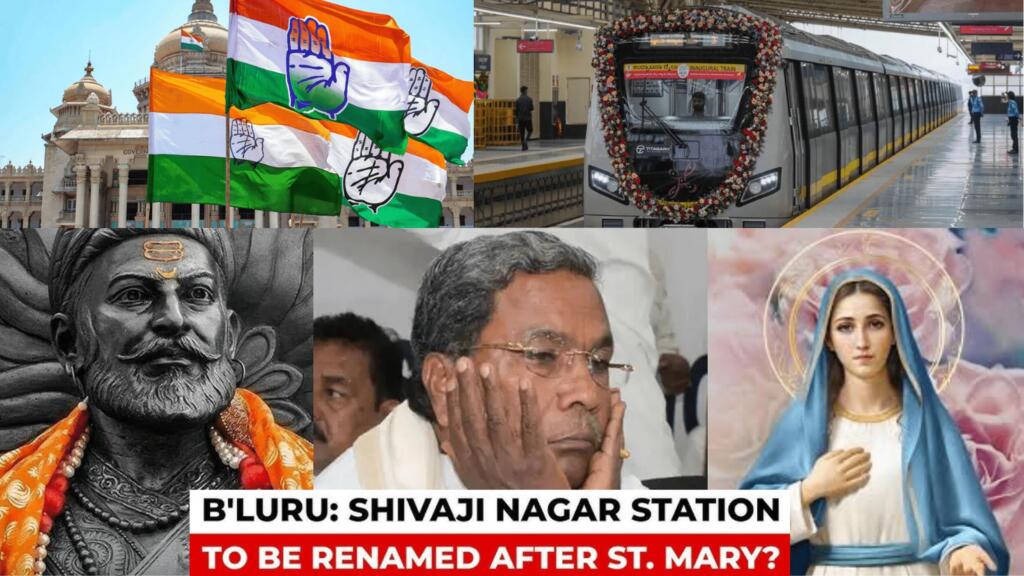
The Congress government in Karnataka has plunged into a fresh controversy by attempting to rename Bengaluru’s Shivajinagar Metro station after “St. Mary.” Chief Minister Siddaramaiah made this announcement at St. Mary’s Basilica in Bengaluru, claiming that the name reflects the faith of devotees who see St. Mary as the “Mother of Health.” But this move has triggered outrage across political and public circles, with critics accusing the Congress of once again insulting Chhatrapati Shivaji Maharaj and indulging in appeasement politics.
The sharpest backlash has come from Maharashtra, where Shivaji Maharaj is revered as a symbol of resistance against colonial oppression. Leaders across party lines have questioned why a foreign religious figure should be honored over India’s legendary warrior king. The episode has reignited the debate over Congress’s long-standing tendency to prioritize minority appeasement over India’s native icons.
Why Sideline Shivaji Maharaj for St. Mary?
At the heart of the controversy lies a simple but powerful question: why would a metro station in Shivajinagar, Bengaluru, not be named after Chhatrapati Shivaji Maharaj or even a local cultural legend, but instead after St. Mary, a figure with no historical connection to Karnataka’s heritage? Shivaji Maharaj is not only a Maratha icon but also a national hero who fought fiercely against Mughal domination and foreign invaders. His memory commands respect across India.
Even from a regional standpoint, Karnataka has its own cultural figures like the late actor Shankar Nag, who is often credited with envisioning a metro system for Bengaluru in the 1980s. Many locals argue that honoring Shankar Nag would have been a fitting tribute. Instead, Siddaramaiah’s choice of a foreign saint smacks of deliberate appeasement.
On social media, outrage poured in as users asked whether St. Mary was a Kannada legend and why homegrown leaders and visionaries were ignored. One comment read, “Why name it after St. Mary? Why not Shankar Nag, who actually dreamt of Bengaluru’s Metro?” Another demanded that public places stop being battlegrounds for politics and appeasement.
What’s happening!! It’s a shame🙆♂️!
Why does the KA government want to name the metro station “Saint Mary”? Why not name it after Kannadigas like Shankar Nag or other deserving people? @CMofKarnataka @siddaramaiah
— MNV Gowda (@MNVGowda) September 9, 2025
BJP and Maharashtra’s Fierce Response
The Bharatiya Janata Party (BJP) has wasted no time in turning this issue into a full-blown political battle. Maharashtra Chief Minister Devendra Fadnavis issued one of the strongest condemnations, saying: “I condemn the Karnataka government’s move to rename Shivajinagar metro station in Bengaluru after St. Mary. It is an insult to Chhatrapati Shivaji Maharaj.” He went on to remind the public that this is not the first time Congress has shown contempt for Shivaji Maharaj, pointing out that even Jawaharlal Nehru made disparaging remarks about him in Discovery of India.
Fadnavis further said that he was praying for the “Almighty to give Siddaramaiah sense” not to go ahead with such a regressive decision. The emotional weight of the statement underscores how deeply Shivaji Maharaj’s legacy resonates across Maharashtra, where any insult to his memory is seen as an attack on Marathi pride itself.
In Karnataka, BJP’s Leader of the Opposition in the Legislative Council, Chalwadi Narayan Swami, also lashed out. He accused Congress of pushing its “first choice appeasement politics.” “Because of appeasement, their party went to the dogs. Still, they are maintaining the same politics. We will not allow this,” he said.
Maharashtra BJP leader Chitra Wagh echoed the sentiment, declaring that Congress’s “hatred” for Shivaji Maharaj had been fully exposed. She specifically called out Congress MLA Rizwan Arshad for demanding the St. Mary renaming, and challenged Maharashtra Congress to clarify whether they support this insult to their own state’s most beloved hero.
Congress’s Old Habit
This controversy is not an isolated instance. For decades, Congress has faced accusations of downplaying India’s civilizational heroes while elevating foreign figures for political gain. From Nehru’s dismissive treatment of Shivaji Maharaj to Sonia Gandhi-era politics that prioritized minority appeasement, the pattern has remained unchanged.
Siddaramaiah’s push to rename a metro station after St. Mary instead of Shivaji Maharaj only confirms this trend. Critics argue that Congress is trapped in a colonial hangover, where honoring Western or foreign figures is seen as more politically rewarding than celebrating homegrown heroes who fought against oppression.
The irony is stark: at a time when Prime Minister Narendra Modi is championing projects like the grand Shivaji statue in the Arabian Sea to honor India’s warriors, Congress is busy insulting the same figure. In today’s digital era, where information spreads instantly, such moves are exposed and condemned almost immediately. The people of India can no longer be fooled by token gestures.
Faith, critics argue, should be respected genuinely not used as a tool for vote-bank politics. By pandering to a narrow section for electoral gains, Congress risks alienating the wider majority that takes pride in its cultural heritage.
Allies in Discomfort: Shiv Sena’s Uneasy Position
Interestingly, even Congress’s allies have not supported Siddaramaiah’s move. Shiv Sena (UBT), part of the INDIA alliance in Maharashtra, has openly expressed disagreement. Party spokesperson Anand Dubey said the Sena would write to Siddaramaiah urging him to respect public sentiments and name the station after Chhatrapati Shivaji instead.
Dubey also highlighted the sensitivity of the issue, noting that while BJP should not exploit it politically, there is no justification for ignoring Shivaji Maharaj. His statement reveals the bind Congress has placed its allies in forcing them to either defend an unpopular decision or distance themselves publicly.
The situation demonstrates how Congress’s outdated politics of appeasement is backfiring, creating friction within its alliances and drawing sharp attacks from rivals. Instead of building consensus, Siddaramaiah’s announcement has inflamed divisions