
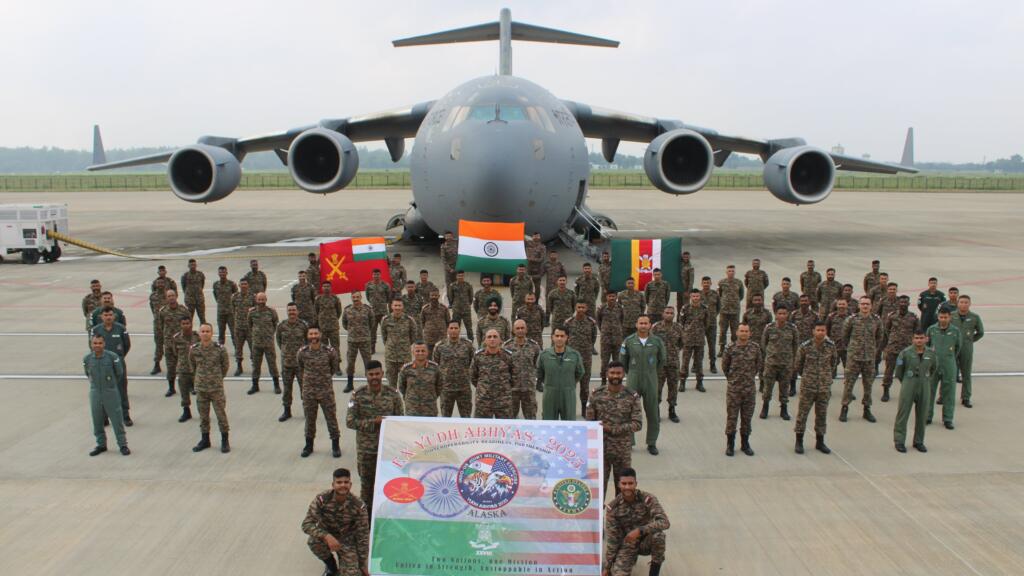
In the icy wilderness of Alaska, where temperatures test the endurance of even the most seasoned soldiers, the armies of India and the United States have begun one of their most significant joint military drills Yudh Abhyas 2025. This year’s edition of the exercise comes at a critical juncture, as Washington and New Delhi face friction over US President Donald Trump’s steep tariff hikes on Indian goods and energy imports. Yet, even amid trade disputes, the military collaboration between the two democracies underscores a growing strategic partnership that neither side can afford to weaken in today’s shifting geopolitical order.
Strategic Setting: Why Alaska Was Chosen
The 21st edition of Yudh Abhyas officially commenced on September 1 at Fort Wainwright in Alaska, with soldiers from the US 11th Airborne Division and the Indian Army’s 65th Infantry Brigade. Running until September 14, the exercise will span two weeks of intense training, tactical drills, and cultural exchanges. Alaska was not chosen by coincidence it sits close to critical Arctic and Indo-Pacific corridors, making it an ideal testing ground for interoperability in extreme climates.
According to the Ministry of Defence, India has sent a battalion of the Madras Regiment, while the US side is represented primarily by the 1st Battalion, 5th Infantry Regiment “Bobcats,” part of the 1st Infantry Brigade Combat Team (Arctic). Together, the two contingents are preparing to strengthen doctrines that are crucial in a world where security challenges are rapidly evolving.
Training Scope: From Mountain Warfare to UAVs
The scale of this year’s Yudh Abhyas is larger and more technologically intensive than previous editions. The training program includes heliborne operations, mountain warfare, artillery live-fire drills, unmanned aerial systems (UAS), counter-UAS tactics, and casualty evacuation exercises. These drills are not just about battlefield rehearsals but about refining doctrines for real-world crises, ranging from natural disasters to counter-terror operations.
The troops will also participate in a brigade combat team command post exercise an advanced simulation linking command-level planning with ground field exercises. Artillery coordination, surveillance integration, and air-to-ground interoperability are key priorities. Academic exchanges and cultural programs will run parallel to tactical training, strengthening not only combat preparedness but also mutual trust and understanding between the two armies.
Bilateral Defence Ties: Beyond the Battlefield
Yudh Abhyas has evolved into much more than a military drill. It is now a reflection of India-US strategic convergence in the Indo-Pacific. Over the last decade, both countries have signed landmark agreements that elevated their defence cooperation:
-
LEMOA (2016): Enabled logistics sharing.
-
COMCASA (2018): Allowed secure communications interoperability.
-
BECA (2020): Facilitated geospatial intelligence sharing.
-
SOSA (2023): Ensured priority supply of critical defence goods.
Big-ticket defence acquisitions underline this deepening partnership. India has procured MH-60R Seahawk helicopters, M777 howitzers, and Sig Sauer rifles from the US. Meanwhile, negotiations are underway for GE F-414 jet engine manufacturing in India, supporting the LCA Mk-2 fighter program. Additionally, the landmark deal to acquire 31 MQ-9B High-Altitude Long-Endurance UAVs represents the next leap in joint defence technology.
Thus, Yudh Abhyas serves as the live operational framework binding together years of defence agreements and procurement deals.
Trade Tensions: Military Unity Amid Tariff Row
While soldiers train shoulder-to-shoulder in Alaska, relations on the trade front are tense. US President Donald Trump has slapped 25% tariffs on Indian goods, alongside an additional 25% levy tied to New Delhi’s import of Russian crude. New Delhi has called these measures unjust, while Trump has labeled US-India trade a “one-sided disaster.”
Yet, despite this tariff row, the continuation of Yudh Abhyas 2025 proves that both countries recognize the necessity of keeping defence ties insulated from trade disputes. With China’s assertiveness in the Indo-Pacific and Russia’s ongoing war in Ukraine reshaping global alliances, neither India nor the US can afford to let economic friction undermine their shared strategic goals.
Building Trust Beyond Tariffs
Yudh Abhyas 2025 is not just a routine military exercise it is a symbol of resilience in India-US ties. Even as trade disagreements flare up, the fact that Indian and American soldiers are training together in Alaska’s unforgiving terrain reflects a strategic choice: to prioritize long-term security cooperation over short-term economic disputes.
For India, the drill enhances capabilities in mountain warfare and joint operations skills vital in both Himalayan and global conflict scenarios. For the US, it strengthens partnerships with a reliable democracy in Asia at a time when the Indo-Pacific is becoming the central theatre of global geopolitics.