

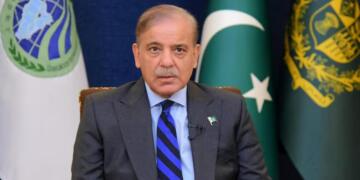











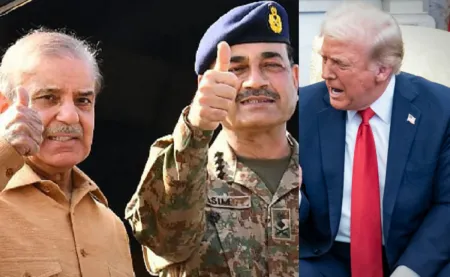
US President Donald Trump will meet Pakistan’s Prime Minister Shehbaz Sharif today (September 25,2025), marking the first meeting between a sitting US President and a Pakistani PM since July 2019 The meeting comes just weeks after Washington and Islamabad announced a trade deal, underscoring a recent warming of ties between the two countries.
Relations between the United States and Pakistan have entered a new phase under Donald Trump, who has sought to rebalance Washington’s South Asia policy. For years, US strategy emphasized closer cooperation with India as a counterweight to China, but strains with New Delhi over tariffs, visas, and Trump’s contentious claims of mediating an India-Pakistan ceasefire have complicated that approach
The July 31 trade agreement, which included a 19 per cent tariff rate set by Washington, marked a turning point for the US-Pakistan economic engagement. By contrast, a trade deal with India remains elusive. According to the analysts, the shifting dynamics are prompting New Delhi to recalibrate its ties with Beijing and it was evident during the recent SCO summit.
Pakistan’s Prime Minister Shehbaz Sharif and Army Chief Field Marshal Asim Munir’s meeting with U.S. President Donald Trump signals that the US may be preparing to embrace a country known as a factory of terrorism. The Pakistani Army Chief will also attend the meeting, marking his second meet with Trump since June. India is closely watching the events.
The presence of Asim Munir at the meeting is highly significant. It is unusual in diplomatic protocol for a country’s army chief to be invited to sit at the table with the US President. This indicates who truly holds power in Pakistan. Trump has already signalled the importance he places on relations with Pakistan. Sharif also joined a Tuesday meeting between Trump and leaders of eight Islamic-Arab countries, held on the sidelines of the UN General Assembly, where the US president discussed proposals aimed at addressing Israel’s offensive in Gaza.
Earlier this year, Trump hosted Pakistani army chief Field Marshal Asim Munir at the White House, a rare meeting for a US president with a Pakistani military leader unaccompanied by senior civilian officials.
Islamabad, meanwhile, has openly supported Trump’s nomination for the Nobel Peace Prize for his efforts to ease India-Pakistan tensions. At the same time, Pakistan has sharply criticised the United States over its backing of Israel during the ongoing conflict in Gaza.
China and the US have Pakistan caught in between
The meeting between Trump and Sharif is a crucial test for Pakistan, especially as Islamabad finds itself at a crossroads. On one side, Washington is enticing it with aid and strategic recognition. On the other, it is deeply linked with China through the China-Pakistan Economic Corridor and other strategic commitments.
The Pakistani military has been sending terrorists into India for years, providing them with funding, weapons, and training. If the US embraces these generals, India’s strategic dilemma will deepen even further. Pakistan Prime Minister Shehbaz Sharif’s informal conversation with Trump on Tuesday lasted only for 36 seconds.
The scheduled meeting on Thursday is at the highest level of diplomatic efforts amid the Israel-Qatar situation, massive floods in Pakistan, and the Pakistan-India situation. The intention for a meeting between Shehbaz Sharif and Donald Trump had been on the build-up for a long time. This marks the third time Asim Munir is heading to the United States, following the visit to the United Kingdom from September 18-23. The meeting of June between Asim Munir and Donald Trump was the first meeting after the India-Pakistan conflict of May.
Asim Munir, since his promotion as Field Marshal, following the Pakistan-India conflict, has been trying to push himself as a trustworthy middleman. With relations between India and the US on a decline, Pakistan’s growing closeness with the US and its extension of nuclear umbrella to Saudi Arabia is seen as a broader push to portray itself as the leader of the Islamic states in the region.