
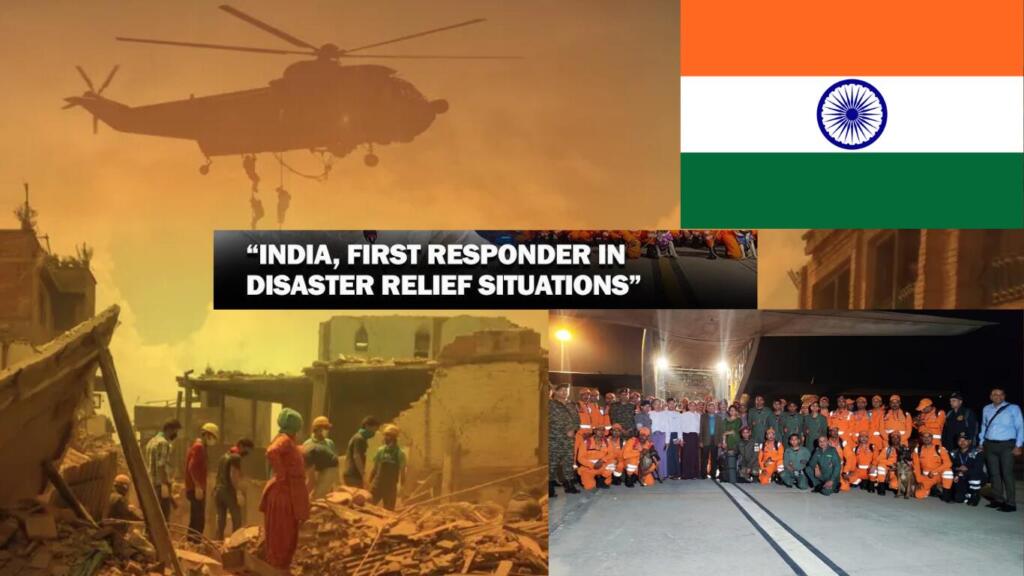
When tragedy strikes, nations look not just for condolences but for immediate, tangible help. Once again, India has stepped forward as the first responder. On Monday, Prime Minister Narendra Modi expressed deep sorrow over the devastating earthquake in Afghanistan, which claimed more than 800 lives. He offered full humanitarian assistance, reaffirming India’s role as a nation that stands with its neighbors and partners in their darkest hours.
“Deeply saddened by the loss of lives due to the earthquake in Afghanistan. Our thoughts and prayers are with the bereaved families in this difficult hour, and we wish a speedy recovery to the injured,” the Prime Minister wrote on X (formerly Twitter). He assured that India stands ready to provide all possible humanitarian aid and relief to those affected.
The earthquake, measuring 6.0 on the Richter scale, flattened villages, trapped hundreds under debris, and left thousands homeless. Rescue teams are racing against time, but amid the despair, India’s readiness to extend help highlights a pattern that has become part of New Delhi’s identity: being the world’s first responder in times of crisis.
India – From Self-Sufficient to Selfless
PM Modi has often highlighted that India’s humanitarian outreach reflects both self-sufficiency and selflessness. “When one can help themselves, we call it self-sufficient. But when help is offered voluntarily, it can be described as selfless. India has not only become self-sufficient during the last few years but has also established itself as a selfless nation,” the Prime Minister said while felicitating Indian teams who returned from Turkey after earthquake relief in 2023.
This spirit is not rhetoric. It is backed by action. The sacrifices of the Indian Army, Navy, Air Force, National Disaster Response Force (NDRF), and State Rapid Action Forces have made India the go-to responder for natural disasters across Asia, Africa, and beyond. Whether it is delivering clean water to a parched Maldives, field hospitals to Turkey, or rescuing Indians and foreigners from war zones, India has built a reputation for speed, scale, and compassion.
Natural Disasters: India’s Global Humanitarian Missions
India’s track record as a rapid responder to natural disasters is long and distinguished:
-
Nepal Earthquake (Operation Maitri, 2015): Within hours of the devastating 7.8 magnitude quake, India dispatched NDRF teams, medical units, and helicopters. Over 5,000 people were rescued and massive relief aid delivered.
-
Maldives Water Crisis (Operation Neer, 2014): When a fire disabled Malé’s water plant, India sent 1,000 tonnes of drinking water by air and sea.
-
Mozambique Floods (2019): Under Operation Sahayata, Indian naval ships carried medical teams and relief after Cyclone Idai.
-
Indonesia Tsunami (2018): India dispatched immediate aid after Lombok earthquake and Sulawesi tsunami.
-
Myanmar Earthquake (2016): Relief teams and medical aid were sent without delay.
-
Turkey & Syria Earthquake (Operation Dost, 2023): India sent NDRF dog squads, medical teams, and a 99-member field hospital unit that treated 4,000 patients. The mission won international praise for professionalism and compassion.
These instances prove that when natural disasters strike, India does not wait for appeals it acts.
Rescue Beyond Borders: India’s Evacuation Operations
India’s humanitarian leadership also extends to rescue missions in conflict zones and pandemics. Some of the most notable include:
-
Operation Rahat (2015, Yemen): Over 6,700 people, including foreign nationals, evacuated from war-torn Yemen.
-
Operation Maitri (2015, Nepal): Evacuated Indians alongside earthquake relief efforts.
-
Operation Ganga (2022, Ukraine): During the Russia-Ukraine war, India rescued over 23,000 students, as well as foreign nationals. The tricolour became a protective shield for many.
-
Operation Kaveri (2023, Sudan): Evacuated nearly 3,800 Indians amid violent civil war.
-
Operation Vande Bharat (2020): One of the largest air evacuations in history bringing back over 70 lakh Indians during COVID-19 lockdowns.
-
Operation Samudra Setu (2020): The Indian Navy brought home 4,000 citizens stranded in the Gulf during the pandemic.
These missions underline not just capacity but also India’s political will to safeguard human lives Indians and foreigners alike.
Vaccine Maitri: Humanity Without Borders
India’s first-responder role is not confined to earthquakes, floods, or evacuations. During the pandemic, the Vaccine Maitri initiative supplied vaccines to over 100 countries, from the Global South to the developed West. This unprecedented outreach, even while India was battling its own COVID crisis, cemented New Delhi’s image as a nation that thinks beyond borders.
India, A Reliable Shield in Global Crises
Whether it is Afghanistan today, Nepal or Turkey earlier, India has demonstrated a consistent doctrine of humanitarian leadership. Unlike countries that politicize aid or respond selectively, India has emerged as a nation that sees humanity first and geopolitics later. The combination of the State Disaster Relief Force (SDRF), National Disaster Response Force (NDRF), and the Armed Forces, backed by political will at the highest level, ensures India can mobilize faster than most.
As PM Modi rightly said, India has become both self-sufficient and selfless. The message to the world is clear: in times of crisis, India is not just a friend in need, but the first friend to arrive.