
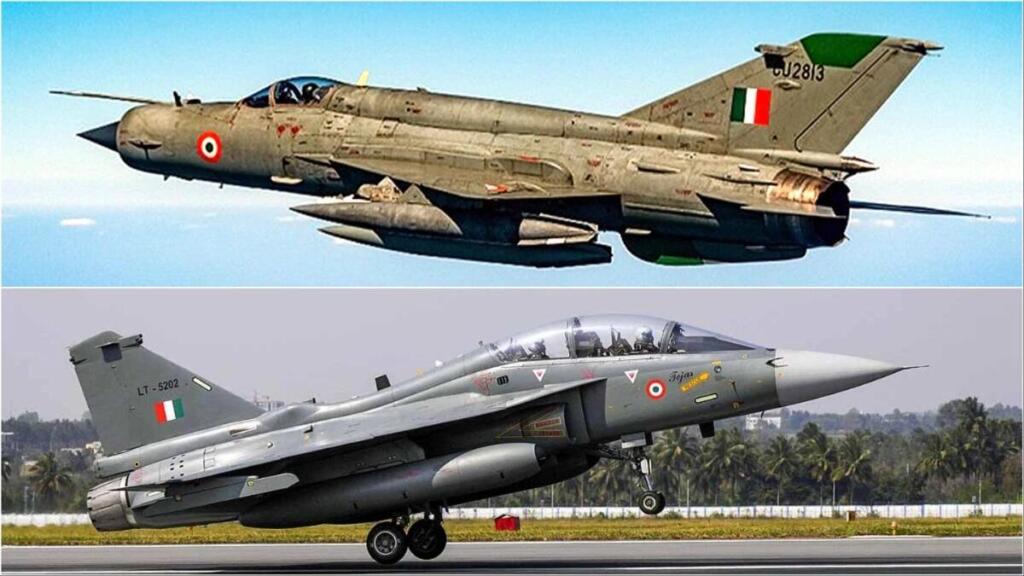
For over six decades, the MiG-21 has been both the backbone and the lightning rod of the Indian Air Force. It arrived in an India that was hungry for modern air power, fought wars that reshaped the subcontinent, trained generations of fighter pilots, and even made headlines in the 21st century with its unexpected victory in the Balakot dogfight. On September 26, 2025, the legendary fighter finally bowed out in a ceremonial flypast at Chandigarh, where its journey began in 1963. A day before its retirement, the Defence Ministry sealed a historic deal with Hindustan Aeronautics Limited (HAL) to procure 97 indigenous LCA Tejas Mk1A jets, symbolising the seamless transition from a Soviet-era icon to an Indian-designed future.
Arrival of the Supersonic Era
When the first MiG-21s touched down in India in 1963, they heralded the arrival of the supersonic age in South Asia. No other regional air force possessed an aircraft capable of Mach 2 speeds at the time. The “First Supersonics” squadron, No. 28 Squadron based at Chandigarh, became the pioneer unit. Within three years, Hindustan Aeronautics Limited (HAL) began licensed production, making India one of the very few nations outside the superpower blocs to locally build advanced fighters.
This combination of imported technology and local assembly created not just a fleet, but a production ecosystem. Over the decades, HAL manufactured hundreds of MiG-21s, cementing its role as a cornerstone of India’s defence industrial base. While the earliest variants had limited capability, successive upgrades and indigenous improvisations allowed the aircraft to evolve from a short-range interceptor into a versatile multi-role platform.
Evolution Through Upgrades
The MiG-21’s journey was marked by constant adaptation. The early Type-74 variant carried little more than heat-seeking missiles and offered modest combat flexibility. But as Indian pilots gained experience and war demands mounted, engineers modified the aircraft to carry cannons, bombs, and rocket pods, dramatically expanding its role.
The introduction of the Type-77 in the late 1960s transformed the MiG-21 into a strike-capable fighter. By the 1970s, the Type-96 variant added improved radar, extended range, and electronic warfare capability, even carrying Swedish Chatterbox jammers. Improvised reconnaissance versions equipped with British Vinten cameras filled the critical gap of photo-reconnaissance until Jaguars arrived.
The MiG-21 Bis, inducted in the 1980s, represented the jet at its peak within the IAF. It combined a powerful engine, radar-guided missiles, and better survivability, making it India’s first true air-defence workhorse. The aircraft also doubled up as an advanced training platform under the MiG Operational Flying Training (MOFT) programme, preparing rookie pilots for frontline combat despite its unforgiving flight characteristics.
Finally, the Bison upgrade in the early 2000s brought the MiG-21 into the fourth-generation era. Featuring Russian radar, Israeli electronic warfare systems, French navigation, and Indian self-protection suites, the Bison could deploy advanced missiles like the R-77 beyond-visual-range weapon. At a fraction of the cost of newer fighters, it gave India a lethal, modernised platform that remained credible well into the 21st century.
Shaping India’s Wars
The MiG-21 became a true warhorse through its combat record. Its baptism of fire came in the 1965 war with Pakistan, though limited numbers prevented a decisive role. By 1971, however, the MiG-21 was available in strength and showcased its devastating potential.
In the East, MiG-21s struck Dhaka’s Tezgaon airfield, crippling Pakistan’s ability to operate fighters. Their rocket attack on the Governor’s House on December 14, 1971, forced the East Pakistan government to resign, breaking the political back of the adversary. Within two days, the Pakistani Army surrendered, and Bangladesh was born. In the West, MiG-21 pilots carried out daring low-level night strikes and defended Indian skies against Pakistani aircraft.
The fighter continued to prove its value in subsequent decades. During the 1999 Kargil War, MiG-21s flew over 500 strike missions in the hazardous high-altitude theatre. With little modern navigation support, pilots relied on hand-held GPS devices and stopwatches to deliver bombs on Pakistani bunkers and supply lines. The aircraft also flew 460 air patrols, reinforcing India’s control of the battlespace.
In 2019, during the post-Balakot aerial skirmish, the MiG-21 Bison once again entered history. Wing Commander Abhinandan Varthaman engaged Pakistani aircraft and shot down an F-16 before being hit and captured. His act proved the Bison’s lethality against more modern adversaries, while his safe return three days later became a moment of national unity.
Controversy and Sacrifice
While celebrated, the MiG-21 was also a source of controversy. Its demanding flight characteristics, coupled with an ageing fleet, led to a high number of accidents over the years. Critics often labelled it a “flying coffin,” a description strongly contested by IAF veterans who argued that most mishaps stemmed from the lack of a modern jet trainer and the sheer volume of sorties flown by the type.
Despite these losses, the MiG-21 trained more Indian pilots than any other aircraft. For many aviators, mastering the unforgiving MiG-21 was a rite of passage that instilled discipline, precision, and combat readiness. Its retirement, therefore, is not just about an aircraft, but about closing a chapter of collective sacrifice and learning.
The Historic Transition: Tejas Mk1A Steps Forward
The MiG-21’s retirement coincided with a landmark decision by the Indian government. On September 25, 2025, just a day before the farewell ceremony, the Ministry of Defence signed a ₹62,370 crore contract with HAL for the procurement of 97 LCA Tejas Mk1A fighters. The deal includes 68 single-seat fighters and 29 twin-seaters, with deliveries scheduled between 2027 and 2033.
This acquisition underscores India’s determination to replace imported workhorses with indigenous designs. The Tejas Mk1A incorporates advanced systems such as the UTTAM AESA radar, Swayam Raksha Kavach electronic warfare suite, and indigenously developed actuators. With 64% indigenous content and 67 new items beyond the previous Tejas contract, the programme is a major boost to the Aatmanirbharta vision.
The project will also energise India’s aerospace ecosystem, with 105 companies forming the supply chain and generating nearly 11,750 direct and indirect jobs annually over six years. Despite delays in the supply of GE-F404 engines, HAL expects deliveries to begin on schedule. Furthermore, India has already selected the GE-F414 engine for the next-generation LCA Mk2 and AMCA projects, with future manufacturing envisaged in India.
In many ways, the Tejas Mk1A is poised to do for India in the 21st century what the MiG-21 did in the 20th: provide affordable, reliable, and indigenously supported air power at scale.
Farewell Ceremony in Chandigarh
The retirement ceremony in Chandigarh was both emotional and symbolic. The same city that saw the MiG-21’s induction in 1963 became the stage for its farewell in 2025. Air Chief Marshal AP Singh, himself trained on the MiG-21, led the ceremonial flypast. Airworthy aircraft will now find places in museums, training institutes, and air bases across the country as enduring symbols of India’s supersonic leap.
Veterans recalled how the MiG-21 transformed not just air combat, but the confidence of an entire nation. From the dusty tarmacs of the 1960s to the snowy heights of Kargil and the tense skies of Balakot, the aircraft stood witness to India’s emergence as a regional power. Its departure leaves behind not emptiness, but the legacy of resilience and adaptability that continues with the Tejas.
The retirement of the MiG-21 closes an era that spanned wars, crises, and generations of aviators. It was celebrated as a war-winner in 1971, condemned during periods of high accident rates, and redeemed by its last moment of glory in 2019. Above all, it was a fighter that gave India speed, strength, and self-reliance when they were needed most.
Its exit coincides with the rise of the Tejas Mk1A, a wholly Indian creation that represents not just technological progress but the confidence of a nation determined to chart its own defence destiny. As the MiG-21 finds its place in history, the Tejas takes to the skies, ensuring that India’s air warriors will never lack for a capable, indigenous blade in the battles of tomorrow.