















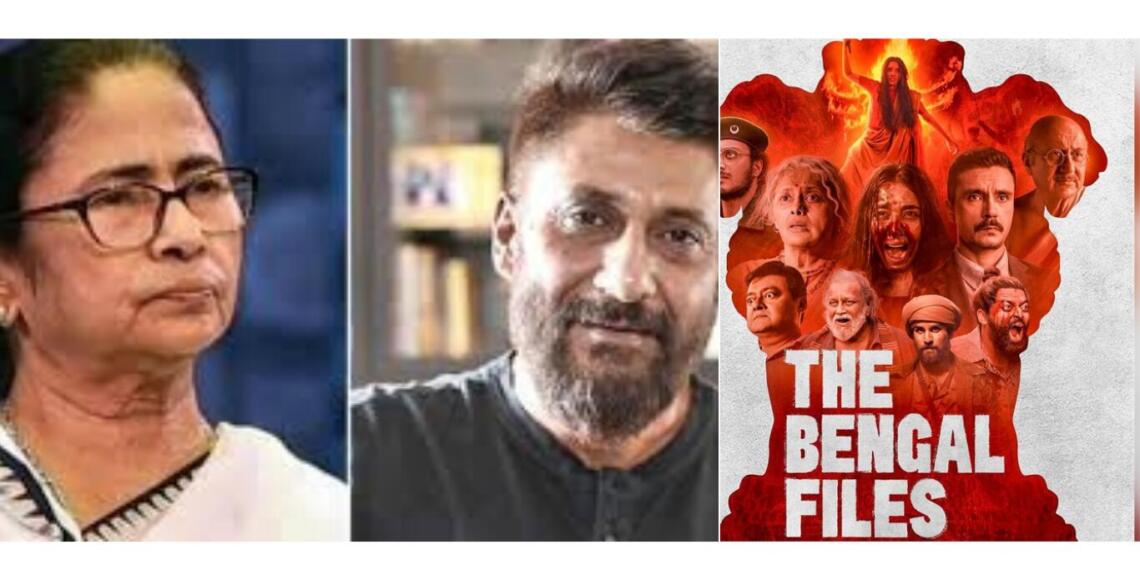
Vivek Agnihotri’s much-awaited film The Bengal Files hit theatres across India on September 5, but in West Bengal the very land where the tragic events unfolded it is facing what the director calls an “unofficial ban.” Multiplex owners have reportedly been threatened and pressured not to screen the film, allegedly at the behest of the state government. Actor-producer Pallavi Joshi has even written to President Droupadi Murmu, seeking intervention for its peaceful release. The larger question now hangs heavy: why is Chief Minister Mamata Banerjee so afraid of allowing the truth of Hindu genocide in Bengal to be told?
A Film on Bengal’s Darkest Chapter Blocked in Bengal
The Bengal Files, the concluding chapter in Agnihotri’s Files Trilogy, revisits the harrowing communal massacres triggered by the Muslim League’s call for “Direct Action Day” in August 1946, which led to the killings of thousands of Hindus in Calcutta and later the Noakhali riots. The film portrays the horrors of Bengal’s Partition-era violence, suppressed stories of Hindu genocide, and the struggles of women and families caught in the bloodshed.
Ironically, while audiences across India can watch the film, people of Bengal whose history it portrays are being denied the opportunity. According to Agnihotri, distributors revealed that police officials have directly warned theatre chains of “consequences” if they screen the movie. Threats of vandalism and mob violence, coupled with intimidation, have left theatre owners with no choice but to back out.
Agnihotri expressed anguish, stating: “When films on Muslim history can be made in this country, why can’t films on Hindu history? This is not about Hindus or Muslims it is about India’s history. Yet, Bengal is being stopped from seeing its own truth.”
Pallavi Joshi’s Emotional Plea to the President
Faced with mounting hostility, Pallavi Joshi, the film’s producer and lead actor, wrote a heartfelt letter to President Droupadi Murmu. In it, she detailed how the film has been stonewalled by West Bengal’s ruling establishment since its announcement. She wrote:
“Years before completion, the Chief Minister mocked the film. Since then, baseless FIRs have been filed, our trailer was blocked, newspapers avoided our ads, and my family has faced constant threats. Now, theatre owners are being intimidated, forcing them to refuse screenings. There is no official ban, yet an unofficial ban silences the film before people can see it.”
Joshi described the film as a tribute to the victims of Direct Action Day, the Noakhali riots, and the trauma of Partition. Her appeal was not for “favours” but for protection so that Bengal’s suppressed history could finally find a voice on screen.
Despite the intimidation, the film has garnered strong support from stalwarts like Victor Banerjee and several Bengali cultural organisations, who have praised it as an “ally of truth.” Yet, in West Bengal, political compulsions seem to outweigh the right of citizens to witness their own history.
Mamata Banerjee’s Appeasement Politics in Full Display
The refusal to allow The Bengal Files to be screened raises a critical question: what is Mamata Banerjee afraid of? Is she worried that acknowledging the truth of Hindu genocide in Bengal’s past will offend a particular community and threaten her vote-bank politics? By silencing the film, her government is effectively denying ordinary Bengalis the right to remember their history.
This is not the first time her government has been accused of double standards. While films glorifying minority narratives have been promoted without objection, a film that dares to expose the horrors inflicted on Hindus is branded “sensitive” and quietly throttled. This selective censorship betrays the very principle of democracy and free expression.
Agnihotri rightly pointed out that if Bengal is India’s cultural lighthouse, why should its people be kept in darkness about their own past? Appeasement politics cannot rewrite history, nor can it erase the pain of those who lived through the horrors of Partition. The truth must be faced, no matter how uncomfortable it is for politicians in power.
A Wake-Up Call for the Nation
The controversy around The Bengal Files is more than just about one film it is about the larger battle to preserve India’s civilisational truth. The tragedies of 1946 were not minor footnotes; they were watershed moments that scarred an entire generation. To suppress them for political convenience is to betray the memory of those who suffered.
The film features acclaimed actors like Anupam Kher, Mithun Chakraborty, Pallavi Joshi, Saswata Chatterjee, and Sourav Das. Its trailer carried a chilling line: “This is not just about land, Bengal is the lighthouse of Bharat.” That lighthouse, however, is now being dimmed by political expediency in Mamata Banerjee’s Bengal.
Agnihotri has described the film as a “wake-up call,” warning that “If Kashmir hurt you, Bengal will haunt you.” Indeed, just as The Kashmir Files uncovered suppressed truths about the Pandits, The Bengal Files seeks to expose the untold stories of Bengal. But the ruling establishment seems determined to bury them once again under fear and silence.
Why Is Bengal Afraid of Its Own History?
The refusal to allow The Bengal Files in West Bengal exposes the Mamata Banerjee government’s deep-seated politics of appeasement. Instead of respecting the people’s right to know their history, the state has chosen to bend before vote-bank considerations. If Bengal truly is the cultural heartbeat of India, then why must its history of Hindu genocide remain hidden?
Suppressing films like The Bengal Files does not erase history—it only delays the reckoning. Bengal deserves to know its truth, and India deserves to acknowledge it. Mamata Banerjee’s government must answer: is protecting political power more important than letting the truth of Bengal’s darkest chapter finally come to light?