










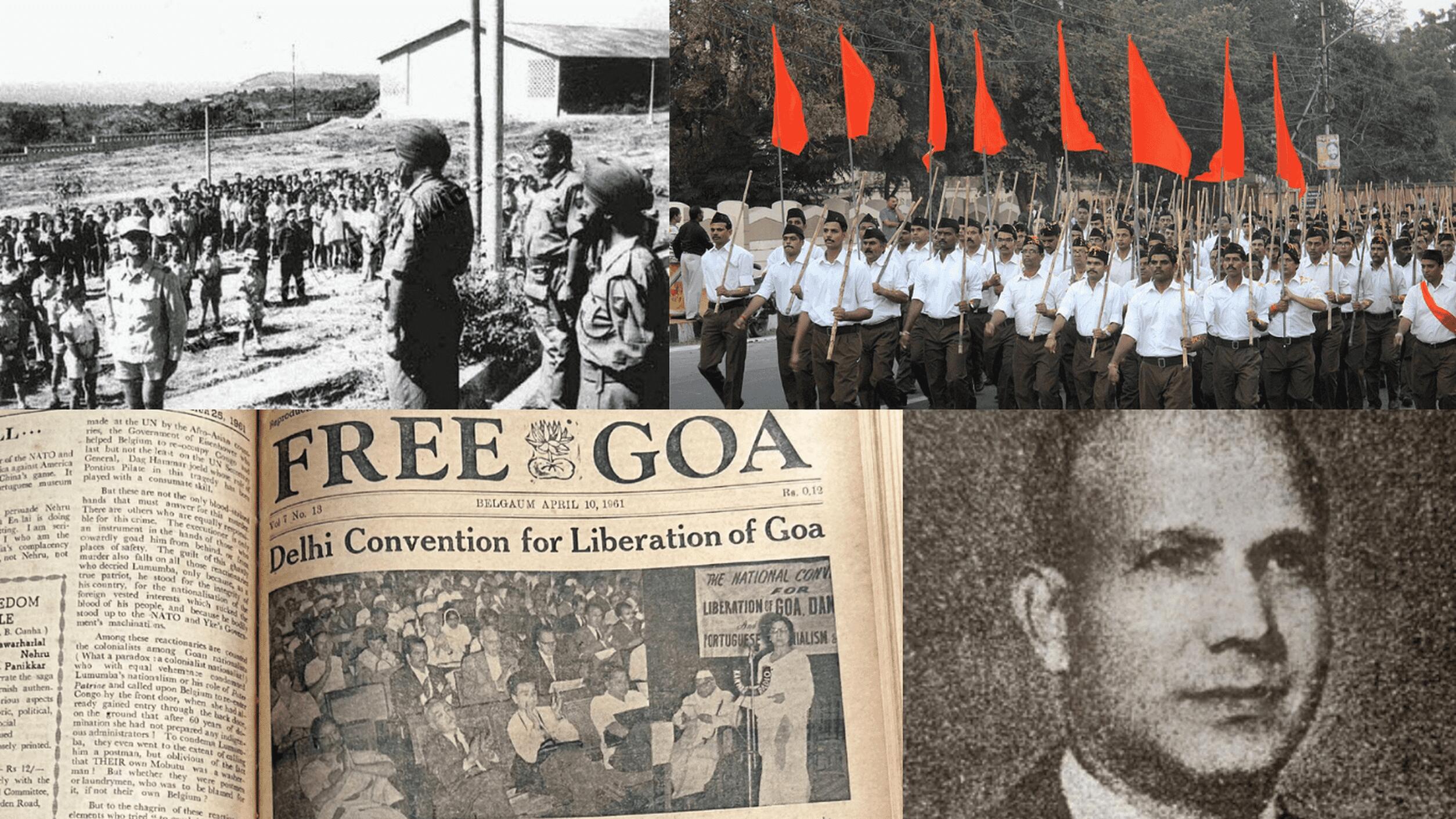
When we speak of India’s freedom struggle, our memory often halts at the British Raj and its downfall in 1947. Yet, there was another brutal colonial power still holding sway over parts of India, Portugal. Goa, Daman, and Diu remained shackled in Portuguese chains even after India achieved independence. The Portuguese were far more ruthless than the British, crushing dissent with inhuman violence and ignoring global calls for decolonisation. But in this dark chapter emerged brave patriots who refused to surrender. Among them was Vishwanath Narayan Lawande, a determined son of Goa who, inspired by socialist ideals and later supported by the nationalist zeal of RSS and Jana Sangh, played a decisive role in sparking the flames of liberation. His story, along with the sacrifices of thousands of Satyagrahis, remains a shining reminder of India’s unfinished battle against foreign oppression until 1961.
Portuguese Oppression: A Cruel Legacy
The Portuguese first seized Goa in 1510, a mere 12 years after Vasco da Gama set foot in Calicut. Unlike the British, who eventually yielded to political negotiations, the Portuguese clung to their colonial outposts with fanatic rigidity. Religious persecution, forced conversions, and violent suppression became the hallmarks of their rule. Even after India’s independence in 1947, Portugal, backed by NATO allies, arrogantly claimed Goa as its “overseas province.” Jawaharlal Nehru’s Congress government adopted a soft, diplomatic stance, reluctant to use military force. But the Portuguese brutality against ordinary Goans, including firing upon unarmed protesters, ensured that the demand for liberation could no longer be ignored.
Vishwanath Narayan Lawande: The Revolutionary Spirit of Goa
Born in Old Goa on February 21, 1923, Vishwanath Narayan Lawande hailed from a middle-class Brahmin family. Educated in Mumbai, Karnataka, and Banaras, he could have easily chosen a comfortable professional life. Instead, the call of freedom drew him into the Goa Liberation Movement. Deeply influenced by Achyut Patwardhan and Dr. Ram Manohar Lohia, Lawande began mobilising Goans against Portuguese imperialism after 1942. He soon became a voice of resistance, openly denouncing the atrocities of the colonial regime. His fiery speeches, including one alongside Dr. Lohia at Bhad village, led to multiple arrests. Yet, each time he emerged from jail, his commitment to the liberation cause grew stronger.
Azad Gomantak Dal and the Armed Resistance
In 1947, as India broke free from British rule, Lawande founded the Azad Gomantak Dal (AGD), a revolutionary organization that refused to wait for diplomacy. Alongside patriots like Narayan Hari Naik, Dattatreya Deshpande, and Prabhakar Sinari, the AGD launched direct action against Portuguese authority. They attacked police posts, treasuries, and colonial offices, sending a clear message that Goa would not remain enslaved forever. Many AGD fighters were captured, tortured, and even deported to Angola, yet the movement never died. Lawande himself escaped captivity and continued directing armed resistance, becoming a symbol of unyielding courage.
RSS, Jana Sangh, and the People’s Satyagraha
While Lawande and his revolutionary comrades fought on one front, the Rashtriya Swayamsevak Sangh (RSS) and Bharatiya Jana Sangh mobilised thousands of Satyagrahis across Bharat to expose Portuguese tyranny. Leaders like Jagannath Rao Joshi and Pandit Deendayal Upadhyaya led processions of volunteers to Goa’s borders. On August 15, 1955, nearly 5,000 Satyagrahis stormed the Goan frontier with cries of “Portuguese Quit India.” The Portuguese opened indiscriminate fire, killing 51 patriots and injuring hundreds. Women like Subhadra Bai displayed valour reminiscent of Rani Lakshmibai, carrying the tricolor even as bullets tore through their bodies. RSS women’s wing Rashtra Sevika Samiti, led by Saraswati Apte, organised logistics, food, and shelter for Satyagrahis in Pune and Belgaum, ensuring the movement never lost momentum. The Jana Sangh repeatedly demanded military action, accusing Nehru’s Congress of betrayal and cowardice. Deendayal Upadhyaya thundered in Delhi that Portugal would never leave without force, and the blood of martyrs must not go in vain.
Dadra, Nagar Haveli, and the Road to Goa’s Liberation
In 1954, the AGD, alongside RSS volunteers, liberated Dadra and Nagar Haveli, hoisting the tricolor after a fierce struggle. Lawande briefly served as its first administrator, proving that freedom was achievable even against NATO-backed Portugal. Meanwhile, international diplomacy failed. The Western powers, instead of siding with India, often shielded Portugal. Even Pakistan tried to exploit the situation, falsely equating Goa with Kashmir. Despite this, the Jana Sangh, RSS, and patriotic organizations intensified their campaign. Cultural icons like Sudhir Phadke (Babuji) used music and theatre to awaken nationalist fervor. The United Front of Goans also played its part, but it was the combination of armed struggle, people’s satyagraha, and nationalist mobilization that forced Nehru to finally abandon his passive stance.
Operation Vijay: The Final Blow to Portuguese Rule
By 1961, tensions reached a breaking point. After Portuguese troops fired on unarmed fishermen in November, patience ran out. Under public pressure, Operation Vijay was launched in December 1961. In a swift 36-hour campaign, Indian forces under General P.N. Thapar crushed Portuguese defences. Governor General Vassalo e Silva surrendered, and on December 19, 1961, the tricolor was hoisted over Panjim. Goa, Daman, and Diu were finally free. This victory was not merely a military triumph it was the culmination of years of sacrifice by revolutionaries like Vishwanath Narayan Lawande, the relentless campaign of RSS and Jana Sangh, and the blood of countless martyrs. Goa eventually attained statehood in 1987, but the spirit of its liberation remains etched forever in India’s nationalist history.
Remembering Lawande and the RSS Role in Goa’s Freedom
The Goa Liberation Movement is a reminder that freedom was not gifted by diplomacy but earned through courage, sacrifice, and nationalist struggle. On his death anniversary Vishwanath Narayan Lawande’s fearless leadership and the daring of Azad Gomantak Dal should be remembered. Also the determination of RSS and Jana Sangh ensured that Goa’s voice could not be silenced.
While Congress hesitated under Nehru’s cautious foreign policy, the RSS mobilized the nation, sending thousands of Satyagrahis to face Portuguese. The martyrdom of 1955 and the victory of 1961 proved that Bharat’s soul could never accept foreign domination. Their legacy is not just about the past it is a timeless call to safeguard Bharat’s unity, sovereignty, and dignity against all forces of oppression.