















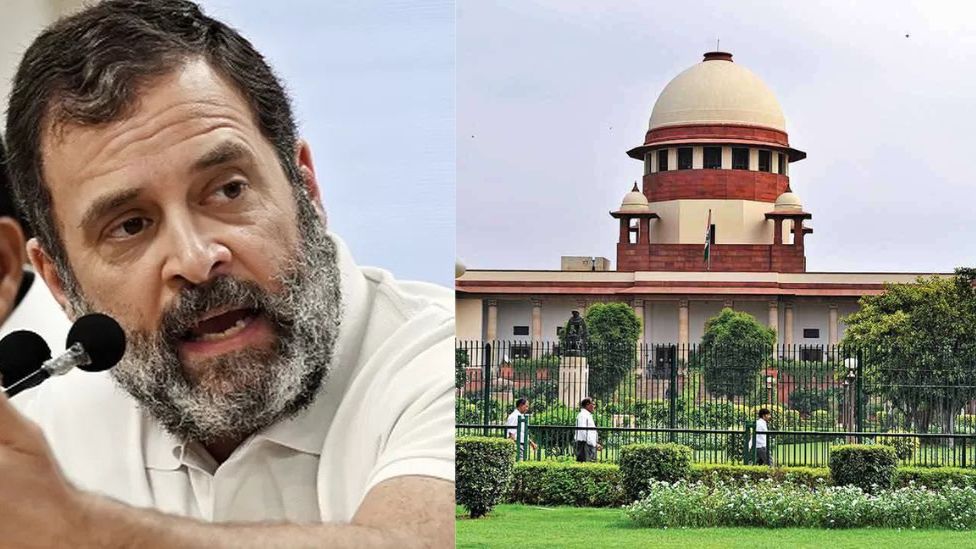
In a scathing courtroom moment that reverberated across the political spectrum, the Supreme Court of India on Monday tore into Congress leader and Leader of the Opposition Rahul Gandhi for his explosive claim that China had annexed 2,000 square kilometres of Indian territory.
In an unusually blunt rebuke, the bench questioned not just the factual basis of Gandhi’s statement but his very sense of national responsibility, remarking pointedly that ‘a true Indian’ wouldn’t make such unverified claims in public. The court’s remarks cut deep, casting a shadow over Gandhi’s credibility and raising sharp questions about the limits of political rhetoric in matters of national security.
Court Rebuke: ‘A True Indian…’
A bench comprising Justices Dipankar Datta and Augustine George Masih was hearing Gandhi’s Special Leave Petition challenging the criminal defamation case filed against him. The case stemmed from Gandhi’s remarks during his Bharat Jodo Yatra in 2022, where he claimed a former Army officer had informed him that Chinese forces had taken over a substantial swathe of Indian territory in Ladakh.
The bench was unsparing in its criticism. ‘Tell Dr Singhvi [Gandhi’s lawyer], how do you get to know that 2,000 square kilometres of Indian territory were occupied by the Chinese? Were you there? Do you have any credible material?’ Justice Datta asked. ‘Why do you make these statements without any basis? If you were a true Indian, you would not say all this.’
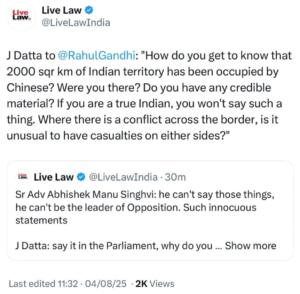
The court also questioned why Gandhi, a senior political leader, chose to make such statements in public forums rather than raising them within the halls of Parliament. ‘Why do you have to say this on social media? Why don’t you say it in Parliament?’ Justice Datta added.
Gandhi’s Controversial Remarks
Gandhi’s original statements were made in December 2022 and later reiterated in January 2023 at the conclusion of his nationwide foot march, Bharat Jodo yatra. He accused the Narendra Modi government of being in denial about the Chinese encroachment, which, according to him, was a dangerous policy position.
‘I recently met some ex-Army people and a delegation from Ladakh. They clearly told me that 2,000 square kilometres of our territory have been taken over by China,’ Gandhi had said. ‘The Prime Minister is the only person who believes otherwise.’
Gandhi also accused the government of weakening India’s stance against Beijing by refusing to publicly acknowledge the situation. His statements came shortly after External Affairs Minister S. Jaishankar indirectly accused him of spreading misinformation for political gain.
The Defamation Complaint
The defamation complaint was filed by former Border Roads Organisation (BRO) Director Uday Shankar Srivastava, who alleged that Gandhi’s comments were defamatory and disrespectful to the Indian Armed Forces. The case is currently being heard by a trial court in Lucknow.
The Allahabad High Court, on May 29, dismissed Gandhi’s plea to quash the complaint, ruling that freedom of speech cannot be used to malign constitutional institutions such as the military.
Gandhi then moved the Supreme Court, asserting that the complaint was politically motivated and aimed at silencing dissent. Senior advocate Dr Abhishek Manu Singhvi, representing Gandhi, argued that curtailing a Leader of Opposition from commenting on national issues was antithetical to democracy.
‘If he can’t raise these concerns which are already in public discourse and reported in the press, then he can’t do his job as Leader of the Opposition,’ Singhvi submitted.
Political Fallout
The BJP too endorced the Supreme Court’s sharp remarks. BJP IT Cell head Amit Malviya slammed Gandhi on X (formerly Twitter), dubbing him ‘China Guru’ and accusing him of habitual recklessness when it comes to national security.
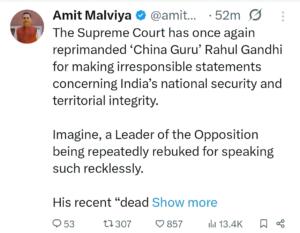
‘The Supreme Court has once again reprimanded Rahul Gandhi for irresponsible statements concerning India’s territorial integrity. Imagine, a Leader of the Opposition being repeatedly rebuked like this. His recent ‘dead economy’ jibe is yet another diplomatic and political misfire. He praises Pakistan’s economy while our own nation marches forward. This is not just carelessness; it’s dangerous,’ Malviya wrote.
Kiren Rijiju, Minister of Parliamentary Affairs too took to X (formerly Twitter) wrote:
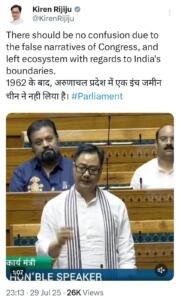
Kiren Rijiju tweeted ‘Supreme Court rebukes Shri Rahul Gandhi for irresponsible claim that Chinese occupied Indian Territory!’ He also added that ‘There should be no confusion due to the false narratives of Congress, and left ecosystem with regards to India’s boundaries’.
B L Santosh, National General Secretary of BJP also tweeted ‘Supreme Court has rapped Rahul Gandhi on the knuckles for his irresponsible statements on border issues and Galwan clash. He and his family have zero right to comment on China issue after all compromises and meet responses to cross border aggression’.
Political Rhetoric vs National Sensitivity
While the court has stayed the defamation case, its oral observations reflect a larger discomfort within the judiciary over political leaders making incendiary, unverified claims on matters of national security. The bench’s remarks, though not binding, send a strong message: dissent is welcome in democracy, but it must be rooted in responsibility.
Rahul Gandhi, for his part, continues to walk a tightrope between aggressive opposition and political miscalculation. While his camp argues that raising questions about Chinese incursions is part of democratic duty, critics view his statements as careless at best and demoralising to the armed forces at worst.
As the case moves forward, the Supreme Court’s intervention has given Gandhi temporary respite but not without placing him under a harsh spotlight. In an era where political speech is under constant scrutiny, the difference between speaking truth to power and speaking recklessly may well define the future of public discourse.