
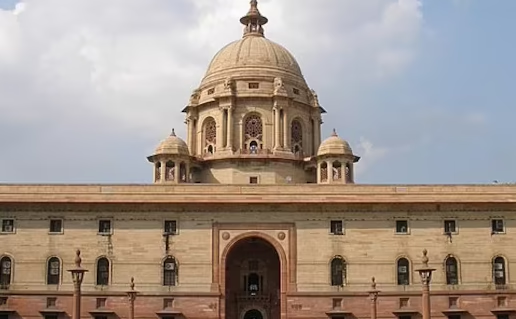
The heart of India’s power corridor is undergoing its most ambitious makeover in decades under the Central Vista Project, and at the centre of this transformation will stand the world’s largest museum, Yuge Yugeen Bharat.
Spanning 117,000 square meters with 950 rooms, the museum will replace the National Museum of India as the country’s flagship cultural institution. It will be housed in the historic North and South Blocks on Raisina Hill, the twin heritage buildings that have been home to India’s top ministries since independence.
The move comes amidst PM Modi’s recent inauguration of Kartavya Bhawan. It is the first of 10 to be inaugurated. Offices of top ministries such as home affairs and external affairs, besides rural development; micro, small and medium enterprises (MSME); and petroleum and natural gas, will operate from Kartavya Bhawan.
Reclaiming India’s Heritage
The Ministry of Housing and Urban Affairs (MoHUA), through the Central Public Works Department (CPWD), is leading a phased restoration of these Grade-I heritage structures. The Heritage Conservation Committee (HCC) recently granted approval for the first stage, refurbishing the North Block with strict directives to preserve the original Lutyens-era architecture, colour, and form.
Over the decades, internal partitions were added to meet office space demands; these will now be reconsidered to restore the original spatial grandeur. While CPWD works on structural longevity, the Ministry of Culture is shaping the narrative and gallery designs for the Yuge Yugeen Bharat Museum.
The National Museum’s Content Committee is carefully selecting artefacts that weave together India’s ancient traditions, medieval heritage, and modern achievements into a cohesive visitor experience. The aim is to create an institution that is both a global cultural destination and a celebration of India’s civilisational journey.
A Larger National Vision: Central Vista Project
The redevelopment of the North and South Blocks is only one part of the Central Vista Project, a sweeping plan to modernise India’s administrative heart while preserving its heritage icons. The project includes:
New Parliament Building: Already inaugurated and in use.
10 Common Central Secretariat Buildings: Designed to consolidate ministries now scattered across Delhi into modern, energy-efficient complexes.
Revamped Kartavya Path: Formerly Rajpath, redesigned as a pedestrian-friendly public space.
Conversion of heritage blocks into cultural hubs: Including the Yuge Yugeen Bharat Museum.
Prime Minister Narendra Modi recently inaugurated Kartavya Bhavan, the first of the new Secretariat buildings, signalling the start of a new era in administrative infrastructure. All 10 Secretariat blocks are targeted for completion within two years, which will free up heritage spaces like the North and South Blocks for cultural reuse.
In this master plan, Yuge Yugeen Bharat is more than a museum; it is a symbol of how the Central Vista Project blends governance, culture, and heritage preservation. The vision is to create a central district where the nation’s political, administrative, and cultural institutions coexist seamlessly in a modern yet historically respectful environment.
Once complete, the transformed Central Vista is expected to become both the nerve centre of Indian governance and a magnet for cultural tourism, with the Yuge Yugeen Bharat Museum as its crown jewel.