
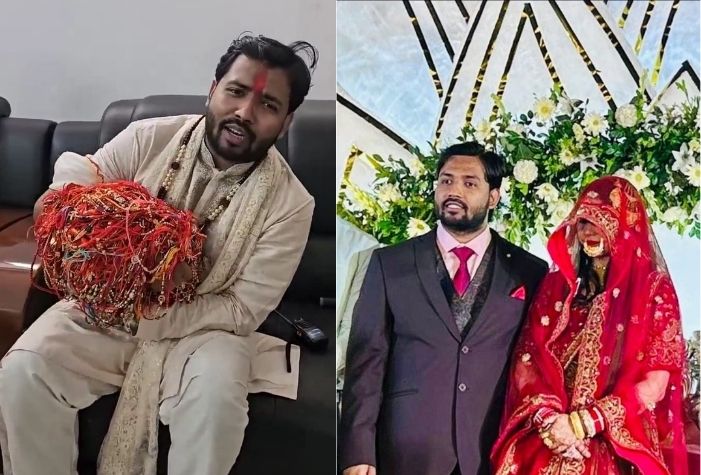
Certain sections of Indians have developed a strange obsession with manufacturing “secular heroes.” In the age of viral reels and instant fandom, Khan Sir of Patna has been elevated to that pedestal with positive optics- a smiling, story-cracking Muslim teacher who can break down UPSC and SSC concepts as if he’s chatting with you over a cup of chai. The narrative is polished: the humble man of the people, loved equally by Hindu and Muslim students, flooding YouTube with “nation-building” lectures.
But strip away the fanfare and one question glares back: Why should Hindus crave Khan Sir’s approval in the first place? And more importantly, why is a man, tainted by whispers of fundamentalist thinking, suddenly playing the benevolent bridge-builder for a Hindu audience? Is this genuine outreach, or a well-rehearsed act in the oldest playbook of image laundering?
‘The Wedding Veil’ Statement
The turning point for many critics came not from a classroom lecture, but from a wedding viral video. When photos emerged of Khan Sir’s bride with her face completely veiled, the reactions were swift and vicious: “He doesn’t even show his wife’s face, how is this man a secular icon?”
For his supporters, the outrage was absurd. They argue the veil was his wife’s personal wish, a childhood fantasy fulfilled on her wedding day. For his detractors, that explanation rings hollow, seeing the act as symbolic of an unshakable adherence to regressive norms.
Khan Sir’s public gestures celebrating Raksha Bandhan, quoting Hindu scriptures in class, engaging warmly with students across faiths are either evidence of genuine pluralism or, as critics claim, a carefully crafted image-management strategy.
Some Hindus suspect he is playing the “friendly Muslim” card to gain influence before revealing a more conservative core.
Some Muslims accuse him of bending over backwards to please the majority at the cost of his own community’s expectations.
In the end, both camps question his motives, just from opposite angles.
Until we stop mistaking optics for sincerity, India’s public discourse will remain trapped in this exhausting cycle of suspicion.
In the end, this isn’t about Khan Sir’s wedding veil, his classroom jokes, or his carefully staged gestures of harmony. It’s about a larger sickness in our public life, the belief that the Hindu majority somehow needs a certificate of approval from a Muslim public figure to feel validated. That desperation is both unnecessary and dangerous.
If Khan Sir’s outreach is genuine, it should stand on the test of consistency and courage, not on choreographed symbolism. If it’s a performance, then it deserves to be called out for what it is: calculated optics aimed at polishing an image, not mending a nation.
Hindus do not need Khan Sir’s nod, and they certainly don’t need to be flattered into accepting a narrative that masks ideology with charm. Approval-seeking is a trap; the sooner we stop walking into it, the sooner we can see people for what they truly are- beyond the PR, beyond the smiles, and beyond the veil.