
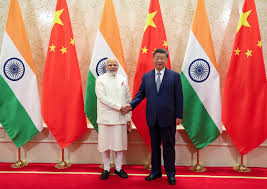
When Prime Minister Narendra Modi sat across from Chinese President Xi Jinping in Tianjin, the images that emerged were no ordinary photographs. They weren’t just about handshakes or protocol—they hinted at a new Asian balance taking shape. For India, they marked not only a cautious thaw in relations with Beijing but also a reminder to the world: New Delhi no longer drifts with global currents; it is increasingly the one redirecting them.
Much ink has been spilled in Washington about India’s recent unease with the U.S. A New York Times report even claimed that tensions were linked to Modi’s refusal to nominate Donald Trump for the Nobel Peace Prize. Whether or not that’s true, what matters is how India has turned this moment of flux into opportunity. While Washington lurches between tariffs and shifting loyalties, New Delhi has reasserted its independent voice.
India Writes Its Own Script in Tianjin
For years, America has cast India as its democratic cornerstone in Asia—a counterweight to China, a pillar of the Quad, a reliable partner in supply chains. But Tianjin revealed something different. India is not content to be someone’s “balancing power.” It is choosing to play its own hand, engaging China on its own terms, and refusing to let outside powers dictate Asia’s future.
The hour-long Modi–Xi dialogue was about more than flights or pilgrimages. It brought back words absent since the Galwan clash of 2020: “mutual trust,” “strategic coordination.” Modi reminded Xi that India and China together represent 2.8 billion people—nearly a third of humanity—and that endless confrontation serves neither side. In that moment, India reclaimed its role not as a bystander, but as Asia’s indispensable stabilizer.
Trump Loves Tariffs—Will He Love Tianjin Too?
The irony is sharp. U.S. tariffs on Indian goods—designed to tighten India’s dependence on the West—ended up nudging New Delhi and Beijing closer. China, quick to denounce the tariffs as “bullying,” positioned itself as India’s partner against economic coercion. India, without forgetting Galwan or decades of mistrust, seized the space for pragmatic engagement.
This is classic Indian diplomacy: turning pressure into leverage, adversaries into interlocutors, and crises into chances to expand options. Far from being anyone’s pawn, India has placed itself as the player who can tilt the balance between the West and Asia’s rising powers.
The SCO and a Multipolar Stage
The Shanghai Cooperation Organization (SCO) summit in Tianjin underscored this reality. Once dismissed as a talk shop, the grouping suddenly looks like the heart of a multipolar moment. With India, China, Russia, Iran, and West Asian partners such as Saudi Arabia and the UAE, it represents both demographic weight and energy power.
For Xi, the SCO was a platform to present China as a pole of an alternative order. For Modi, it was an even greater opportunity—to demonstrate that India is not a camp follower. His presence told Washington plainly: India is not bound to a single camp. It is the camp.
If India and China can even partially manage their rivalry—not resolve it, but manage it—the global implications are profound. Washington’s leverage over Asia would shrink. The long-dormant Russia–India–China (RIC) triangle could reemerge, rewriting rules of global governance in multipolar terms.
India’s Guiding Star
Of course mistrust remains. The border is tense. Galwan is not forgotten. But India has shown it will not be chained by the past—or by anyone else’s grand strategy. It will negotiate when useful, maneuver when necessary, and assert its interests always.
One day, historians may look back on Tianjin as the starting point of a new Asian equation. Some may say tariffs pushed it. Others may credit Trump’s antics. But the truth is simpler: it was India’s clarity of purpose that turned adversity into advantage.
In world politics, nothing is permanent except self-interest. And India has reminded everyone that its interests are not to be managed by others—they are to be managed by India alone.