
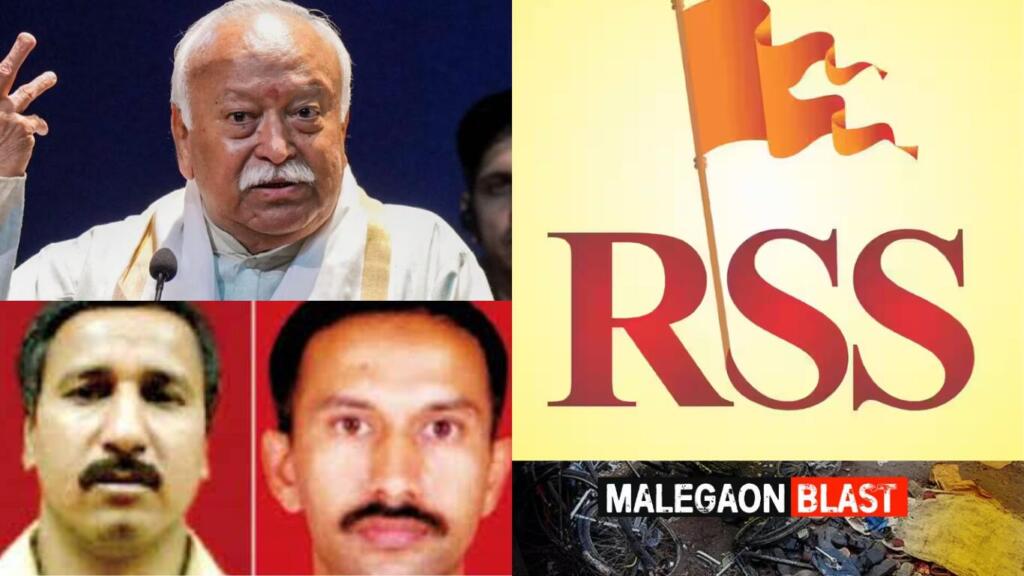
Now living quietly in Pune, former Maharashtra Anti-Terrorism Squad (ATS) officer Mehboob Muzawar has dropped a bombshell that could shake the very foundations of Malegaon Blast Case. Speaking to Dainik Bhaskar, Muzawar alleged that the ATS illegally detained three men linked to the Rashtriya Swayamsevak Sangh (RSS) Sandeep Dange, Ramji Kalsangra, and Dilip Patidar torturing them to death before officially declaring them “absconding.”
According to him, this was not a rogue episode but part of a larger conspiracy. The officers, he claims, fabricated an elaborate story involving 600 kilograms of RDX to falsely implicate former BJP MP Sadhvi Pragya Singh Thakur, Lieutenant Colonel Shrikant Purohit, and, ultimately, RSS chief Mohan Bhagwat in the 2008 Malegaon blast case.
Muzawar insists that if this conspiracy had succeeded, the existence of the RSS would have been “wiped out” in the public mind. Yet, almost two decades later, the alleged custodial killings of Dange, Kalsangra, and Patidar remain uninvestigated, and the officers he accuses are still walking free.
Fabricated Evidence and the Myth of 600 kg RDX
One of Muzawar’s most startling claims is about the “600 kg RDX” figure a number that became central to the Malegaon narrative. He says this was pure fabrication, designed to create a sensational link between the accused and an implausibly massive weapons cache.
The inflated figure, he argues, was not an investigative error but a deliberate political tool. It allowed the ATS to spin a sprawling terror conspiracy, rope in high-profile names, and justify extraordinary measures like extended detentions and secret interrogations.
The court’s eventual acquittal of all accused, Muzawar suggests, is not proof that justice was served but a confirmation that the case was rotten from the start. The real tragedy, he says, is that the people who allegedly orchestrated this frame-up and covered up three custodial killings remain untouched by the law.
Three Men, Three Families : No Closure, No Justice
The alleged victims were young, between 30 and 32 years old. Patidar had small children, Dange was an unmarried preacher, and Kalsangra was married. Muzawar says their deaths robbed their families not only of loved ones but of the right to truth and justice.
In court affidavits submitted in Solapur in 2015–16, Muzawar explicitly stated that Dange and Kalsangra were already dead, contradicting official records. Yet no judicial inquiry was ordered, no FIR registered, and no trial has ever taken place against the officers accused of involvement.
The question hangs heavy: if Muzawar’s account is accurate, how can officers implicated in custodial killings still serve without consequence? Why have the systems meant to prevent such abuses failed so comprehensively?
Inside the Alleged Conspiracy: ‘Bring Mohan Bhagwat’
Muzawar’s claims take the story far beyond procedural irregularities. He alleges that his then-superior, Param Bir Singh, recruited him on deputation to the ATS and provided a secret fund to form a special 10–12 member team. The mission, as he describes it, was chilling: detain RSS chief Mohan Bhagwat along with Dange, Kalsangra, and Patidar, and use them to cement a narrative linking the RSS leadership to the blast.
During the covert operations, all three men were allegedly picked up in Indore. Muzawar says they were interrogated for 15 days straight, with Patidar being targeted solely because he had rented a room from Kalsangra. Refusing to carry out an abduction of Bhagwat, Muzawar claims he was punished framed in a false case, jailed for 20 days, stripped of salary for 7–8 years, and forced into retirement under suspension.
The fate of the three detained men, according to Muzawar, was sealed in those interrogation rooms. “They were murdered brutally,” he says, maintaining that their deaths were concealed by staging police visits to their homes and continuing to list them as “absconding” in official records.
The Malegaon Blast Case: From Tragedy to Acquittal
On 29 September 2008, a bomb exploded in Malegaon, Maharashtra, killing six and injuring over 100. Within weeks, ATS officers claimed to have cracked the case, naming Sadhvi Pragya and Colonel Purohit as key conspirators. The narrative quickly expanded to suggest a “Hindu terror” network, with RSS-linked figures painted as part of a dangerous extremist plot.
Fast forward to 31 July 2025 after 17 years of trials, delays, and shifting charges a special court acquitted all nine accused, including Sadhvi Pragya and Purohit, citing lack of credible evidence. But even before the verdict, Muzawar had been alleging that much of the case was built on fabricated evidence, coerced confessions, and deliberate suppression of the truth.
Justice Denied Twice Over
The Malegaon blast verdict closes a 17-year chapter for the accused, but it does nothing to address the darker allegations raised by Mehboob Muzawar. If his account is true, there are two tragedies here: the deaths of six innocent people in the blast, and the unlawful killing of three more in ATS custody followed by a state-sanctioned cover-up.
Seventeen years on, neither the families of the blast victims nor those of Dange, Kalsangra, and Patidar have received full justice. The court’s acquittal removes a legal cloud over the accused, but it leaves untouched the question of accountability for the officers who, according to these allegations, abused their power to settle political scores. Until those questions are confronted in a court of law with evidence examined, witnesses heard, and culpability assigned the Malegaon case will remain less a story of justice delivered than one of justice denied twice over.