






















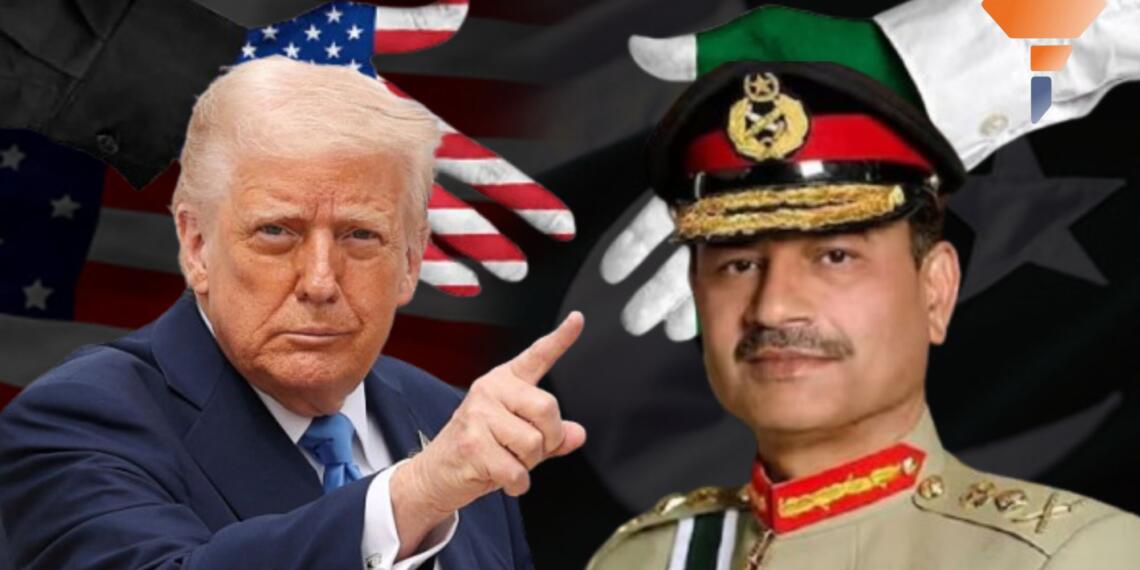
In a shocking display of recklessness, Pakistan’s Army Chief Field Marshal Asim Munir has issued nuclear threats and he did it not from Islamabad, but from US soil. This marks the first time in history that a Pakistani military chief has used an official visit to America to peddle nuclear sabre-rattling. Munir’s remarks, dripping with hostility and devoid of any responsibility expected from a nuclear-armed state, have raised eyebrows globally. The world has long been aware of Pakistan’s dangerous nexus between its military, extremist ideology, and its nuclear arsenal — but the fact that such language was uttered on American soil, with no immediate condemnation from Washington, exposes a glaring double standard in the West’s approach to “responsible nuclear powers.”
The Provocation in His Own Words
In Tampa, Munir attended the Retirement Ceremony of outgoing US Central Command (CENTCOM) Commander General Michael Kurilla and the Change of Command Ceremony for Admiral Brad Cooper, who took over as CENTCOM head. Munir praised Kurilla’s leadership and contribution to US-Pakistan military ties, while wishing Cooper success in tackling shared security issues.
Munir, on his second US visit in two months since the four-day conflict with India, took aim at India over control of the Indus River. “We will wait for India to build a dam, and when it does so, we will destroy it with ten missiles,” he said, adding, “The Indus river is not the Indians’ family property… We have no shortage of missiles, Alhumdulillah,” Munir said, as quoted by ThePrint, citing sources.
“We are a nuclear nation. If we think we are going down, we’ll take half the world down with us,” he said, according to reports.
For the global audience, these may sound like standard Pakistan Army talking points but the context makes them unprecedented. This was not an emotional outburst at home; it was a carefully staged statement, in a foreign country, during a high-profile diplomatic visit. The message was deliberate: to project Pakistan’s nuclear arsenal as a political weapon against India while attempting to garner sympathy from Washington’s policymakers.
Pakistan’s Nuclear Obsession and Strategic Irresponsibility
Pakistan has a long history of using its nuclear capability as a shield to conduct terror operations against India. From the Kargil War in 1999 to countless cross-border terror attacks in Jammu and Kashmir, the Pakistani establishment has relied on the narrative that India cannot retaliate beyond a point because of the “nuclear card.” What Munir did in the US was to reaffirm this dangerous doctrine in public, legitimising Pakistan’s policy of using nuclear weapons as both deterrent and diplomatic blackmail.
Unlike responsible nuclear powers such as India, which maintains a “No First Use” policy and treats nuclear weapons as a last-resort deterrent, Pakistan flaunts its arsenal as a primary tool of statecraft. Munir’s statement reflects not just military posturing, but a deep strategic immaturity — an attempt to gain relevance in Washington by painting India as an aggressor, while whitewashing Pakistan’s own track record of exporting terrorism.
General Asim Munir had also reportedly said at a Pakistani community event in Tampa, Florida, “India is shining a Mercedes coming on a highway like Ferrari, but we are a dump truck full of gravel. If the truck hits the car, who is going to be the loser?
Munir Threatens Indian Industrialist : US Hypocrisy on Full Display
What makes this episode even more troubling is the setting. Munir’s remarks were made in the United States the same country that routinely lectures the world about nuclear responsibility, arms control, and the need to avoid escalatory rhetoric. Washington has historically been quick to condemn even mild comments from countries it views with suspicion, but when it comes to Pakistan, silence seems to be the default setting.
From his pre-prepared notes, Munir read, “Ek tweet karwaya tha with Surah Fil and a picture of (the industrialist) Mukesh Ambani to show them what we will do the next time.” Surah Al-Fil, also known as “The Elephant,” is the 105th chapter of the Quran, which describes how Allah sent birds to drop stones on an enemy’s battle elephants and reduced them to “chewed-up straw”.
“We’ll start from India’s East, where they have located their most valuable resources, and then move westwards,” Munir was quoted as saying by ThePrint.
Munir, a conservative, is reportedly the first Pakistan army chief to have a seminary education.
The question is obvious: will the US issue even a symbolic statement of disapproval, or will it continue to indulge Islamabad because of short-term geopolitical calculations in Afghanistan and the region? This hypocrisy is not lost on India, which has been a consistent partner to the US in counter-terrorism, trade, and global security. While India’s nuclear posture is measured and transparent, Pakistan’s is opaque, unstable, and heavily influenced by military adventurism. Yet, Washington’s strategic patience with Islamabad persists even when a Pakistani Army Chief openly threatens nuclear retaliation against a democratic neighbour from American soil.
Pakistan’s Growing Isolation and Desperation
Munir’s nuclear rhetoric also reflects Pakistan’s internal desperation. The country is battling economic collapse, IMF dependency, political instability, and a growing insurgency in its own provinces. In such circumstances, Pakistan’s military leadership often resorts to externalising threats painting India as the eternal enemy to distract its population from domestic failures. Nuclear sabre-rattling has become a convenient political tool to rally nationalist sentiment at home and project power abroad.
But the international audience is not blind. The Financial Action Task Force (FATF) has repeatedly flagged Pakistan’s links to terrorism financing, and its military-intelligence establishment has been exposed multiple times for harbouring wanted terrorists, including Osama bin Laden. In this context, Munir’s comments only reinforce the global perception of Pakistan as an irresponsible custodian of nuclear weapons.
India Must Respond Firmly, and the US Must Choose Its Side
It is imperative for India to treat Munir’s nuclear threats with the seriousness they deserve not because Pakistan is likely to follow through, but because such rhetoric aims to shape global narratives. New Delhi should use diplomatic channels to highlight the recklessness of these statements and to press Washington for a formal clarification on its stance. Silence from the US would set a dangerous precedent, effectively normalising nuclear threats in official discourse.
For the United States, the choice is clear: it can either stand by its own stated principles of nuclear responsibility and condemn Munir’s rhetoric, or it can quietly enable a military establishment that has a history of destabilising South Asia. The world cannot afford to let Pakistan’s nuclear blackmail become an accepted tool of diplomacy. India, with its track record of restraint and adherence to international norms, remains the responsible actor in this equation.
Munir’s words from US soil are a warning not of an impending war, but of the moral erosion that occurs when powerful nations allow reckless actors to speak unchecked. The US must act, and India must ensure the world remembers exactly who is brandishing the nuclear card in South Asia.