
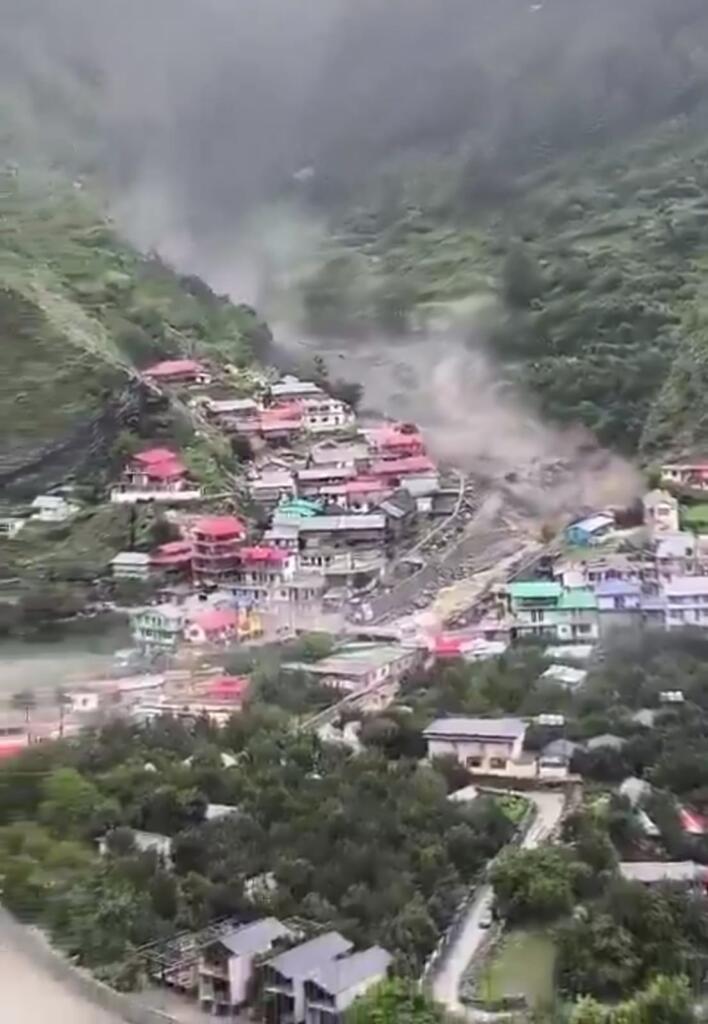
On August 5, 2025, the serene mountain village of Dharali in Uttarkashi district, Uttarakhand saw catastrophic devastation by a massive flash flood that swept away lives, homes, and history; leaving at least four dead, over a hundred missing, a market destroyed, and a temple buried beneath debris.
But while authorities first pointed to a cloudburst, mounting evidence suggests something even more alarming: a possible glacier collapse or lake burst. Rescue operations led by the Indian Army, SDRF, and NDRF were challenged by harsh weather, unstable terrain, and vast stretches of debris.
This incident stands out not just for its destruction but also because it questions the traditional understanding of flood triggers in the Himalayas. Initial fears of a cloudburst were debunked by meteorological data, which showed rainfall levels too low for cloudburst classification. Instead, satellite imagery and expert analysis point toward a glacial event, a chilling reminder of how fragile and unpredictable these high-altitude ecosystems have become.
A History Written in Water and Ruins
The mountains remember. From Kedarnath in 2013 to Chamoli in 2021, and now Dharali in 2025, the Himalayas have been trying to tell us something. The 2025 Dharali disaster is not an isolated tragedy. Uttarkashi and its surrounding regions have faced multiple such catastrophic floods over the past two decades:
In 2013, flash floods and landslides across Uttarakhand (especially Kedarnath and Uttarkashi) resulted in thousands of deaths in what was one of India’s worst natural disasters.
The August 2012 floods killed at least 34 people after heavy rainfall and cloudbursts battered villages.
In the 2021 Chamoli disaster, a massive rock-ice avalanche triggered a glacial lake outburst, destroying two hydro projects downstream.
Year after year, monsoon-triggered flash floods have stranded pilgrims, washed away bridges, and turned narrow mountain rivers into raging torrents.
These past instances underscore a disturbing pattern: flash floods in Uttarkashi are becoming more frequent, intense, and deadly.
But What Exactly is a Flash Flood?
A flash flood is a sudden, violent flood event caused by heavy rain, glacial activity, or dam/lake breaches, which occurs within minutes to hours of the trigger. Unlike general flooding, flash floods are fast, forceful, and often without warning, making them especially lethal in narrow mountain valleys.
They’re often misunderstood as being synonymous with heavy rain, but not all rain leads to flash floods. For instance, a cloudburst (defined as >100 mm of rainfall in an hour over a small area) may cause one, but so can the collapse of a glacier or the bursting of a glacial lake.
In Dharali’s case, rainfall was only 95.4 mm between 8:30 am and 5:30 pm, below the threshold for a cloudburst. Yet the destruction was massive, pointing to a hidden threat high in the mountains likely a weakened glacier or an overfilled glacial lake suddenly giving way.
Why Do Such Events Keep Happening in Uttarkashi?
Several natural and human-induced factors converge in Uttarkashi to make it a flash flood hotspot:
Topography: With steep slopes, narrow valleys, and high-altitude glaciers, the terrain funnels water and debris rapidly downstream.
Climate Change: Rising temperatures have accelerated glacier melt, forming hundreds of unstable glacial lakes in Uttarkashi, many marked ‘high risk’ by geologists.
Rainfall Patterns: The monsoon is becoming more erratic, with extreme rainfall days increasing in frequency and intensity.
Unplanned Development: Roads, hotels, and hydropower projects have destabilized slopes and blocked natural drainage paths, worsening the impact of floods.
Historical Load: The region carries centuries of moraines and loose glacial debris, which get dislodged during such events and flow like liquid cement.
Is Flash Flooding the Only Threat?
No. While flash floods are the most visible disasters, they are part of a larger web of Himalayan risks- landslides, avalanches, glacier bursts, and even earthquakes. These are interlinked. For example, a small landslide could breach a glacial lake; an earthquake could trigger a glacier collapse; intense rainfall might saturate loose soil and cause entire slopes to fail.
Thus, flash floods are not just a result of rainfall, but of the region’s inherent fragility, now amplified by human pressure and warming temperatures.
The Dharali flood is a tragic chapter, but it should also be a turning point. Scientists are urging for:
Real-time monitoring of glaciers and glacial lakes via satellite and ground sensors.
Better forecasting and warning systems for both cloudbursts and GLOFs.
Strict construction norms in ecologically sensitive zones.
Community awareness and disaster drills in flood-prone villages.
As Uttarkashi continues to reel from this latest tragedy, one message is clear: the Himalayas are warning us. We must listen before the next village, market, or sacred shrine is swept away.