
















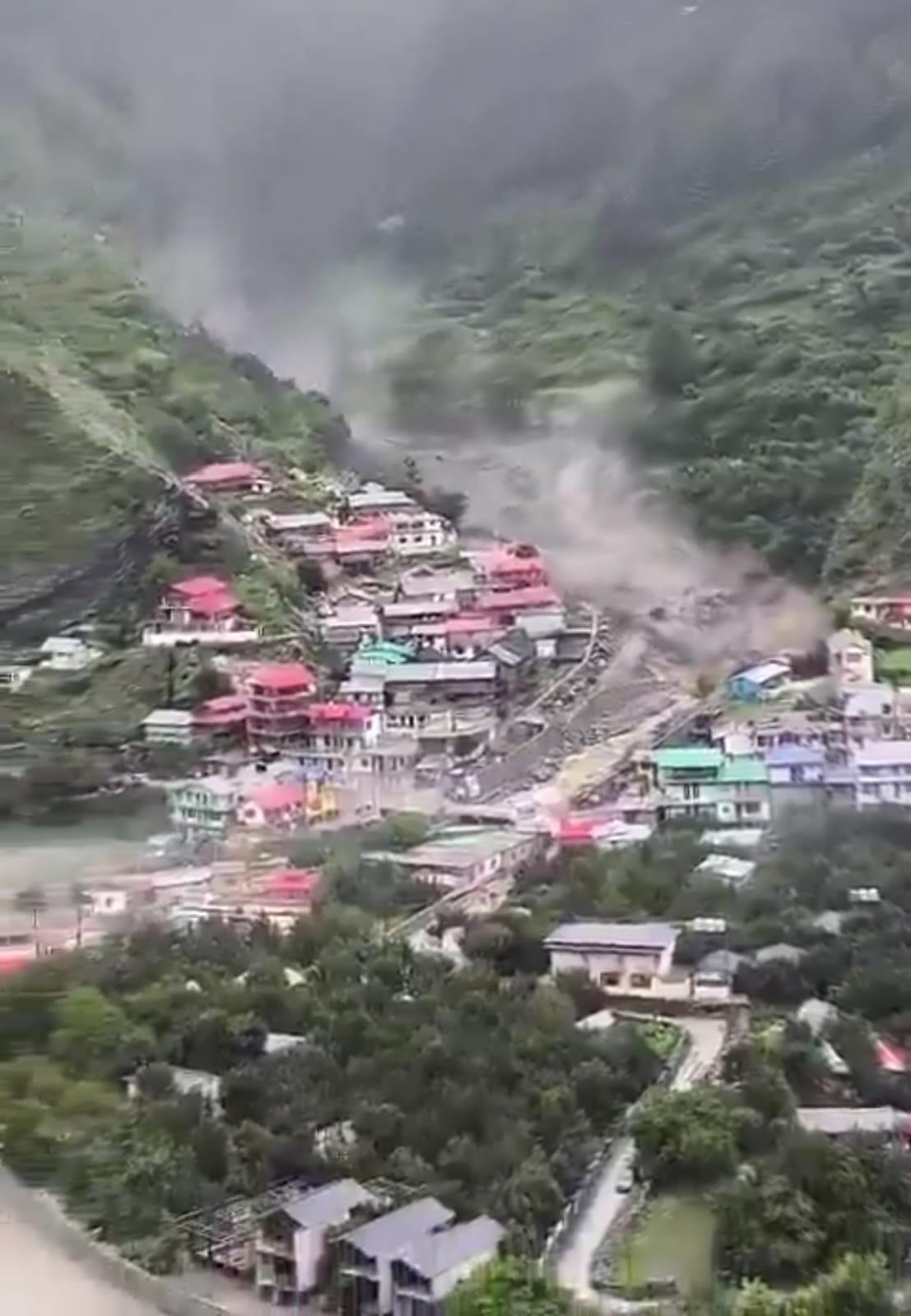
As torrential rains and cloudbursts wreaked havoc in Uttarakhand, leaving behind a trail of destruction and despair, most of India responded with empathy and grief. But amid the mourning, a sinister echo emerged from a section of populace, a disturbing chorus of mockery and glee from radical Islamist elements, who viewed the tragedy not as a humanitarian crisis, but as a cause for celebration.
The floods that ravaged our Devbhoomi Uttarakhand, revered in Hinduism as the land of the gods were grotesquely framed by some extremist voices as divine retribution, a cosmic ‘bulldozer’ sent by nature to punish Hindus. This perverse celebration of death and devastation reveals a festering ideological rot, one that cloaks itself in religiosity while discarding every shred of human decency.
Hatred Unmasked in Digital Glee
Social media platforms, which often become spaces of solidarity during national tragedies, were tainted by the likes of Ali Sohrab and Karishma Aziz, online figures whose reactions to the flooding showcased not concern, but gloating. Using phrases like nature’s bulldozer, they twisted a natural calamity into a malicious narrative of vengeance, attempting to frame the floods as a divine backlash against Hindus and the state’s governance.
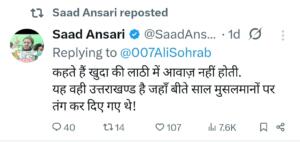
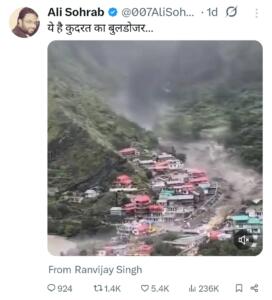
Posts flooded in, not with prayers, but with thinly veiled delight. Some asked mockingly whether this was a disaster or a bulldozer at work, others smugly invoked phrases like “Khuda ki laathi mein awaaz nahi hoti” (God’s stick strikes silently), a revolting rationalization of suffering as divine punishment. This is not satire. This is ideological sadism.
A Backlash Against Accountability
To understand this poison, one must trace the political context. Under the leadership of Chief Minister Pushkar Singh Dhami, Uttarakhand has seen bold moves to reclaim illegally encroached land, many of which were occupied by unauthorized religious structures, including Islamic ones. Bulldozers became a symbol of a government reclaiming the rule of law, not discriminating on the basis of faith, but enforcing legality across the board.
But for certain entrenched Islamist elements, accustomed to decades of political appeasement, equality is seen as an attack. When everyone is held to the same standard, those long shielded by victimhood politics cry persecution. Their wrath is not about injustice; it is about the erosion of unearned privilege.
And so, the floods, which should have united the nation in shared grief, were instead hijacked as an opportunity for ideological retribution. In their eyes, this wasn’t a natural disaster; it was Allah’s answer to the bulldozers. Such framing isn’t protest, it is hate speech. It is the deliberate dehumanization of an entire community, rooted in theological supremacy, and shielded by selective secular silence.
The Deafening Silence of the ‘Secular’ Class
Perhaps more troubling than the hatred itself is the silence that surrounds it. Had Hindus mocked the tragedy of a Muslim-majority region, headlines would have screamed, debates would have raged, and op-eds would have poured in.
This selective outrage, this partisan compassion, has allowed Islamist supremacism to grow unchecked under the guise of minority rights. When hatred is celebrated and suffering is mocked, and no prominent secular voice rises in protest, it is not neutrality. It is complicity.
Let us be clear, this is not about India’s Muslim community. Millions of Indian Muslims reject this hate and mourn the loss of life just like any other citizen. The issue lies not with a religion, but with a poisonous ideology- ‘Islamist extremism’ that thrives on grievance, views equality as oppression, and weaponizes tragedy to push communal agendas.
India has endured calamities, both natural and man-made, but few moments have revealed such a stark moral divide. The idea that one can laugh at the drowning of villages, the displacement of families, and the destruction of livelihoods just because it happened in a Hindu-majority state is not political commentary. When death becomes a meme, and divine wrath is weaponized in the name of sectarian revenge, we are not witnessing dissent, we are staring into the abyss of radicalized inhumanity.
The Bulldozer as Symbol of Justice, Not Hate
The bulldozer, in today’s political discourse, is not a symbol of religious persecution, it’s a symbol of governance, of long-overdue enforcement of the law. Its opponents don’t hate the machine; they hate the message- that no one is above the law, regardless of faith.
The flash floods have shown us more than nature’s fury; they have exposed an undercurrent of festering hate that cannot be ignored. If India is to survive as a pluralistic republic, it must draw a firm line. Ideological hate- whether Hindu, Muslim, or otherwise must be condemned with equal force. The tragedy in Devbhoomi should have been a moment of national mourning. That it became a festival of mockery for some is a national shame.
In the face of such cruelty, silence is no longer an act of peace, it is an endorsement. Bharat must find the moral courage to call out this sickness by its name. Hatred, regardless of the source, is not dissent. It is treason to the human soul.





