
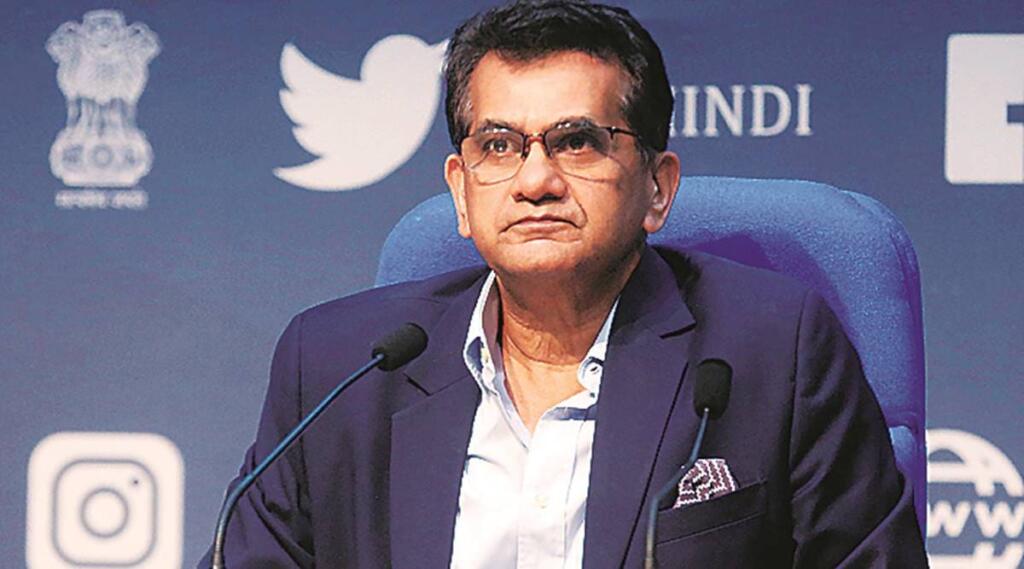
When U.S. President Donald Trump announced a sudden doubling of tariffs on Indian exports from 25% to a staggering 50%, many in India reacted with concern. But for Amitabh Kant, former G20 Sherpa and ex-CEO of NITI Aayog, the move represents not a mere setback, but a clarion call.
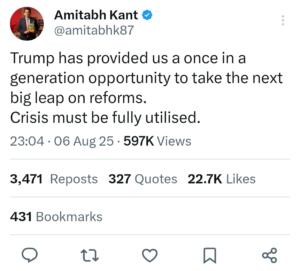
In a bold statement posted on X (formerly Twitter), Kant called the tariff escalation a “once-in-a-generation opportunity” for India to enact long-overdue economic reforms. “Trump has provided us a once in a generation opportunity to take the next big leap on reforms. Crisis must be fully utilised,” he declared.

To him, this moment is not unlike India’s Agneepath, a hard but necessary path of transformation. It is, as he puts it, time to scale the “tariff Deewaar”, a symbolic wall of protectionism and inefficiency that India must now break through.
A Shock, But Also a Catalyst
The tariff hike, which targets a wide array of Indian goods ranging from textiles, chemicals, and gems to machinery and furniture poses a serious risk to India’s export competitiveness. Products such as vehicles and petroleum will also face higher duties, and the repercussions are already rippling through Indian trade corridors.
Yet Kant’s stance is clear: this external shock should not merely be viewed as a hurdle. Instead, it must serve as a catalyst for structural transformation.
India must stop treating adversity as an excuse for protectionism. It must now modernize manufacturing, raise product quality, and execute long-pending reforms in trade, industry, and policy.
Global Lessons: Countries That Turned Crisis into Growth
Kant draws inspiration from a host of Asian economies that turned crisis into opportunity, nations that faced deeper devastation but rose by embracing reform, quality, and competitiveness.
Japan: The Economic Miracle Post-WWII
In the ashes of World War II, Japan faced total economic collapse. Yet, through strategic industrial policy, investment in technology and education, and a disciplined corporate structure, Japan rose to global prominence in sectors like automobiles, electronics, and robotics.
The keiretsu system of corporate alliances and the culture of precision and quality enabled Japan to become a world leader, demonstrating what is possible when a country refuses to let crisis define its future.
South Korea: From Poverty to Global Powerhouse
South Korea, emerging from the Korean War even poorer than the North, engineered an economic miracle through chaebols like Samsung and Hyundai. With a strong focus on education, global competitiveness, and collective discipline, South Korea achieved decades of rapid growth and became a major exporter.
The national ethos of “working harder after every crisis” became a pillar of its transformation.
Taiwan and Singapore: Quality over Quantity
Both Taiwan and Singapore started with limited resources and fragile post-colonial foundations. Taiwan invested in manufacturing and electronics, while Singapore focused on education, workforce development, and becoming a hub for finance and logistics.
Singapore’s transformation from a trading outpost to a high-income global city exemplifies how policy clarity and execution can redefine a nation’s trajectory.
China: Reform and Opening Up
China’s shift from strict central planning to a market-oriented economy in 1978 under Deng Xiaoping unleashed decades of growth. Massive infrastructure investments, manufacturing scale, and export focus turned it into the “world’s factory.”
While its model may not be fully replicable, China’s leap reflects the power of decisive reform and integration with global markets.
Vietnam: The Doi Moi Revolution
Following war and stagnation, Vietnam’s Doi Moi reforms in the 1980s liberalized the economy and opened it to foreign investment and global supply chains. The result: rapid poverty reduction and integration into the modern global economy.
India’s Wake-Up Call
Analysts across the board are echoing Kant’s assessment: while Trump’s tariffs will hurt in the short term, they may serve as a “wake-up call” for Indian industry and policymakers. Robinder Sachdev, President and Vice Chairman of the Imagindia Institute, a prominent public voice, summed it up succinctly: Indian work force should shift to a six-day workweek, which represent a 20% increase in available labour time, hence, increasing the GDP by 2% in one year.
There is a consensus that India must:
Modernize its manufacturing ecosystem to boost productivity and quality.
Streamline trade and industrial policies, removing bureaucratic hurdles.
Invest in workforce skills and technology, especially in sectors like semiconductors, EVs, and AI.
Diversify export markets, reducing overdependence on any single nation.
Encourage domestic firms to move up the value chain and aim for global leadership.
Complacency is No Longer an Option
For decades, India’s export strategy has depended heavily on cost competitiveness and favorable trade preferences. The Trump tariffs have now shaken that foundation. They also underscore a deeper vulnerability, an overreliance on low-margin manufacturing and fragile global goodwill.
To stay competitive, Indian firms must produce world-class goods, not just low-cost alternatives. This requires a nationwide effort from government policy to corporate boardrooms to factory floors.
India’s “tariff Deewaar”, a metaphorical wall built from protectionism, inefficiency, and complacency now stands as the ultimate test. Will India scale it like Japan, South Korea, and China once did? Or will it retreat into a shell?
Amitabh Kant believes the choice is clear.
This is India’s Agneepath. The path may be painful. But as history shows, it is also the only path to real transformation.
“Let us not waste this crisis,” Kant says. “Let us use it to become a high-quality, high-tech, globally competitive economy.”
The time for incrementalism is over. The age of reinvention has begun.