
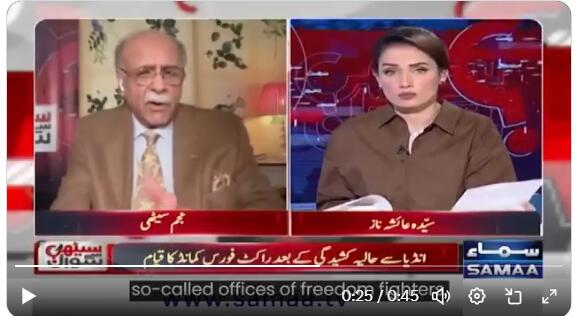
A top Pakistani journalist and political commentator Najam Sethi has punctured the Pakistan’s narrative of standing any ground against India during Operation Sindoor. The senior Pakistani journalist deemed close to the establishment, recently admitted speaking on Samaa TV, Pakistan’s vulnerabilities when it comes to countering India’s precision missile strikes.
Sethi highlighted that India has developed the capability to strike deep inside Pakistani territory with accuracy, while Islamabad lacks a robust defence system to counter such attacks. “India managed to target parked aircraft. We couldn’t do the same,” Sethi said, bluntly acknowledging Pakistan’s limitations. He said “we don’t possess defence systems like S-400s”.
Operation Sindoor, launched by India in May 2025 in response to a major terror attack in Pahalgam, became the backdrop for an unprecedented surge of misinformation and fake news especially regarding supposed attacks, military operations, and dramatic outcomes, spread predominantly by Pakistani sources and social media networks. This flood of disinformation distorted the true nature of the operation and India’s actions, while Indian authorities mounted continuous fact-check efforts to counter these fabrications. Its been 3 months to the operation and steadily true information is coming to surface which reveals the dire state of Pakistan’s defense system and its shortcomings.
Operation Sindoor is India’s response to Pakistan Sponsored Terrorism. The term Sindoor, a bright vermillion powder traditionally applied along the hair parting by married Hindu women; symbolizes commitment, protection, and the sanctity of vows.
On April 22, terrorists murdered at least 26 individuals by shooting them in Pahalgam, Jammu and Kashmir. The terrorists questioned the victims about their religion before shooting them, and even forced people to undress, allegedly to check for circumcision- which is a distinctive body feature for men who follow Abrahamic religion. During the initial probe into the attack, it was revealed that the terrorists involved had direct connections with Pakistan. This terrorist attack had ignited the people of India with great anger and outrage. There were demands all around that this time around, firm and decisive action has to be taken against Pakistan.
To retaliate against the Pahalgam attack, India launched airstrikes against terrorism in Pakistan and Pakistan-occupied Jammu and Kashmir (PoJK) under “Operation Sindoor”. In this operation, India targeted and destroyed nine terrorist camps, deep within Pakistan, and sent across the world a strong message that its anti-terrorism policy is now firmer and more resolute. “Operation Sindoor” reaffirmed once again India’s military might, strategic prowess, and technological prowess.
The operation is also reportedly as a transformative moment, it highlighted India’s shift from strategic restraint to decisive action, with the government claiming a strengthened security apparatus. It also demonstrated a new strategic red line for India, making it clear that any future terror attacks will be treated as an act of war, with a strong response against both terrorists and their sponsors. India’s actions redefined the rules of engagement and challenged the notion that Pakistan-based terror groups operate with impunity.