
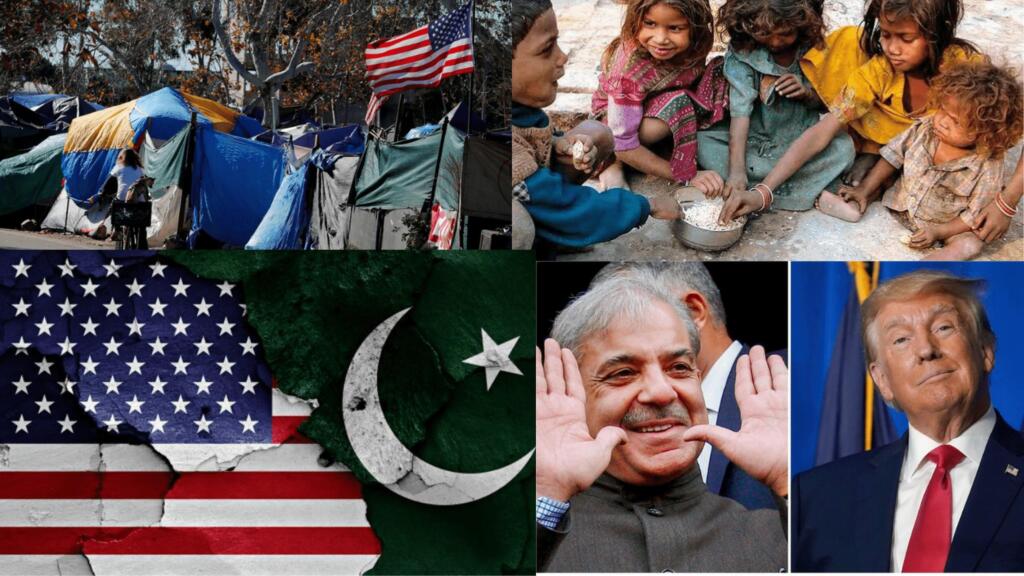
On the surface, the U.S. and Pakistan look like two entirely different worlds—one a “superpower,” the other a “developing state.” But when we strip away the global image and zoom into the lived reality of the common man, the parallels are disturbingly valid.
The Shared Tragedy of the Common Man: USA and Pakistan
At first glance, the United States and Pakistan appear worlds apart—one flaunting its superpower status, the other struggling to survive as a developing state. But when the mask of propaganda is stripped away, the everyday reality of the common man in both countries converges in startling, tragic ways.
Survival Instead of Living
In both nations, ordinary people are trapped in cycles of survival. In America, millions juggle two or three jobs yet cannot afford rent, healthcare, or basic food. In Pakistan, families scrape by through informal work or daily wages, barely managing to feed children. In both cases, life is reduced to a desperate hustle to stay afloat.
Debt as a Weapon of Control
Debt has become the defining shackle for citizens of both countries.
- In the U.S., workers are chained by student loans (over $1.7 trillion), mortgages, and medical debt, ensuring a lifetime of repayments that benefit banks more than families.
- In Pakistan, microfinance traps, informal loans, and rising utility debts condemn entire households to generational poverty.
For the ordinary man in New York or Lahore, the future has already been mortgaged to the elites.
Vanishing Jobs and Broken Promises
Low-skill and unskilled workers—the majority of the population—are abandoned in both countries.
- In the U.S., deindustrialization and outsourcing have hollowed out manufacturing, leaving service jobs that pay starvation wages. Factories that once built the middle class have been shipped abroad, and automation wipes out what little remains.
- In Pakistan, industrial collapse, corruption, and elite capture have left millions with no avenues beyond low-paying, insecure labor or migration.
The promise of dignified work has been systematically destroyed, ensuring that the common man remains expendable.
Governments for the Few, Not the Many
Both Washington and Islamabad govern not for their citizens, but for oligarchs, corporations, and power-brokers. Subsidies, tax breaks, and bailouts are reserved for the wealthy. The poor are taxed, indebted, and discarded. The gap widens relentlessly: billionaires multiply, while poverty deepens.
War Over Welfare
Trillions are spent on war and defense while citizens are left in despair.
- In Pakistan, bloated military budgets are justified by the perpetual specter of India.
- In the U.S., endless wars abroad and inflated defense spending drain trillions that could fund healthcare, schools, or housing.
In both countries, guns are prioritized over bread.
Homelessness, Hunger, and Hopelessness
Homeless encampments grow across American cities just as slums expand across Pakistan’s urban sprawl. Hunger bites 44 million Americans and millions more in Pakistan. Healthcare remains a privilege of the wealthy in both places, with the poor left to suffer or die in silence.
The Bitter Truth
For the common man, there is no real difference between Detroit and Karachi. Both nations—one rich, one poor—are united by a shared disease: an elite-driven order that sacrifices the many for the wealth of the few, destroys industries that could provide jobs, and enslaves the majority through debt.
The real tragedy is this: the American and Pakistani everyman are condemned to the same fate—working harder, earning less, and living with the knowledge that their governments will never serve them, only exploit them.
At its core, the lived reality is this: both nations, despite their wealth or their rhetoric, have betrayed their people. America hides poverty behind the façade of global dominance, Pakistan hides it behind narratives of survival against enemies. But for the ordinary citizen, the outcome is the same: a life of endless struggle, shrinking hope, and the crushing burden of debts not their own.