












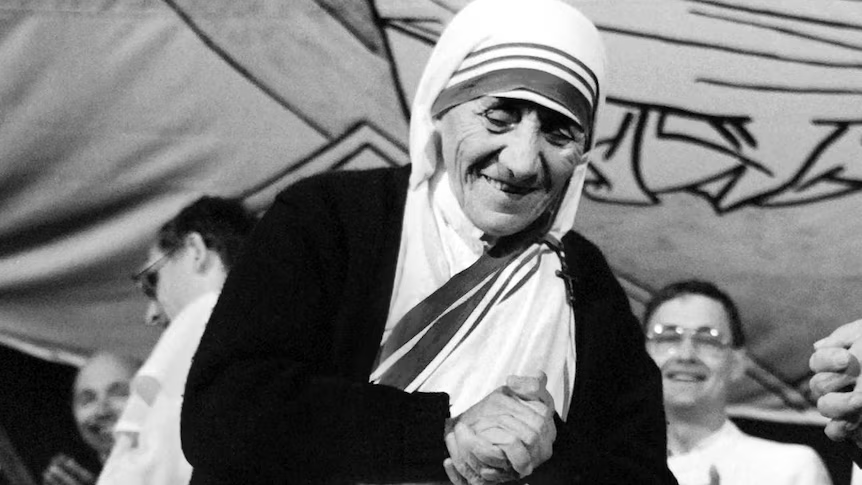
For decades, Mother Teresa has been hailed as the saint of the gutters, a symbol of compassion immortalized in school textbooks, hospital portraits, and political speeches. Yet, behind the halo lies a far darker reality one of hypocrisy, exploitation, and calculated image-building. She condemned abortion even in cases of rape, denied basic medical care to the suffering, and secretly baptized dying children without their families’ knowledge. Backed by dictators, fraudsters, and the Catholic Church, her legacy was more about religious dogma and global PR than genuine compassion. It is time to question: was Mother Teresa really a saint or the 20th century’s greatest deception?
Blind Devotion and the Myth of Compassion
Mother Teresa’s carefully constructed image as a savior of Kolkata’s poor hides a disturbing pattern of glorifying suffering instead of alleviating it. When Malcolm Muggeridge asked her if she taught the poor to endure their misery, she responded that it was “very beautiful for the poor to accept their lot.” This theology of suffering justified the appalling neglect in her homes, where patients were left without painkillers, antibiotics, or even proper sanitation. Dr. Robin Fox of The Lancet, after inspecting her “Home for the Dying,” described the conditions as “haphazard,” with reused needles, banned medical tests, and unnecessary deaths from treatable diseases.
Hypocrisy on Abortion and Contraception
Mother Teresa’s hardline opposition to abortion and contraception became her most prominent political position, aligning her with the Vatican’s dogma rather than human compassion. In Ireland, she urged citizens to continue their draconian abortion laws, laws that later led to tragic deaths like that of Savita Halappanavar. Even in India, she wrote threatening letters to Prime Minister Morarji Desai in 1977, warning of “spiritual consequences” if Christian demands were not met. Her obsession with controlling women’s reproductive rights contrasted sharply with her silence on poverty, rape, and malnutrition. For someone celebrated as a humanitarian, her advocacy only deepened the suffering of the vulnerable.
Exploiting the Suffering of the Poor
Far from alleviating misery, Mother Teresa appeared to exploit it to advance her religious mission. Former sisters of her order, like Susan Shields, testified that patients were denied pain relief and told their agony was akin to Christ’s suffering on the cross. Donations flowed in from across the globe, but very little translated into better care for the poor. Instead, patients with simple ailments died from preventable causes. Teresa herself received world-class medical treatment in American hospitals, highlighting the staggering hypocrisy between her personal care and what she subjected India’s poorest to. Her message was clear: the suffering of others was spiritually useful, but her own pain was not to be endured.
Secret Baptisms and Religious Agendas
Beyond poor medical practices, perhaps the most chilling revelations concern the secret baptisms of dying children. Witnesses, including Susan Shields, confirmed that sisters of the Missionaries of Charity would stealthily rub wet cloths on children’s foreheads while reciting baptismal prayers—without parental consent. This was not compassion; it was religious opportunism at its cruelest, turning vulnerable children into instruments of conversion at their deathbeds. Such acts expose Mother Teresa less as a humanitarian and more as a zealot determined to expand her faith’s influence under the guise of charity.
Cozying Up to Dictators and Criminals
Despite her saintly image, Mother Teresa was no stranger to questionable alliances. She praised the Duvalier dictatorship in Haiti, describing it as “friends of the poor,” despite its record of mass corruption and brutality. She laid a wreath at the grave of Albania’s dictator Enver Hoxha, a man who violently suppressed religion in her own homeland. Closer home, she supported Indira Gandhi’s Emergency, claiming, “People are happier. There are more jobs. There are no strikes.” Perhaps most disgracefully, she accepted money from Charles Keating, later convicted in the U.S. Savings and Loan scandal, and even appealed for clemency on his behalf without returning the stolen money he had donated.
Manufactured Miracles and Media Complicity
The Catholic Church fast-tracked Mother Teresa’s canonization, aided by “miracle” claims that collapse under scrutiny. The most famous was the supposed cure of an abdominal tumor in Monica Besra. Her doctors and husband both insisted she was healed by medicine, not prayer. Yet the Church pressured hospitals to validate the miracle narrative to bolster her sainthood. Journalists and academics who investigated her clinics Dr. Aroup Chatterjee, Mary Loudon, and even Christopher Hitchens consistently revealed shocking neglect, religious opportunism, and financial opacity. Still, mainstream media clung to the myth, unwilling to challenge a narrative that had been carefully cultivated for decades.
A Saint or a Master of Deception?
Mother Teresa’s story is less about a saintly humanitarian and more about the successful creation of a global myth. Her refusal to provide basic medical care, her glorification of suffering, her meddling in reproductive rights, and her alliances with dictators and criminals reveal a deeply troubling legacy. The Church, Western media, and political elites eagerly fed this narrative to the world, turning her into an untouchable symbol of virtue. But as testimonies, medical reports, and evidence pile up, it becomes clear that Mother Teresa was no angel of mercy she was a powerful operator who weaponized poverty, religion, and Western guilt to build an empire of suffering.